How to Grow and Care for Potted Hydrangea (Hydrangea macrophylla): Methods and Precautions
There are many ways to propagate hydrangea (Hydrangea macrophylla). Let's start with the most familiar one. Cuttings - everyone knows this method, and it works much like the saying "a careless willow cutting grows into shade." Cut off fresh young shoots from the top and insert them into soil in spring when the temperature is around 15°C. The second method is layering, which is similar to the first, except that the branch is not cut off from the parent plant. It is carried out when the buds begin to sprout, and growth occurs after 30 days. The following spring, cut it from the mother plant, transplant it with the soil ball, and it can bloom that same year.
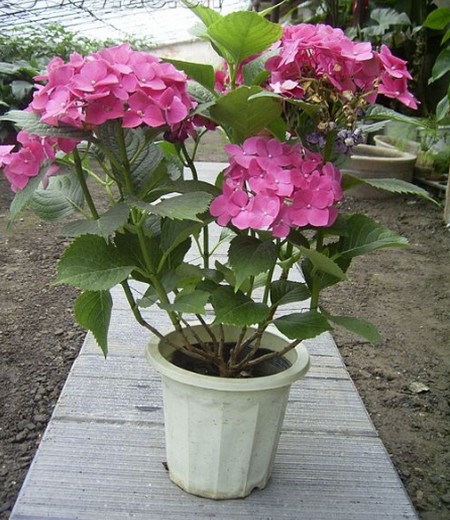
Next is division. In early spring, separate the branches at the base from the mother plant and plant them directly into soil, but be sure to tend them carefully in partial shade and wait for them to sprout. The last method is tissue culture, which is more advanced and not something an ordinary household can do. Using dormant buds as explants, disinfect them routinely and inoculate them on MS medium supplemented with 0.8 mg/L of 6-benzylaminopurine and 2 mg/L of indoleacetic acid to grow adventitious buds. When the shoots reach 2-3 cm in height, transfer them to 1/2 MS medium supplemented with 2.0 mg/L of indoleacetic acid to grow into complete small plantlets.
1. Soil Selection
In early spring, the rooted hydrangea (Hydrangea macrophylla) seedlings from cuttings can be transplanted into pots. For pot cultivation, it is best to use a potting mix of 4 parts leaf mold, 3 parts garden soil, 2 parts river sand, and 1 part cake fertilizer; or a mixture of 4 parts compost soil, 5 parts sandy soil, and 1 part cake fertilizer; or a mix of 6 parts leaf mold, 3 parts sandy soil (or furnace ash residue), and 1 part cake fertilizer. After potting, water thoroughly and keep indoors for care, then move outside in early May. Flower color is affected by soil pH: acidic soil produces blue flowers, while alkaline soil produces red flowers.
2. Light Requirements
Hydrangea (Hydrangea macrophylla) prefers shade. After being moved outside in spring, it should first be placed in a semi-shaded environment for care. In midsummer, move it to a cool, well-ventilated spot to prevent leaf scorch. After September, as light intensity gradually weakens, move the pot to a brighter location to promote flower bud differentiation. When sunlight is too intense in midsummer, provide appropriate shade to extend the viewing period of the flowers.
3. Temperature Requirements
The optimal growing temperature for hydrangea (Hydrangea macrophylla) is 18-28°C, and winter temperatures should not drop below 5°C. Flower bud differentiation requires 6-8 weeks at 5-7°C. A temperature of 20°C can promote flowering. After flowers appear, maintaining 16°C can extend the viewing period. However, high temperatures cause the flowers to fade quickly.
4. Watering Method
Potted hydrangea (Hydrangea macrophylla) is commonly grown in 15-20 cm pots. After spring sprouting, water potted plants thoroughly to ensure the leaves do not wilt. Hydrangea (Hydrangea macrophylla) leaves are relatively large and fleshy, requiring more water. Water frequently in spring and summer to keep the potting soil moist; during midsummer heat, water once in the morning and once in the evening, and provide appropriate shade; water less in winter, just enough to maintain potting soil moisture; during the growing period, water thoroughly to keep the potting soil consistently moist, especially in summer when ample water is even more important.
From May to August, in addition to meeting the potting soil's water needs, mist the leaf surface once a day. However, hydrangea (Hydrangea macrophylla) has fleshy roots, so do not overwater, as excess water can easily cause root rot. After September, as the weather gradually cools, gradually reduce watering to keep branch growth sturdy, which helps with winter dormancy.
5. Fertilizing Method
Hydrangea (Hydrangea macrophylla) likes fertilizer. During the growing period, apply dilute cake fertilizer water once about every 15 days. To keep the potting soil consistently acidic, add 0.2% ferrous sulfate when applying liquid fertilizer, making it into alum fertilizer water for irrigation. During the bud stage, apply 1-2 additional doses of 0.5% superphosphate soaking solution to promote larger and more colorful flowers. During the flowering period from June to July, fertilizer and water should be ample, fertilizing once every half month or using Huiyou 21-7-7 acid fertilizer.
6. Repotting Tips
Hydrangea (Hydrangea macrophylla) should be repotted every 1-2 years in early spring, replacing with fresh potting soil; ideally repot once every spring. When repotting, remove some old soil and rotten roots, and prune as part of the repotting process.
7. Pinching and Pruning
When new branches grow to about 10-15 cm, pinch them to encourage branching; when the branches reach 8-10 cm, pinch a second time to help the plant form a neat and balanced shape. After September, flower buds differentiate. After flowers fade, promptly cut back the branches to encourage new growth. When new branches reach 8-10 cm, pinch again to make the new buds fuller, which benefits flowering the following year. After flowering, remove the flower stems to encourage new branches. Prune appropriately to maintain a beautiful plant shape.
Thereafter, every year in early spring (March), cut off diseased, dead, and weak branches from the base, keep 3-5 healthy main branches and cut them back, leaving 2-3 buds per branch to encourage new growth and abundant flowering. Through pruning and shaping, the plant can be made compact, full, well-balanced, with many large, brightly colored flowers. If not pruned, the base of branches over 3 years old becomes woody and is less likely to sprout new growth, easily leaving the lower part of the plant bare and reducing its ornamental value.
Precautions:
Hydrangea (Hydrangea macrophylla) is a relatively beautiful flower and also a good ornamental plant, widely planted in landscaping and decoration. In addition, hydrangea (Hydrangea macrophylla) can also be used medicinally, with effects such as treating heart disease. However, note that since the flower stems and leaves of hydrangea (Hydrangea macrophylla) are somewhat toxic, and the flowers can easily cause allergic reactions, hydrangea (Hydrangea macrophylla) is not suitable for growing indoors, especially in bedrooms. Friends who love growing flowers should be aware of these issues.
Also, note that during cultivation, hydrangea (Hydrangea macrophylla) prefers warm, humid conditions, is not tolerant of drought, and also dislikes waterlogging; it prefers semi-shaded environments, is not cold-hardy, and is suitable for growing in fertile, well-drained acidic soil. It is recommended to fertilize once every half month, using farmyard manure; if the smell is too strong, add 1%-3% ferrous sulfate to the fertilizer solution before applying. Regular irrigation with alum fertilizer water can keep the plant's branches lush and leaves green.
Also pay attention to pest and disease control. Diseases that commonly strike include wilt disease, powdery mildew, and leaf spot disease, which require spraying with 65% zineb wettable powder at 600 times dilution for control. Pests are mainly aphids, which can be treated with a folk remedy - soaking cigarette butts in water and rinsing with it, which is quite effective, or spraying with 40% omethoate emulsifiable concentrate at 1500 times dilution.
Prevention and control of common diseases of hydrangea (Hydrangea macrophylla):
1. Hydrangea flower thrips
In forced cultivation of hydrangea, prevention of flower thrips pests and diseases should be strengthened.
Control method: For flower thrips, use Haoniandong or imidacloprid before flowering for control. During flowering management, maintain adequate soil moisture and sufficient light to extend the viewing period of hydrangea flowers. After flowers fade, cut back the branches to encourage new growth for flowering the following year.
2. Hydrangea gray mold
In forced cultivation of hydrangea, prevention of gray mold pests and diseases should be strengthened.
Control method: Gray mold occurs under low-temperature and high-humidity conditions. During flowering, reduce air humidity, ensure ventilation, and spray with Sumilex or Iprodione 2-3 times before flowering. During flowering management, maintain adequate soil moisture and sufficient light to extend the viewing period of hydrangea flowers. After flowers fade, cut back the branches to encourage new growth for flowering the following year.
3. Hydrangea aphids
Hydrangea rarely has pests or diseases, only occasional aphids in early spring.
Control method: Since only occasional aphids appear in early spring, use a 1000-times diluted pesticide solution to kill them. During flowering management, maintain adequate soil moisture and sufficient light to extend the viewing period of hydrangea flowers. After flowers fade, cut back the branches to encourage new growth for flowering the following year.
4. Hydrangea red spider mites
In forced cultivation of hydrangea, prevention of red spider mite pests and diseases should be strengthened.
Control method: Use Yamank to prevent red spider mites. During flowering management, maintain adequate soil moisture and sufficient light to extend the viewing period of hydrangea flowers. After flowers fade, cut back the branches to encourage new growth for flowering the following year.