Desert Rose Potted Cultivation Methods and Precautions
Some flower enthusiasts have asked how to cultivate Desert Rose. In general, Desert Rose is easy to grow in summer — just place it outdoors and water once a week. Keeping it dormant in winter is more difficult. Below are some insights from the author's experience growing Desert Rose in recent years, which I hope will serve as a reference for fellow enthusiasts.
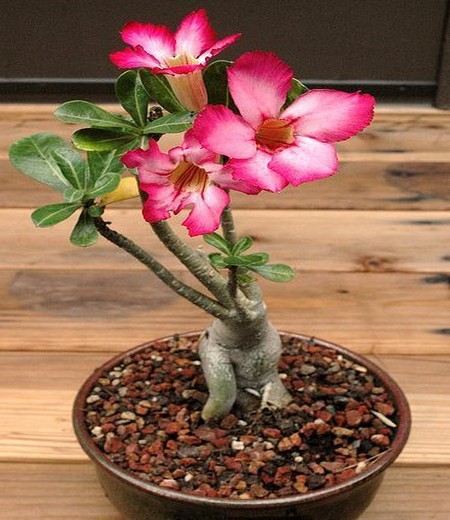
1. Propagation: mainly by cuttings and layering. Cuttings are best taken during the vigorous growing season. Cut the branches into pieces about 10 cm long, dip the lower ends in water to dilute the milky sap at the cut, so as to prevent it from gumming up and affecting root formation. After dipping in plant ash, insert them into sterilized growing medium; roots will form in about 15-30 days. For propagation, it is recommended to use the sowing method, as this allows the root caudex to naturally swell and form a good plant shape; cutting-propagated plants cannot do this, which greatly reduces their ornamental value. Layering propagation all uses the air-layering method; air-layering produces robust root growth and a high survival rate. It can be done during the growing season. First, use a sharp knife to score or girdle the layering site, then treat with rooting powder, then wrap with sphagnum moss and cover with plastic film. If the sphagnum moss dries out during the air-layering period, water can be added with a syringe; after half a year, it can be cut from the mother plant and potted up. I only propagate Desert Rose by cuttings, but the results are poor, so I suggest not bothering. Cutting-propagated Desert Rose plants have no thick, large roots and have low ornamental value.
2. Potting soil: My potting soil is: orchid stone or crushed red brick, pumice, and Sanyuan soil or ordinary potting soil; the ratio is 1:1:1. Note: mix in an appropriate amount of slow-release fertilizer or fermented granular chicken manure, with more at the bottom of the pot.
3. Sunlight: The thick root caudex and leathery leaves of Desert Rose indicate that it can tolerate strong sunlight; good light helps Desert Rose bloom. It needs sunlight not only during the vigorous growing season but also during dormancy. In Beijing, Desert Rose overwinters (passes through dormancy) with ample sunlight. Environments with less sunlight are not suitable for growing it.
4. Temperature: The growing environment for Desert Rose is high temperature and good ventilation. In Beijing, around May when the temperature reaches about 25°C, move the plant from indoors to outdoors; when the average temperature exceeds 30°C, it grows vigorously even without shading. Desert Rose has poor cold tolerance. After October 1 in Beijing (when the minimum temperature drops below 15°C), the plant should be moved indoors and kept dry (essentially cutting off water) to ensure dormancy. Only with good dormancy can Desert Rose bloom in spring and summer.
5. Watering: The thick root caudex of Desert Rose fears moisture most; long-term moist potting soil easily causes root rot, leading to plant death. Therefore, when watering Desert Rose, one must follow the principle of "better too little than too much." My experience is: in Beijing, during the 3 winter months, absolutely do not water the pot; keep the potting soil dry. For winter watering, depending on how dry the indoor environment is, you can spray the surroundings or water via a saucer placed under the pot (my actual method is: water into the saucer once a month or once every month and a half, and choose a sunny noon each week to spray water, with the soil surface being moist as the goal). Also, when the plant is moved from outdoors to indoors, the leaves drop very quickly (almost completely bare) — don't be alarmed, and absolutely do not water; wait at least 15 days before watering. From May to October in Beijing is the growing season for Desert Rose (outdoors). At this time, the watering method is: just after the plant is moved outdoors, the outdoor nighttime temperature is still low, so do not water; just spray some water when the sun is good. When the plant begins to leaf out, use the winter watering method. When the temperature reaches 30°C, you can water into the pot, but the amount must not be too much. Each watering should only be done after confirming that the potting soil is completely dry.
Recommended control method: To accurately monitor the wetness and dryness of the potting soil, I found a flower pot the same size as the one used for growing Desert Rose, filled it with the same type and the same amount of soil, and watered both pots together — one with a plant and one without. After a week, I tipped out the soil from the pot without a plant to check the wetness and dryness. If the potting soil is completely dry, you can then work out your watering interval — this shows that watering once a week is fine.
6. Fertilizing: From May to October each year in Beijing is the growing season for Desert Rose, and this is also when it blooms, so you can add a little fertilizer to support its growth. Note: absolutely do not apply raw fertilizer. Raw fertilizer easily causes root rot and breeds insects in the potting soil.
7. Repotting: The method is simple — do it each year when the plant is moved outdoors, as it is dry then and easy to handle. After replanting, absolutely do not water; place it in partial shade to recover, and wait until the leaves recover before giving a thorough watering.
8. Pest and disease control
Disease control: Desert Rose is mainly harmed by leaf spot disease and root rot. When leaf spot disease is severe, it can cause a large number of leaves to drop. It can be controlled with 25% carbendazim wettable powder at 500 times dilution, or 50% thiophanate at 1000 times dilution. Root rot often causes the plant's roots to rot and the plant to die; it can be controlled by drenching with 50% thiophanate wettable powder at 500 times dilution or agricultural streptomycin at 1000 times dilution.
Pest control: The main pest of Desert Rose is scale insects. When the infestation is severe, it causes all the leaves to drop, the growing points to die, and even the plant to die. Once discovered, immediately wipe them off with a water-moistened cotton swab. Alternatively, during the egg-laying and hatching periods, spray 1-2 times with 40% omethoate emulsifiable concentrate at 1000-2000 times dilution, or 50% fenitrothion emulsifiable concentrate at 1000 times dilution.