A Detailed Guide to Growing Calendula (Pot Marigold)
Calendula, also known as pot marigold, is a plant of the genus Calendula in the Asteraceae family, commonly used for flowerbed displays, and native to southern Europe. Calendula has brilliantly colorful flowers and is one of the common flowering plants; growing it in pots to decorate the home is also not uncommon. It is suitable for flowerbeds and flower borders, and can also be used as an edging flower for lawns or grown in pots for ornamental viewing. The long-stemmed large-flowered varieties can be used as cut flowers. What is the growing method for calendula? Let's find out below.
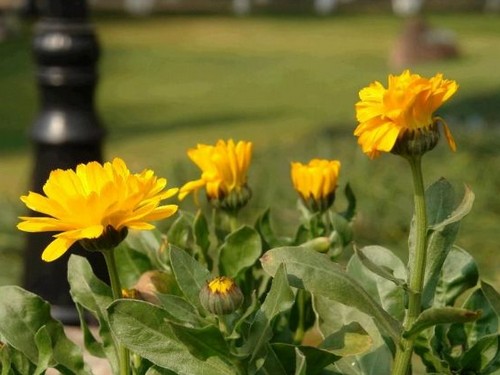
Growing methods for calendula:
1. Soil: It is not demanding about soil and can tolerate poor, dry soil. Loose, fertile, slightly acidic soil is best. It is not particular about soil; fertile, loose, well-drained sandy loam or potting mix is suitable, with a soil pH of 6-7 being best. This way the plant has more branches and produces larger and more numerous flowers.
2. Sunlight: It likes sunlight and has strong adaptability, but fears hot weather, so it should be shaded appropriately in summer. In spring, summer and autumn it needs to be kept under shaded conditions. When temperatures are relatively high (daytime temperature above 25°C), if it is placed in direct sunlight, the leaves will noticeably become smaller, the internodes of the branches will shorten, the lower leaves will yellow and drop, and growth will be very slow or it will enter a semi-dormant state. In winter it should be given direct sunlight to facilitate photosynthesis and the formation of flower buds, flowering and seed setting.
3. Temperature: It likes a warm climate, with the most suitable growing temperature being 15-25°C. It dislikes extreme heat, and when the summer temperature is above 34°C its growth is noticeably poor; it is not tolerant of frost and cold, and when the winter temperature falls below 4°C it enters dormancy or dies.
4. Humidity: After cuttings are taken, the relative humidity of the air must be kept at 75-85%. Humidity can be increased by misting the cuttings, 1-3 times a day; the higher the temperature on sunny days, the more frequent the misting, while on cloudy and rainy days with lower temperatures, mist less often or not at all. However, excessive misting makes the cuttings prone to infection and rot by pathogens, because many kinds of pathogens exist in water.
5. Watering: In spring and autumn, water once a week, keeping the potting soil moderately moist. In summer, water about twice a week, and in addition the plant should be misted frequently. In winter, watering is usually about once every 10 days.
6. Fertilizing: 7-10 days after planting out, pinch off the growing tips to encourage branching, or spray the leaves 1-2 times with a 0.4% daminozide (B-nine) solution to control plant height. During the growing period, fertilize once every half month, or use "Huiyou" 20-20-20 general-purpose fertilizer. With sufficient fertilizer, calendula produces more and larger flowers. Conversely, with insufficient fertilizer, the flowers noticeably become smaller and degenerate. After sprouting in the season, apply a dilute decomposed manure water once a week; during the growing period, apply decomposed urine diluted 10 times with water once every 15-30 days, with fertilizing continuing until the end of February. Sufficient fertilizer can make calendula produce more flowers and larger blooms.
7. Pruning: Every two months, cut off branches bearing old and yellow leaves. As long as the temperature is suitable, it can bloom in all four seasons.
8. Pests and diseases: Common pests and diseases mainly include fusarium wilt, downy mildew and rust, and in the flowering period in early spring it is susceptible to damage from red spider mites and aphids. Indoor cultivation, due to poor ventilation and high humidity, often suffers from fusarium wilt and downy mildew; it can be controlled by spraying with a 500-fold dilution of 65% zineb wettable powder. When temperatures rise in early summer, rust damage is often found on the leaves of calendula; spray with a 2000-fold dilution of 50% carboxin wettable powder. In the flowering period in early spring it is susceptible to damage from red spider mites and aphids, which can be killed by spraying with a 1000-fold dilution of 40% omethoate emulsion.
Calendula flowers are rich and brilliantly colored, and growing them in pots can be used to decorate and accent the home interior. The growing methods for calendula have been introduced here, and I believe everyone now has a certain understanding of how to grow calendula.