What are the home cultivation methods for Cymbidium goeringii (spring orchid)?
Cymbidium goeringii is a typical representative of the petal-type flowers among Chinese orchids and has been widely grown since ancient times. There are many famous varieties of Cymbidium goeringii, and their prices are stable and moderate, affordable for ordinary enthusiasts. But they are cheap to buy and expensive to keep - let's take a look at how to cultivate Cymbidium goeringii at home!
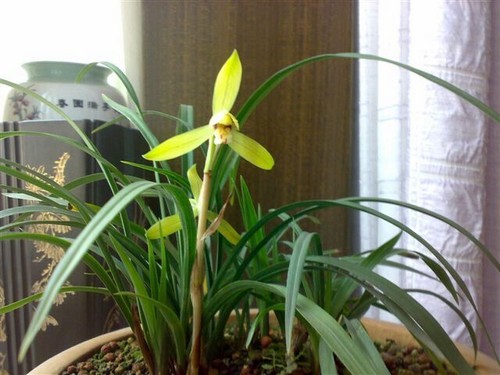
Environmental requirements for Cymbidium goeringii:
Cymbidium goeringii prefers cool, semi-shaded to semi-sunny environments and does not need much fertilizer, but it has relatively high humidity requirements and grows well in environments with large day-night temperature differences. In northern regions, the most ideal place is of course an enclosed outdoor balcony. With appropriate environmental modifications - installing shading, humidifying and ventilation equipment - Cymbidium goeringii will grow very robustly. However, if left to grow freely, it generally will not grow well.
Selecting Cymbidium goeringii seedlings:
First, you need to compare your home environment and choose seedlings from similar environments, so that excessive environmental differences do not affect growth. It is best not to choose seedlings; instead, choose orchids that have already grown for one year in a transition nursery, with large pseudobulbs, strong roots, and many wide, thick leaves - these grow robustly and are easier to care for after being bought home.
Old plants of more than three years are not advisable - beware of mosaic virus-infected seedlings, and consult the seller carefully when purchasing.
Care of Cymbidium goeringii:
1. Potting medium: Newly potted plants should use clean soil with fine particles. Kanuma soil (plant gold stone) has strong water retention and is an ideal medium for growing high-grade Cymbidium goeringii. Mix it with granular humus soil, and cover the pot surface with sphagnum moss to retain moisture. After the orchid has adapted to the environment, gradually increase the humus soil content.
2. Water reduction in summer, moisture retention in autumn, vernalization in winter: Summer temperatures are relatively high and water evaporates quickly, but you should not water without restraint - appropriate water reduction is more beneficial to the growth of Cymbidium goeringii. In autumn, the weather is dry, so pay attention to moisture retention. In winter, northern homes have heating, which is not conducive to the growth of Cymbidium goeringii flower buds, so they should be moved to an outdoor balcony with the temperature controlled so it does not get too high.
3. Fertilizing: Cymbidium goeringii does not need much fertilizer and is best grown with light feeding and moist conditions. Do not apply heavy fertilizer to non-robust seedlings, and do not grow non-robust seedlings dry.
4. Dividing pots: Cymbidium goeringii propagated in the hot, humid environment of the south consumes very little nutrition when flowering and has a very high germination rate, sprouting 3-4 times per year. Due to insufficient nutrient reserves and excessive consumption from sprouting, in the dry environment of the north, the grass declines faster. Newly introduced Cymbidium goeringii usually also has a high germination rate in the first year, but this does not mean it has already adapted to the new environment. After 2-3 years of cultivation, its biological clock adjusts to the new environment and gradually stabilizes. Therefore, after 1-2 years of introduction, old and weak seedlings should be removed promptly to reduce consumption and promote the growth of robust seedlings.
Cymbidium goeringii is one of the common varieties of indoor flowers. When it blooms, it gives off a delicate fragrance and has relatively high ornamental value. Let's take a look at its cultivation methods:
1. Requirements for potting soil
A neutral to slightly acidic soil containing plenty of humus, loose and well-draining is best, with a pH generally around 5.5 to 6.5.
2. Placement location and position
In spring, summer and autumn, orchids can be cultivated outdoors and on balconies, choosing a place with good ventilation, moist air and no environmental pollution. Near a pond or riverside is best.
3. Appropriate shading
Orchids need appropriate shading. In early to mid-April, you can remove the netting and open the windows to let in more sunlight to promote growth. In May, except for the midday sun, they can receive 6 hours of sunlight; starting from June, shade all day; after October, except for the midday sun, they can be fully exposed for care.
4. Maintaining nutrients
Cut off the stems after the flowers fade as early as possible to avoid consuming nutrients and affecting the sprouting of axillary buds. After cutting the flower stems, use soft gauze or a cotton ball dipped in a 0.1% omethoate or dichlorvos solution to gently wipe the front and back of the orchid leaves to remove insect eggs, dust and stains.
5. Appropriately adjusting light
Although orchids like cool, well-ventilated environments, they also need appropriate sunlight exposure. Reasonably adjust the light to promote healthy growth of orchids. Generally speaking, green-leaf varieties, exotic flower varieties and dwarf varieties of orchids need 60% of full-day sunlight in spring, then 50% afterward; variegated-leaf orchid varieties need 50% of full sunlight in spring, then 30% afterward.
To regulate light well, families that grow flowers on balconies can set up a movable plastic frame on the balcony, pulling it open when needed and covering it when not, to ensure the orchid's light duration.
6. Reasonable fertilizer supply
When orchid plants are in a dormant or semi-dormant state and when freshly divided and potted, the fertilizer applied cannot be absorbed; in seasons with high air humidity, applying too much fertilizer water will also place a heavier burden on the orchid's root system. To ensure safety, orchids generally should not be fertilized during the dormant period, and should not be fertilized at the roots when freshly divided and potted.
7. Appropriate watering
Rainwater and spring water are best for watering orchids; tap water or rice-washing water should be left overnight before use. When watering, pour from the edge of the pot and do not pour into the flower buds. The amount of water should be determined according to temperature, the dryness or wetness of the potting soil and the growth condition of the orchid grass. Water more for large leaves, less for fine leaves. In April-May, when new shoots have not yet emerged from the soil, the potting soil should be somewhat dry, as too wet will easily rot the new shoots; June-September is the growing period for new orchid shoots, so watering should be increased - on sunny days, water once each morning or [once]; never water under the blazing midday sun. In autumn, reduce the water amount appropriately; you can use foliar misting to keep the potting soil moist. In winter, control the water amount even more, keeping it at "80% dry, 20% wet" as appropriate.
8. Regular sterilization and pest removal
Around the orchid growing area and the flower pots, spray with medications such as virus-clearing solution or chlorothalonil once every 7 days, and spray with insecticidal medications such as omethoate or trichlorfon once every 10 days. Note that 2 hours after applying insecticidal medication, spray the orchid leaves with clean water to avoid chemical damage.
9. Evening misting
Orchids originally grow in humid environments, so in dry seasons, besides shading, you must also mist in the evening to increase air humidity and lower the temperature; you can also water the ground (table surface) where the potted orchids are placed - "one cold, one hot" can better stimulate orchid growth.
10. Wind and rain protection
Cut off dead branches and withered leaves. Orchids can tolerate light rain, but avoid moldy rain, torrential rain or continuous rain, otherwise the heart and leaves easily rot. In rainy seasons, you can appropriately scatter a small amount of plant ash.
11. Cold protection and warmth measures
Because orchid varieties differ and their places of origin vary, their cold resistance also differs, so the time to move them indoors in winter and the position to place them indoors are also different.
Cymbidium kanran, Cymbidium ensifolium (autumn orchid) and Cymbidium sinense (Chinese cymbidium) grow in the south and should be moved indoors (or have windows closed and netting drawn) when the temperature is 5°C, and placed in a sunny spot facing south as much as possible. Spring and summer orchids have strong cold resistance and can be moved indoors only when the temperature reaches 0°C. On sunny, windless days, open the windows and draw the netting for ventilation. Cymbidium ensifolium (autumn orchid) should not have windows opened on sunny days at 1-2°C, and electric light heating can be used.