Cymbidium goeringii Cultivation Methods and Daily Care Tips
Cymbidium goeringii is a very precious orchid variety, with symbolic meanings such as “beauty”, “nobility”, “simplicity”, “virtue”, “chastity”, and “elegance”, and can be given as a gift to friends. Cymbidium goeringii is a relatively well-known flower variety, can be used in the home to decorate and beautify the living space, and can also be used medicinally as well as given as a gift to friends. Cymbidium goeringii is an elegant flower with cultural connotations, and is an excellent flower variety. Orchids have graceful leaf forms, peculiar flower shapes, and enchanting fragrance, and are very precious potted ornamental flowering plants; placed in the home living room and other places, they make the home appear elegant and tasteful.
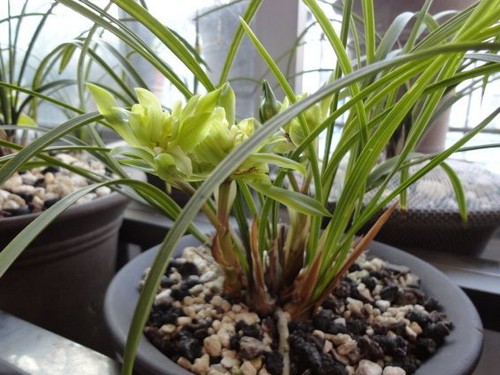
Through long-term orchid-growing practice, the ancient Chinese summarized for us a "four prohibitions" experience for growing orchids. That is, "no going out in spring, no sun in summer, no drying in autumn, no wetness in winter". The so-called no going out in spring: orchids like moisture, spring is windy and dry, and the temperature is relatively low; to avoid suffering from cold wind damage, orchids should not leave the room in spring and can be placed in a semi-light indoor spot for care. But Cymbidium goeringii and Cymbidium faberi need to be placed in a sunny spot near the windowsill. The so-called no sun in summer: orchids by nature like shade and coolness, and avoid direct sunlight, especially fearing exposure to the scorching sun. Therefore in summer they need to be placed in a cool, well-ventilated semi-shaded spot for cultivation. Among orchids, Cymbidium sinense is the most shade-tolerant, followed by Cymbidium ensifolium, while Cymbidium goeringii and Cymbidium faberi need more sunlight. The so-called no drying in autumn: orchids, especially Cymbidium ensifolium, are in the bud stage in autumn and like a moist and cool environment most; if the potting soil or air is dry, it is unfavorable for their growth and development, the leaves easily turn yellow and withered, and at the same time the flower buds will drop, affecting flowering the following year. Therefore in autumn the watering amount should be appropriately increased, and the leaf surfaces should also be sprayed frequently. Around the Autumn Equinox, some thoroughly decomposed dilute liquid fertilizer should also be appropriately applied. During the flowering period, some plant ash water can be applied to the roots, which is very beneficial for promoting the development of orchid roots, stems, and flowers. The so-called no wetness in winter: in winter orchids are in a dormant state and watering needs to be controlled, generally keeping the potting soil alternately dry and moist as suitable. If the watering amount is too much, the roots easily rot. Only Cymbidium sinense blooms in winter, so the watering amount should be somewhat more.
1. Pot selection: Planting Cymbidium goeringii is best done in late autumn. Before planting, it is best to choose a new clay pot that has been soaked in clean water for several hours; if using a purple clay pot or plastic pot, attention must be paid to drainage. The size of the pot should be suitable for the roots to spread out inside the pot.
2. Soil: The most ideal growing medium is orchid mud, or use half leaf mold (or humus soil) and half sandy loam mixed evenly. Never use alkaline soil.
3. Potting: First place a tile over the drainage hole at the bottom of the pot (preferably with 3 drainage holes), then add broken stones, furnace slag, and similar materials, accounting for about 1/5 of the pot, spread a layer of coarse sand on top, and then put in the growing medium. Best is to place the orchid seedling into the pot, straighten the roots, and let them stretch out naturally; when the soil is filled to halfway, gently lift the orchid seedling while shaking the flower pot so that the orchid roots and potting soil are tightly combined, then continue filling soil to the pot rim and press firm. Leave about 3cm of rim space at the top for fertilizing and watering.
4. Temperature: Generally the suitable growth temperature for Cymbidium goeringii is 15°C to 25°C, of which from March to October it is 18°C to 25°C, and from October to the following March it is 10°C to 18°C. In winter it can even flower normally at a short-term 0°C, and can tolerate low temperatures of -5°C to -8°C, but it is best to keep the room temperature at 3°C to 8°C as optimal, or keep the potting soil from freezing, and place it in a sunny spot near a south-facing window.
5. Shading: After potting, water thoroughly and place in a shaded spot. In early spring and winter, place indoors for care; the rest of the time, place under a shade shed. In summer, shade from 8 a.m. to 6 p.m.; in summer the shading degree for Cymbidium goeringii should reach about 90%. In spring and autumn, about 70%-80% is sufficient.
6. Watering: Orchid leaves have a relatively thick cuticle and sunken stomata, and are relatively drought-tolerant, so they do not need much water; it is best to often keep the orchid soil at “seven parts dry, three parts moist”. Under normal circumstances, water once every 2-3 days in spring; after flowering it is best to keep the potting soil somewhat dry, and after April it is best to keep the potting soil slightly moist; in summer the temperature is high, so water once a day; in autumn it is best to follow "dry then wet"; in winter water should be less. During the bud stage of Cymbidium goeringii, it is best to keep it moist, but not excessively wet. In dry and hot seasons, in the evening spray the ground around the flower pot to increase air humidity.
7. Fertilizing: Cymbidium goeringii particularly avoids raw fertilizer, concentrated fertilizer, and heavy fertilizer, especially high-concentration chemical fertilizers, which can very easily cause the fleshy roots to dehydrate and necrose; use thoroughly composted dilute organic fertilizer as much as possible, or use special orchid fertilizer, and truly achieve "light fertilizer applied frequently". Orchids avoid concentrated fertilizer. Newly planted orchids should not be fertilized in the 1st year; only after 1-2 years of cultivation, when the new roots are growing vigorously, may fertilizer be applied. Generally from April until the Beginning of Autumn, apply once every 15-20 days a fully decomposed dilute cake fertilizer solution; in the intense heat of midsummer, stop fertilizing. The best time to fertilize is in the evening, and avoid the liquid fertilizer staining the leaves.
8. Bud thinning: In cultivating Cymbidium goeringii, a relatively important step is bud thinning; select and keep one flower bud with the best development and the best ornamental value, and remove all the rest. Spraying Huadu Zhuangdiling can promote strong flower buds, plump petals, bright flower color, rich fragrance, and a longer flowering period. When the flowers of Cymbidium goeringii are about to wilt, cut off the flowers together with the flower scape; do not wait until the flowers naturally fall off before cutting, so as to reduce nutrient consumption and benefit flowering the following year. After buds appear, it is best to select and keep one flower bud with the best development and the best ornamental value, and remove all the rest; only in this way can the flowers be large and the color beautiful. About 10-14 days after Cymbidium goeringii flowers, the flowers can be cut off together with the flower scape; do not wait until the flowers naturally fall off before cutting, so as to reduce nutrient consumption and benefit flowering the following year.
9. Pruning: During orchid cultivation, pruning must be carried out continuously. When old leaves turn yellow and withered, they should be cut off in time to facilitate ventilation, and some leaves whose tips have dried up should also be cut off. In particular, leaves harmed by pests and diseases need to be removed promptly to avoid contagion. When cutting off leaves with viral disease, the scissors used should not then be used to cut healthy leaves, to prevent virus transmission. If the same pair of scissors is used, it must be disinfected.
After the flower buds of precious orchids emerge from the soil, if there are too many flower buds, the strong buds should be kept and the remaining thin and small flower buds removed; per pot it is suitable to keep 1-2 flower buds. If there are too many flower buds, it will both make the current year's flowers bloom poorly and consume too much of the mother plant's nutrients, affecting flowering the following year. Generally orchids do not need their flower buds cut off.
The flowers of Cymbidium goeringii bloom for about half a month, and then need to be cut off; the flowers of Cymbidium ensifolium, when the last flower on the inflorescence has been open for a week, should also have the inflorescence cut off. Precious varieties should not be allowed to be pollinated and set seed, otherwise it affects flowering the following year. If used for hybrid breeding, then additional careful cultivation is needed to make the fruit plump and ripe.
10. Pests and diseases: Cymbidium goeringii is relatively prone to pests and diseases, generally including southern blight, anthracnose, scale insects, root rot, and so on. Attention should be paid to ventilation and light transmission and good potting soil drainage for prevention; during the disease period, first spray with 50% thiophanate-methyl wettable powder 800-1500 times solution, once every 7-10 days, and then supplement with 1% Bordeaux mixture of equal proportions, once every half month. For severe damage, repot immediately and replant.