What are the care methods for red flower loropetalum bonsai?
Red flower loropetalum is an evergreen plant, with new leaves bright red; different strains vary in leaf color and flower color when mature, and leaf size also differs. In landscape applications, the different effects brought by the two factors of leaf color and leaf size are mainly considered. Red flower loropetalum has luxuriant branches and leaves, an elegant form, tolerates pruning and tolerates wiring, and can be used for hedges, and can also be used to make stump bonsai. When it blooms, the whole tree is full of red flowers, which is extremely spectacular.
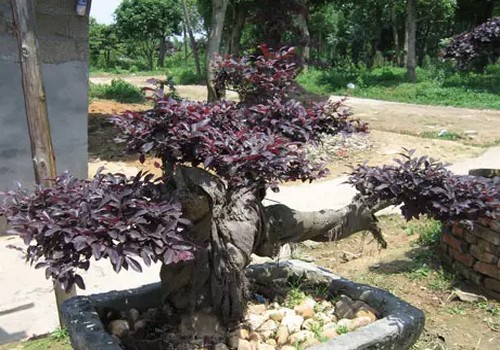
Before transplanting red flower loropetalum, the fertilizer should be a base fertilizer mainly of decomposed organic fertilizer, combined with broadcast application or hole application of compound fertilizer; be careful to mix thoroughly to avoid damaging the roots. During the growing season, use a neutral foliar fertilizer diluted 800-1000 times for foliar topdressing, spraying 2-3 times a month to promote new shoot growth. In the plum rain season in the south, care should be taken to maintain good drainage; in the hot and dry season, watering should be guaranteed once each in the morning and evening, and at noon water should be sprayed to lower the temperature; in northern regions, because the soil and air are dry, water must be given in time to keep the soil moist; in autumn, winter and early spring, pay attention to spraying water to keep the leaf surface clean and moist.
The care and management of red flower loropetalum bonsai is more meticulous than that of potted flowers. Because there is little soil and little fertilizer, it is easily affected by the outside world and attacked by pests and diseases, and its growth must also be controlled to maintain a certain shape. Therefore, in addition to doing well in watering, fertilizing, loosening the soil, weeding, repotting and pest and disease control, more effort must also be put into shaping and pruning, so that the loropetalum stump bonsai maintains a beautiful artistic image.
1. Watering: After the loropetalum bonsai is potted or repotted, water until it flows out from the bottom of the pot, and also spray more water on the stump, branches and leaves; on the day after fertilizing, water thoroughly once. Shallow pots or small pots of loropetalum bonsai should be watered frequently; for large pots or deep pots, grasp the rule of not watering until the soil is dry, and generally be careful not to make the potting soil too wet or too dry. Usually, during the growing season, the amount of watering and spraying is greatest in summer; in winter, which is the dormant period of loropetalum, water less, but the potting soil must not be made too dry either. When it is windy or the weather is too dry, spray more water on the trunk, branches and leaves.
2. Fertilizing: For loropetalum bonsai, use 7 parts cake fertilizer (bean cake, peanut cake, rapeseed cake, etc.), 2 parts chicken manure, and 1 part bone meal, add 10 times the water, put it in a jar and seal it; after complete fermentation, add another 10 times the water to dilute it and apply it, or use various kitchen wastes (egg shells, fish heads, chicken heads, crushed bones, intestines and tripe, fish scales, blood water, rice-washing water, etc.), put them in a jar and seal them for fermentation, then take the upper layer of fertilizing liquid and dilute it with 4-5 times the water before applying. Fertilizing should be done on cloudy days or on clear evenings. Generally, during the growing season, apply once every 15 days; during the dormant period, apply less or not at all; before sprouting in spring, apply 1-2 times; fertilizing can only be done 3 months after potting or repotting. When fertilizing, if the liquid fertilizer touches the leaves and young buds, spray them with clean water, so as not to affect the growth of the leaves and young buds. Loropetalum is an acid-loving plant, so 1% ferrous sulfate (500 g added to 50 kg water) should be added to the composted fertilizing liquid for application, or a 0.2%-0.3% ferrous sulfate solution should be sprayed on the leaves, 3-5 times each year. When loropetalum sprouts, spray 1-2 times with a 0.1% urea solution; before and after flowering, spray once each with a 0.1%-0.2% potassium dihydrogen phosphate solution, etc.
3. Pruning: After the loropetalum bonsai has taken shape, methods such as pinching, leaf removal, bud removal and branch pruning should also be used to keep it in a beautiful shape. Proper density of branches and leaves can improve ventilation and light transmission, reduce the occurrence of pests and diseases, and prevent the lower branches and leaves from dying.
4. Repotting: There is little soil in the pot, and nutrients are also limited, so after several years the soil quality will become hard, affecting air permeability and drainage. In addition, the pot is densely filled with old roots, which affects the sprouting and growth of new roots, significantly weakening the absorption capacity, so the branches and leaves cannot grow normally. Therefore, repotting and changing the soil must be done regularly; generally, small bonsai are repotted about once every 2 years, medium bonsai about once every 3 years, and large bonsai about once every 4 years. Some time before repotting, watering and fertilizing should be stopped. After the potting soil dries, take the loropetalum out of the pot with the soil, remove half or 2/3 of the old soil, and cut off rotten roots, dead roots and some old roots; place broken pot pieces or tiles over the drainage hole at the bottom of the pot, then place a layer of coarse-grained soil at the bottom of the pot, then plant the loropetalum back into the pot (be careful to maintain its original posture and shape), fill new soil (that is, leaf mold) around it, press it firm and then water thoroughly once, then follow the rule of not watering until the soil is dry, provide shade and spray more water on the trunk, branches and leaves, and resume normal care after one month.
Red flower loropetalum bonsai
5. Shading: Loropetalum bonsai has little soil and shallow roots, so exposure to the scorching sun can easily make the soil dry and harden, and young buds, young shoots and young leaves can be sunburned or killed by the sun, affecting ornamental value. Therefore, in summer shade must be provided, by setting up a shade shed or placing it indoors, under the eaves, in tree shade, or in other places without direct sunlight.
6. Cold protection: Loropetalum bonsai has little soil, shallow roots and relatively poor cold resistance, and is easily frozen, dried out, or even killed. Therefore, in winter it should not overwinter outdoors; it should be placed indoors, with attention to ventilation, and the room temperature kept above 5 degrees; when the room temperature exceeds 25 degrees, windows can be opened to avoid leggy growth caused by high temperature; when the room temperature is below 5 degrees, a plastic bag can be put over it for insulation (when the room temperature is above 5 degrees, the plastic bag should be removed immediately); when the room temperature is below 0 degrees, heating methods such as raising the temperature with hot water should be used to protect the loropetalum bonsai through the winter safely.
7. Prevention and control of pests and diseases: Attention should be paid to the prevention and control of pests and diseases in loropetalum bonsai. Because there is little soil, its growth is relatively weak, and it is easily harmed by pests and diseases, which damages its normal physiological functions, thus harming local branches and leaves, affecting ornamental value, and even causing the plant to die.
(1) Prevention and control of diseases: The main diseases of loropetalum bonsai are: root rot, which can be controlled by drenching the roots with a 1000-fold dilution of 12% copper octanoate emulsifiable concentrate; sooty mold, which can be sprayed with 0.3-0.5 degree Baume lime sulfur mixture; chlorosis, which can be sprayed with a 0.1%-0.2% ferrous sulfate solution; powdery mildew, leaf spot and others, which can be prevented and controlled by spraying with thiophanate-methyl, carbendazim and the like.
(2) Pest control: The main pests of loropetalum bonsai include red spider mites, aphids, inchworms and others. They should be captured in time or controlled with pesticides such as fenpropathrin, trichlorfon and dicofol.