How do you care for and manage a Mahonia bealei bonsai?
The name "Mahonia" doesn't sound like the name of a plant at all, yet it really is one, and because it can be used both medicinally to treat various ailments and to decorate and beautify the environment, it has relatively high economic value. This plant with its unique ornamental value can not only clear heat and detoxify, but can also be used to treat burns, scalds, sores and other symptoms, making it a very reliable little helper in home life.
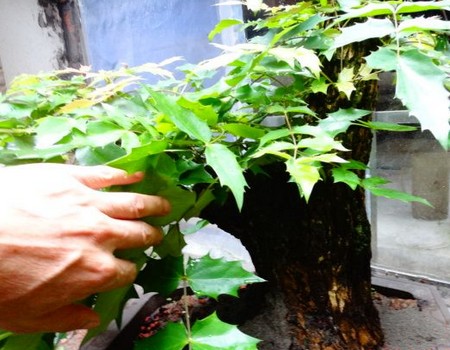
Mahonia has peculiar leaf shapes, golden-yellow flowers like brocade, and an elegant, beautiful appearance, making it a rare ornamental flowering shrub. In Jiangnan gardens it is often planted in clumps beside rockeries or set out as part of rockery displays, and it can also be used as foundation planting in courtyards and along garden walls, looking quite beautiful. It can also be potted and placed at entrance halls, in meeting rooms, guesthouses and conference halls, giving a serene and lovely feel, and as a cut flower it is even more unique. So how do you care for such a beautiful flowering bonsai? Let's learn together below.
Placement location:
Mahonia prefers shade and grows well in moist, sheltered conditions, so its bonsai is suitable for a semi-shaded spot. During the high-temperature period in summer, shade it and spray water to prevent sunscald; in winter it is not cold-tolerant, so it should be brought indoors to overwinter.
Light:
Mahonia bealei prefers a warm, humid, semi-shaded environment. From April to September it can be kept under a shade frame, under tree shade, or in another spot with bright light but no direct sunlight. Too strong sunlight will scorch the new leaves at the tips, affecting that year's growth and the plant's appearance; but it should not be too shaded either, otherwise the lower leaves will turn yellow and drop.
Watering:
Mahonia likes moisture, so water it frequently in normal times to keep the potting soil moist, but it should not become waterlogged. Generally, during the spring and summer growing season you can water a bit more to encourage budding and new shoot growth; in summer, water in the morning and evening and also spray the leaf surfaces so the leaves are thoroughly wet; in winter, water around midday and avoid watering late in the day to prevent the roots from freezing. Keep the potting soil moist during the growing season, and once new leaves emerge, control watering and water only when the potting soil dries out. You can also use the method of watering less and spraying the leaves more often, which makes the leaves smaller and thicker and increases their ornamental appeal. In dry weather, besides normal watering, also spray the plant frequently to raise air humidity and keep the leaf color lustrous and attractive.
Fertilizing:
During the spring and summer growing season, apply topdressing several times, using organic fertilizer based mainly on phosphorus and potassium, bone meal, or decomposed soybean cake fertilizer, to encourage flowering and fruiting. Before winter arrives, apply a stronger cake fertilizer once as a base fertilizer. During the growing season, apply a decomposed dilute liquid fertilizer or a quick-acting compound fertilizer once a month; the fertilizer solution should have a complete balance of nitrogen, phosphorus and potassium, and especially the nitrogen content must not be too high, so the plant does not grow leggy with oversized leaves and lose its elegant charm.
Pruning:
Before spring budding, you can prune dead branches and withered leaves and tidy up the tree shape. At ordinary times you can prune at any time, cutting off sprouting branches and overly dense branches to maintain a certain tree shape.
Repotting:
Generally repot once every 2~3 years. When repotting, you can combine it with division propagation, while also cutting off dead roots and some overly long old roots, replacing 1B2 of the old soil, and filling in with a new, loose growing medium rich in humus.
Pest and disease control:
Mahonia has relatively few pests and diseases, but poor ventilation and light transmission can lead to scale insect damage, which can be brushed off with a brush dipped in laundry detergent water.
It can be seen that care in all aspects of Mahonia is very important, including watering, fertilizing, pruning, repotting and pest and disease control, so that you can grow a bonsai you like. This relatively common shrub, because it is evergreen all year round, is often used to beautify and decorate courtyards and as a shrub arrangement in garden design, and so on, and has very high ornamental and economic value. Moreover, because it is itself a wild-type plant, it is also relatively simple and easy to grow.