How to grow a golden-edged daphne bonsai? Detailed care methods
Golden-edged daphne is known as the “king of fragrant flowers” and one of the three treasures of Chinese horticulture, with extremely high ornamental and medicinal value. Through measures such as summer pruning, golden-edged daphne can be made to open its first batch of flowers in late January, with the flowers fading by the end of February; the second batch begins blooming at the end of February and fades in early April, with the flowering period lasting more than two months, about 1 times longer than conventional cultivation.
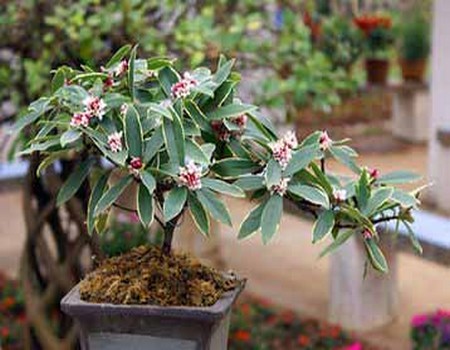
Golden-edged daphne adapts to warm climates, but is not tolerant of strong light and prefers semi-shade; its roots are fleshy, tolerant of drought and averse to wetness, and it is prone to mosaic disease during hot and humid seasons. Bordeaux mixture can be sprayed 2-3 times before the hot and humid season arrives for prevention and control.
Usually pay attention to observing the leaves of the golden-edged daphne. If the leaves stand upright and upward, it indicates that fertilizer and water are normal; if the leaves droop, it means the fertilizer is too concentrated, too raw, or applied too frequently, or that watering is too much or too frequent. The cause should be identified and corresponding measures taken. If there is too much watering, it is easy to correct. If the fertilizer was applied improperly, you can continuously water thoroughly to let the fertilizer drain out of the pot, then place it in a ventilated place so the potting soil dries quickly. If the roots have rotted, you need to repot, cut off the rotten roots, wash them clean with a fungicide, then plant it in sandy soil to let it grow new roots. Some of the upper branches and leaves should also be pruned accordingly.
For golden-edged daphne, water thoroughly once in early spring when the buds are about to sprout, and thereafter water thoroughly only after the potting soil has dried out. In summer, in addition to keeping the potting soil alternating between dry and wet, you also need to spray water regularly around it and on the leaf surface to lower the temperature. In late autumn, keep the potting soil in a semi-dry state to slow growth, which is beneficial for overwintering.
After autumn begins, apply light fertilizer frequently until the flower buds open. In spring, apply fertilizer water mainly based on nitrogen and potassium; after autumn, apply fertilizer mainly based on phosphorus. After the flower buds form, you can spray the branches and leaves with monopotassium phosphate at a concentration of 0.1~0.2% for foliar feeding, but the fertilizer water must be sprayed on the back of the leaves to improve fertilizer efficiency and promote abundant flowers and lush leaves. Golden-edged daphne should not be given human feces or urine fertilizer.
Taking advantage of the golden-edged daphne's tolerance of pruning and strong apical dominance, use the method of removing the top to promote sprouting for pruning. In June-July, prune away part of the new shoots of the current year or 1/2 of the new shoots in stages and batches (the cut branches can be used for water cuttings or soil cuttings), to promote the lateral buds below the cut to sprout new branches. Golden-edged daphne undergoes flower bud differentiation and bud formation after autumn begins. Unpruned spring shoots, because they stopped growing long ago, undergo flower bud differentiation and bud formation immediately after autumn begins, while the summer shoots that sprout after pruning, because their growth has not yet stopped in early autumn, undergo flower bud differentiation slightly later, thereby extending the flowering period.
In July-August, stop root fertilization, but you may apply 0.3% monopotassium phosphate solution 2 times-3 times in combination with watering or foliar spraying to promote strong branches and thick leaves; in early September, apply monopotassium phosphate solution once every 10 days to promote flower bud differentiation and bud formation; in winter, spray 0.3% monopotassium phosphate solution on the leaves once a month to improve the plant's cold resistance, promote early flowering, and encourage large, brightly colored flowers and a long flowering period. Stop fertilizing after the flowers open.
Watering should follow the principle of watering when dry and stopping when wet. Especially in summer, when the temperature is high and the air is dry, and the golden-edged daphne is in a semi-dormant state, the potting soil should be kept slightly dry. However, the relative air humidity needs to be slightly higher, so spray water on the leaf surface 1 time-2 times daily, and sprinkle water around it to increase humidity. In mid-autumn, water less to stop the summer shoots from growing and promote flower bud differentiation.
At the same time, attention should be paid to providing reasonable light and ventilation conditions, doing a good job in overwintering management and pest and disease control, and not moving the flowerpot during the flowering period.
Precautions:
1. Selection of growing soil: Choose soil rich in humus with good drainage and water retention. This kind of soil can be obtained by digging leaf mold from the surface layer directly in mountain forest areas and then mixing in a small amount of river sand and decomposed cake fertilizer, or you may also use garden soil with some leaf mold, a small amount of river sand, and decomposed cake fertilizer.
2. Selection of the placement environment for potted flowers: Golden-edged daphne is a plant that likes a cool and ventilated environment. From June-October, from 9 a.m. to 4 p.m., the potted flowers should be placed in a cool place. Or this can be solved by setting up a shade frame.
3. Water management: In summer and autumn, the soil must be kept moist, better wet than dry, to ensure the plant's water supply.
4. Timely pruning: For plants that grow vigorously and have many branches and leaves in spring, pinch off the growing tips and remove leaves, and thin out excessive new sprouting branches to control excessively rapid water evaporation.
5. Handling of diseased plants: Once golden-edged daphne becomes diseased, the diseased plant should immediately be disposed of together with the potting soil, and the flowerpot should be rinsed and disinfected. Other unaffected plants should be watered and washed with 500 times carbendazim for disinfection to prevent the spread of the disease.