What are the pest and disease control methods for Jatropha pandurifolia?
Jatropha pandurifolia, also known as Jatropha multifida, fiddle-leaf cherry, South Seas cherry, and everyday cherry, belongs to the genus Jatropha in the family Euphorbiaceae. It is an evergreen shrub with red flowers, and the plant body contains milky sap, which is toxic. Because its leaf shape resembles a fiddle, it is called fiddle-leaf cherry; and because it looks like cherry blossoms, it is called everyday cherry. The other name, South Seas cherry, comes from the fact that it was introduced from the South Seas.
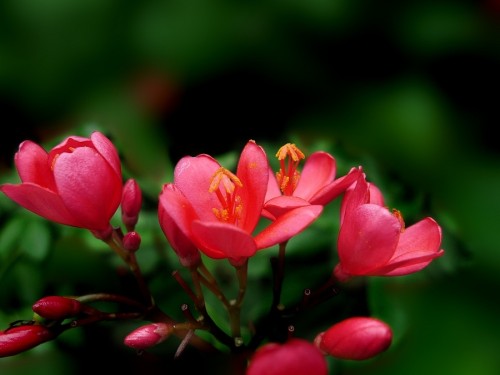
Jatropha pandurifolia is not immune to illness. In the process of growing Jatropha pandurifolia, you will find that it can actually get sick, and the cause of its illness is those pests and diseases.
Symptoms of sooty mold on Jatropha pandurifolia:
Sooty mold harms leaves, branches, and fruits, seriously affecting leaf photosynthesis, causing the plant to decline in vigor and affecting its ornamental value. In the early stage of sooty mold, a layer of dark brown mold spots appears on the surface of leaves, branches, or fruits, and gradually spreads.
Control methods for sooty mold on Jatropha pandurifolia:
1. Spray the diseased areas with 50% thiophanate-methyl wettable powder at 800 times dilution, 50% carbendazim wettable powder at 400 times dilution, and 5% junduqing at 500 times dilution.
2. Prune Jatropha pandurifolia moderately to create good internal ventilation conditions.
Pests of Jatropha pandurifolia:
No pests have been found on Jatropha pandurifolia for the time being. If flower growers find pests on Jatropha pandurifolia, they can choose the corresponding insecticide to kill them.
Precautions for Jatropha pandurifolia:
Jatropha pandurifolia prefers high temperature and high humidity environments, and fears cold and dryness. It must be kept above 12°C during winter. It likes sufficient light and is slightly tolerant of semi-shade; it prefers to grow in loose, fertile, organic-rich acidic sandy soil.
The milky sap of Jatropha pandurifolia is toxic, so when treating its ailments, remember to be careful yourself too~ do not put yourself in danger!
The milky sap is toxic and must not be swallowed by mistake. Accidental contact with the sap causes blisters or pustules, severe skin inflammation, and is also extremely harmful to the eyes; if livestock accidentally eat the fallen leaves, it often causes severe blistering of the mouth.