What to Do When Potted Bamboo Leaves Turn Yellow? Causes and Solutions
Bamboo grows relatively fast and is easy to cultivate; it can even thrive when the potting soil is submerged in water, and it can also grow in water, which is why it is also called water bamboo. It naturally has a quiet, elegant posture, with upright stems and lush leaves, distinct layers, graceful and natural, evergreen all year round. It is an excellent choice for indoor display and also a good material for cut flowers. Its care is simple and its management is undemanding; it can be grown in water or in pots. This is why it is so favored by bonsai enthusiasts.
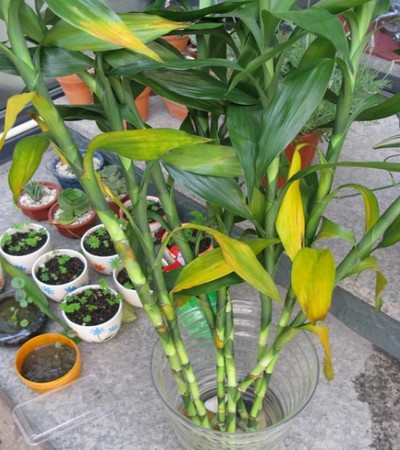
Analysis of the causes of bamboo leaves turning yellow:
1. Water yellowing: Never let water accumulate in the pot; too much water easily causes root rot and yellow, withered leaves.
Solution: Take the plant out of the pot, place it in a ventilated, shady spot to let the soil ball dry naturally, then put it back in the pot.
2. Drought yellowing: Bamboo likes moisture. If watering is neglected, or only the surface potting soil is watered, the roots do not absorb enough water and the stems and leaves slowly turn yellow.
Solution: Simply water thoroughly and generously.
3. Scorch yellowing: Bamboo cannot be exposed to direct strong sunlight, as this will cause the branches and leaves to wither and turn yellow.
Solution: Simply move it to a shady spot.
4. Light-deficiency yellowing: Bamboo likes warmth. If it is placed in a shaded environment for a long time, the plant grows weak and then turns yellow. In winter, it is best to place it in a spot with plenty of sunlight. If it is placed in a spot with insufficient light, combined with poor ventilation and cold, it is prone to causing the branches and leaves to wither and turn yellow.
Solution: Supplementing light can prevent this problem.
5. Fertilizer yellowing: Too high a concentration or the use of fertilizer that has not yet fully decomposed can easily burn the seedlings and cause them to dry up; long-term failure to apply additional fertilizer can also lead to nutrient deficiency and yellowing.
Solution: Stop fertilizing immediately; in severe cases, use a large amount of water to flush out some of the fertilizer.
6. Nutrient-deficiency yellowing: Regularly fertilize the asparagus fern so it has enough nutrients. When nutrient supply falls short of demand, the branches and leaves will turn yellow.
Solution: Check the potting soil; if it is dry and compacted, replace the soil. Usually apply light fertilizer frequently and water occasionally with alum water (lucky bamboo is a foliage plant, so fertilizer should be mainly nitrogen-based).
Another cause of yellow leaves is iron deficiency. You can buy some ferrous sulfate and add an appropriate amount to water according to the instructions. The simplest method is to find two small iron nails and put them in the water (rusty nails are best).
The following points should be noted when caring for water bamboo:
1. Bamboo likes warmth and fears waterlogging, so keeping bamboo immersed in a water-filled dish for a long time is wrong and can easily cause root rot. Rotting fibrous roots cause the leaves to turn pale yellow, then dark yellow. Although water bamboo likes water, it cannot be left soaking in stagnant water; flowing water is better. In summer, water about every 1-2 days on average, and usually mist the leaves. Summer evaporation is high, so pay attention to topping up and changing the water to keep the water quality free from contamination. Autumn is dry, so prevent it from being blown over by wind; frequently spray the leaves with "Xin Gao Zhi Mo" (New High Lipid Film) emulsion to retain moisture and enhance resistance to natural disasters. Let it receive night dew. Spray the bamboo leaves with water several times a day until water roots grow from the bottom of the planting basket and extend into the water; continue lowering the water level to encourage the roots to keep growing into the water, until they reach the length you are satisfied with. Before the roots emerge from the water, pay attention to avoiding light, providing ventilation, and maintaining humidity.
2. Fertilize bamboo with light applications applied frequently; in spring and summer, a 1% compound fertilizer can be applied with the water. Avoid over-fertilizing, which easily causes leaves to turn yellow.
3. Bamboo prefers acidic to slightly acidic water. Because most areas in the north have soil with relatively high salinity and alkalinity, after being cultivated for a period of time, bamboo will gradually lose its green color and turn yellow due to a lack of soluble iron that the plant can absorb. You can water with 0.2% ferrous sulfate once a month.
4. In high-temperature seasons, move the bamboo to a cool place and avoid exposure to the scorching sun, which will burn the leaves. In winter, maintain a certain humidity and prune appropriately; place it indoors in a warm, sunny spot. It can overwinter safely as long as the temperature does not drop below 5°C. In high- or low-temperature seasons, spray "Xin Gao Zhi Mo" (New High Lipid Film) emulsion to resist intense sunlight, prevent moisture transpiration, prevent freezing, and resist cold. In addition, pay attention to damage from aphids, scale insects, and the like.
Bamboo care tips:
1. Appropriate watering: In spring each year before the shoots emerge (March), water thoroughly to promote shoot growth; in May and June, water thoroughly to promote jointing. In the rainy season, water according to rainfall conditions. In November and early December, water to promote shoot bud development. In winter, if it is too dry, spray water appropriately. After planting bamboo, regardless of wind or rain, water the bamboo thoroughly and fill the soil firmly; as with the care of other seedlings, water to settle the roots.
2. Loosening soil and weeding: Do this twice a year, the first time during May and June, and the second time during July and August before the weed seeds mature.
3. Reasonable fertilization: To promote bamboo renewal and earlier forest formation, apply additional fertilizer in a timely manner. The best fertilization times are early spring in March and from August to September; using both farmyard manure and chemical fertilizer gives good results. In autumn and winter, applying organic fertilizers such as cake fertilizer and miscellaneous soil manure helps shoot buds develop and overwinter. In spring and summer, applying human waste and chemical fertilizer can promptly meet the needs of bamboo growth and development.
4. Reasonable thinning: New bamboo sprouts quickly and in large numbers, but the sizes are uneven, so thin them in a timely manner. When thinning, remove the small and keep the large, remove the weak and keep the strong, remove the old and keep the young, remove the dense and keep the sparse. Every 3 to 5 years, transplant out overly dense bamboo to maintain appropriate bamboo forest density and ensure ventilation and light penetration. At the same time, carry out deep plowing and rhizome cutting, and dig out old rhizomes more than four years old and bamboo stumps left after each year's harvesting. After transplanting and digging out bamboo stumps, backfill the pits with miscellaneous soil manure in a timely manner to keep the forest land level.
5. Bamboo forest planning: When land is abundant and the landscape requires it, deep-plow the soil in the direction in which the bamboo forest is planned to expand, and apply miscellaneous soil manure to guide the rhizomes to extend.