A detailed guide to growing Hippeastrum (amaryllis) in water, a step-by-step tutorial
In the blooming season where spring meets summer, the Hippeastrum delights the eye with two flowers borne opposite each other on the scape. Its blooms are large and brightly colored, funnel-shaped and much like a lily, making it highly ornamental. The Hippeastrum, also known as amaryllis, is a perennial herbaceous flower of the Amaryllidaceae family. Its flower colors include bright red, dark red, light red, orange-red, purple-red, blue, white, white with red stripes, speckled gold, and edged, making it a prized variety among household potted flowers.
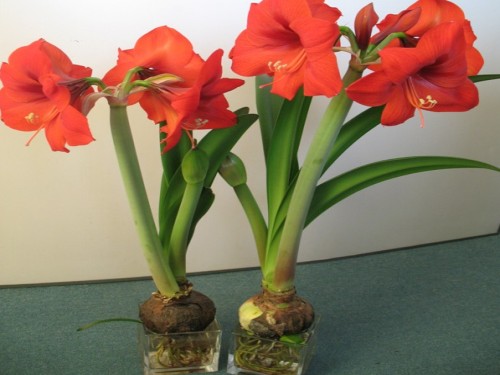
The Hippeastrum bears terminal funnel-shaped flowers, large like a lily, with vivid colors. It is suitable for ground planting to form community landscapes and enhance garden scenery. Grown in pots, it is used to decorate interiors and windows, and can also be used as a cut flower. In Europe and America, the Hippeastrum is also a very popular canned flower.
Growing the Hippeastrum in water is simple and easy, similar to the way narcissus is grown. But after narcissus is grown in water, its bulb shrivels and its nutrients are exhausted, so it cannot bloom the following year. A Hippeastrum grown in water, however, can be moved into potting soil to continue growing when the weather warms after flowering, and then simply with a bit more water and fertilizer it quickly recovers its vigor and becomes a strong seedling; in winter it can be continuously grown in water this same way. Below is an introduction to the water culture method for the Hippeastrum:
Step 1: Selecting the bulb
Generally choose a Hippeastrum that is more than 3 years old (a bulb larger than 6 cm is best). After autumn and before frost, cut off all the leaves, and control water to promote dormancy (the dormancy period should be no less than 25 days, or 50 days before Spring Festival; if later, flowers will be hard to see before the festival).
Step 2: Planting
Soak and wash the bulb with a 1/1000 deep potassium permanganate solution, remove old roots and impurities, then plant it in a narcissus pot (place clean coarse sand grains or small stones to secure the new roots growing from the bulb). If a glass vessel is used as a wall hanging, no sand grains or stones need be placed. The water only needs to cover a small half of the bulb.
Step 3: Transplanting
After the Hippeastrum bulb grows roots of about 0.5CM, move the Hippeastrum into a clean water culture container, support it upright with a water culture basket, with the water depth preferably covering half the bulb, and finally place it in a spot indoors with ample sunlight.
Step 4: Care
1. Temperature: The best temperature for indoor growth of the Hippeastrum is 20°C-25°C, and it is best not to go below 15°C; cooler temperatures will delay the growth and flowering time of the Hippeastrum.
2. Changing the water: Check the culture bottle regularly and change the water promptly. For the first half month, change the water every 2-3 days, and afterward every 4-5 days, always keeping the water level in the pot at the original water line.
3. Fertilizing: To make the Hippeastrum plant grow better and its flowers bloom more vividly, when the leaves grow to 2-3CM you can regularly supplement fertilizer, adding an appropriate amount of 1% urea solution or 0.03% monopotassium phosphate or other compound fertilizer solution containing nitrogen, phosphorus and potassium every 10-20 days when adding water.
Post-flowering handling of a water-grown Hippeastrum:
1. Soil culture
Growing the Hippeastrum in water is simple and easy, similar to the way narcissus is grown. But after narcissus is grown in water, its bulb shrivels and its nutrients are exhausted, so it cannot bloom the following year. A Hippeastrum grown in water, however, can be moved into potting soil to continue growing when the weather warms after flowering, and then simply with a bit more water and fertilizer it quickly recovers its vigor and becomes a strong seedling; in winter it can be continuously grown in water this same way.
2. Pruning and care
When the Hippeastrum flowers have fully opened and begin to fade, cut off the scape at 2CM from the base of the scape, so as to avoid competing for nutrients with other developing scapes or leaves, and at the same time do not harm the leaves; keeping the leaves healthy and vigorously photosynthesizing can produce and accumulate nutrients for blooming again the following year. The Hippeastrum's leaf form is very beautiful, so even after the entire flowering period it can be kept as a green plant for foliage viewing, and moved into potting soil to continue cultivation when the weather turns warm.
Many people feel that a water-grown Hippeastrum is more suitable than a soil-grown one for decorating and beautifying the home. When a water-grown Hippeastrum blooms, you can admire its unusually shaped flowers, its emerald-green branches and leaves, and the snow-white root tendrils in the glass bottle. Together these give a fresh and clean feeling, with unexpected effects when used in home decoration.