How to grow and care for potted amaryllis (Hippeastrum) and points to note
Amaryllis is a very popular potted plant in home beautification today, with large flowers, unusual flower shapes, many flower colors and a wide range of varieties. It is a very rare flower variety, and growing it is also relatively simple, as can be seen from the amaryllis growing methods summarized above. I believe everyone can also grow high-quality amaryllis to beautify their homes.
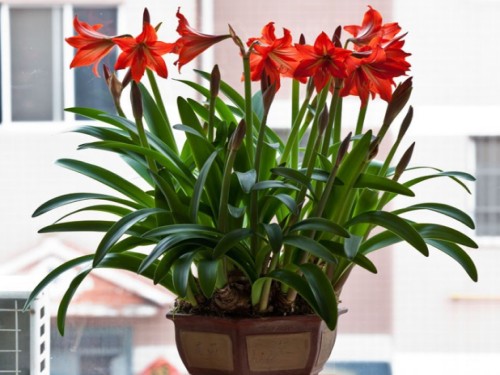
Amaryllis has huge flowers and brilliant colors, with very high ornamental value. It is a flower plant widely used in the arrangement of home living rooms, studies and other places today, and its beautifying effect is very good. Today, the editor will take you to learn about the growing methods of amaryllis:
Amaryllis likes fertilizer. When its leaves grow to 5-6 cm, you should start fertilizing the flowers, applying decomposed cake fertilizer water once every half a month. After flowering, change to applying it once about every 20 days to promote bulb enlargement and the production of new bulbs. Amaryllis relatively likes sunlight, and can be given appropriate direct sunlight, but not for too long. It is suitable to place it in a bright, well-ventilated place, by a window without strong direct sunlight.
Growing methods for amaryllis:
1. Soil: Amaryllis planting soil requires loose, fertile sandy loam, with a pH of 5.5-6.5, and must never be waterlogged. The potting soil can be prepared by mixing 2 parts decomposed manure soil, 6 parts leaf mold soil and 2 parts sandy soil evenly.
2. Sunlight: Amaryllis likes sunlight, and can take an appropriate amount of direct sunlight, but not for too long. It is suitable to place it by a window with bright light, good ventilation and no strong direct sunlight.
3. Temperature: Amaryllis likes warmth and is not cold-tolerant. In summer it should be cool, with a temperature of 18-22°C being suitable. During the winter dormant period, it requires a cool and dry environment, and the temperature must not be lower than 5°C.
4. Watering: Amaryllis needs to keep the plant moist, and watering should be thorough. But too much water and poor drainage should be avoided. Generally, indoor air humidity is sufficient.
5. Fertilizing: Amaryllis likes fertilizer. When the leaves grow to 5-6 cm long, start applying topdressing, generally applying decomposed cake fertilizer water once every half a month. After flowering, change to applying it once about every 20 days to promote bulb enlargement and the production of new bulbs.
6. Pruning: Amaryllis grows fast, and its leaves are long and dense. When changing the pot and soil, you should also cut off withered leaves, dead roots, and roots and leaves damaged by pests and diseases, leaving vigorous leaves.
7. Pests: To make amaryllis grow vigorously and bloom early, pest and disease control should be carried out, spraying flowers with pesticide once a month. Spraying should be done on sunny days at around 9 a.m. and 4 p.m. Do not spray under the strong midday sun to prevent pesticide damage.
Points to note:
1. Special attention should also be paid when amaryllis is dormant. Watering should be strictly controlled, and the amount of water should be controlled so that it is just enough to keep the bulb from withering. Keeping the temperature at 10-15°C is fine. At the end of December or in early January, you can water the pot with a thin, thorough watering to wake the dormant amaryllis. After about a week, apply a thin calcium phosphate fertilizer water once, and keeping the temperature at around 16°C can promote sprouting and earlier flowering.
2. Attention should also be paid after flowering. After amaryllis blooms, the above-ground part will partially set fruit, while the underground part will grow bulbs. At this time, you should fertilize 1-2 times after flowering, and do not water frequently, letting the substrate be somewhat dry. After amaryllis blooms, it should be moved to a semi-shady, well-ventilated place for potted care.