How to Grow Bleeding Heart Vine (Clerodendrum thomsoniae) as a Household Potted Plant
Bleeding heart vine (Clerodendrum thomsoniae) belongs to the Verbenaceae family as a perennial plant, native to West Africa, and is a potted climbing flowering plant. During the growing period it needs plenty of water, and in each flowering season it should be fertilized once every 7-10 days. To grow a perfect potted bleeding heart vine, during the growing period the height of the branches must be strictly controlled, and the branch parts should be pruned and cut back, to promote the growth of the bleeding heart vine.
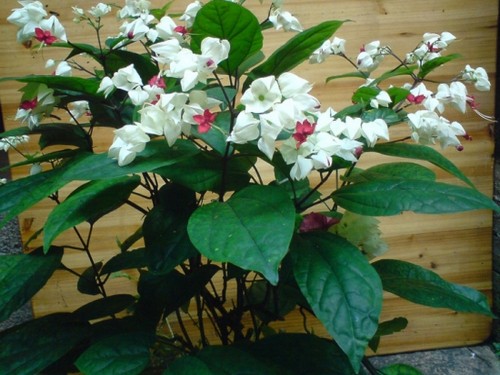
How do you grow bleeding heart vine? I believe many people are not very familiar with it. It has not been cultivated in our country for very long. Next, let us learn about the cultivation methods for bleeding heart vine together!
[Planting]
For potted bleeding heart vine, generally repot once every 1~2 years, and the repotting time can be either in early spring or after the flowers fade. When repotting, first use broken tile pieces to cover the drainage hole, then put in a small amount of bone meal as base fertilizer, then fill in new culture soil (4 parts leaf mold, 4 parts garden soil, 2 parts sand soil), plant the plant well, and leave 2~3 cm of rim at the top for fertilizing and watering. After repotting, water thoroughly and place in a shaded place to recover; after recovery, move to a place with ample sunlight for care.
[Watering]
Bleeding heart vine is fairly sensitive to water. During the stem and leaf growing period, the saline soil should be kept moist, but watering must not be excessive; too much water will cause it to grow only vines without flowering, and even cause the leaves to turn yellow and fall off, and the roots to rot and die. In the hot summer season, water fully and shade appropriately. In winter, reduce watering to let it go dormant, so as to overwinter safely.
For potted bleeding heart vine, you need to master the two main aspects of watering and pruning. Bleeding heart vine likes humidity and requires sufficient water during the growth and development period. However, watering too much and making the potting soil too wet easily causes the leaves to turn yellow and drop off. During the growing period, watering should be even; the potting soil should often be kept in a moist state, and it should not be too wet or too dry, nor should it be alternately wet and dry.
[Fertilizing]
Fertilizing should not be excessive; in the flowering season, apply 1 time of fully rotted dilute cake fertilizer water every 7~10 days, and applying 3~4 times in succession is enough. If yellowing is found during the cultivation of bleeding heart vine, combined with topdressing, apply 0.2% ferrous sulfate water, and the leaves will gradually turn from yellow to green.
[Temperature and Light]
Bleeding heart vine needs ample light in winter, and when the weather is too hot in summer it should be shaded, otherwise the leaves turn yellow. When light is insufficient, it will cause vine-like growth and will not flower. Flower bud differentiation is not affected by photoperiod, but stronger light promotes flower bud differentiation and development. It should not be placed in darkness for too long; at a temperature above 21°C, for more than 24 hours, it will drop its flowers.
After the weather warms up in spring, place it in the yard or on a south-facing balcony, and give it ample light in spring and autumn. In summer, when it is hot, place it under a shade shed or in a shaded place. After winter begins, move it indoors, control watering, stop fertilizing, place it in a sunny spot, and keep the room temperature above 12°C for safe overwintering.
[Key Care Points]
Potted bleeding heart vine commonly uses a 12-15 cm pot, and 3 plants can be planted per pot. During the growing period it needs plenty of water; if the soil is too wet, it will cause the leaves to turn yellow and drop off. If the branches do not wither, then stop watering and let it recover and sprout new leaves. Fertilize once every half month; in the flowering season of bleeding heart vine, apply 1-2 additional applications of phosphorus and potassium fertilizer, or use "Huiyou" 20-8-20 all-season high potassium nitrate fertilizer.
In winter, reduce watering and stop fertilizing. To shape a beautiful plant form of bleeding heart vine, when cutting seedlings or seedling potted double-color plants have grown to 15 cm, cut the branch 10 cm from the pot rim to promote the sprouting of thick new branches. During the growing period, strictly control the height of the branches, and pay attention to pinching and topping to achieve neat branches and dense flowering in the future. Half a month after pinching, apply B9 or chlormequat to control plant height, achieving a short plant, lush leaves, and many flowers. When repotting each spring, prune and cut back the aboveground branches to make the plant round and neat, with many branches and many flowers.
Bleeding heart vine has deep green leaves, jade-like calyxes, and crimson corollas, full of poetic charm. Potted plants adorn windowsills or balconies, with graceful posture, bright and novel. During storage and transportation, the flowers are sensitive to ethylene; 10 days before storage and transportation, spray 0.4 mmol/L silver thiosulfate solution. Flowering plants that have not been sprayed with silver thiosulfate and are transported in darkness for more than 1 day, at a transport temperature of 20°C, will drop their flowers.