Reasons and Solutions for Yellowing and Wilting Leaves of Pothos Bonsai
Overall, when pothos leaves turn yellow, in the case of water cultivation it is mostly due to bacteria in the water, while in the case of soil cultivation it may be root rot. Relatively speaking, water-cultivated pothos is more prone to yellow leaves than soil-cultivated pothos. The specific factors behind pothos leaves turning yellow are mainly improper watering, unbalanced light, and incorrect fertilizing. Below, the editor analyzes in detail the conditions of the three major factors that cause pothos leaves to turn yellow.
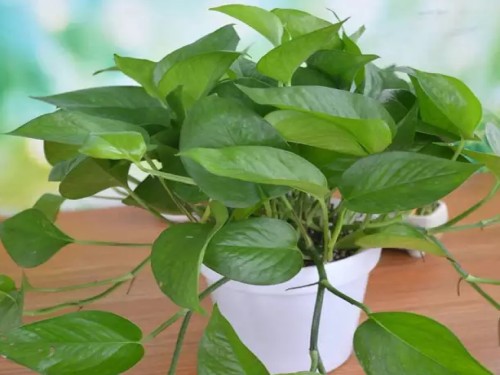
1. Improper watering
Too much or too little watering can both cause water-related yellowing in pothos. If the leaf surface is dull yellow and lusterless, and the newly grown tips shrink and stop growing, it may be overwatering; while if the leaf tips or edges become scorched and dry, the new leaves grow normally, but the old leaves turn yellow and fall off, it is underwatering. Yellow leaves should be removed promptly once discovered.
2. Improper light
Pothos prefers shade. Strong light exposure will cause the leaf tips and leaf edges of the plant to become scorched, and yellow spots will appear on the sun-facing part of the leaves. On the contrary, if placed in a dark environment for a long time, the leaves cannot get enough sunlight and cannot form chlorophyll, which will also cause pothos leaves to turn yellow, so light must be supplemented in time.
3. Improper fertilizing
Too much fertilizer, too high a concentration, or even no lack of fertilizer at all can cause pothos leaves to turn yellow. When too much fertilizer is applied, the pothos leaf surface is thick and lusterless, and the leaf surface looks unrelaxed, with old leaves turning yellow and falling off; this can be reduced by flushing with water. When fertilizer is lacking, the leaf surface color becomes lighter, appearing pale green or yellow, and fertilizer should be supplemented in time; in severe cases, the potting soil must be changed.
Reasons and solutions for pothos leaves turning yellow:
The solution for pothos leaves turning yellow should be adjusted in good time according to the cause of the yellowing. Since pothos can be propagated by cuttings, each node of its stem bears a leaf bud, and just one section is enough to grow when planted. So when the leaves of cultivated pothos turn yellow severely, the rotted roots can be removed, the yellow leaves picked off, and the plant replanted as a cutting; note that when water-cultivating, the water must be replaced with fresh water. You can also cut off the vine sections whose leaves have not yet turned yellow and replant them. During planting, bury two to three nodes; for water cultivation, likewise two to three nodes, and change the water once every three to four days (cooled boiled water is best). Just after planting, it must not be exposed to direct strong light; it can be placed in a position with weaker light, and in about 20 days the newly planted pothos will root and grow.
Among foliage plants, pothos can be said to be the easiest to grow! But once autumn and winter come and the leaves turn yellow, the whole plant becomes limp and wilted, and it no longer looks so pleasing to the eye! When we encounter pothos leaves turning yellow during cultivation, what should we do? How should we remedy it? It is nothing more than light, temperature, water, and fertilizer!
1. Light
Everyone knows pothos prefers shade, but being in a dark environment for a long time will make the leaves turn yellow, the leaves become smaller, and the internodes multiply.
Solution: Give appropriate light, move it to a position not in direct sunlight, and supplement light.
2. Temperature
The optimal growing temperature for pothos is 20°C, which can basically be reached when kept indoors. In winter, take care not to place pothos near a radiator, electric heater, or directly facing an air conditioner vent to “keep warm”.
Solution: For those outdoors, build warmth-retaining measures, or move them back indoors.
3. Water
Pothos likes water. Soil-cultivated ones must keep the soil moist, and water-cultivated ones must have the water changed frequently, keeping the container clean and avoiding bacteria breeding in the water. The degree of watering must be well controlled; too much watering causes yellow leaves, and lack of water also causes yellow leaves……
Solution: For soil cultivation, water according to “dry then wet”, watering thoroughly, and reduce watering frequency in winter; for water cultivation, change the water once every 3-4 days.
4. Fertilizer
If you do not fertilize pothos, the nutrients provided by the water and soil are enough for pothos to grow; if you often fertilize pothos, the pothos may get yellow leaves.
Solution: Supplement fertilizer regularly, applying light fertilizer frequently.
5. Air
If pothos is placed in an unventilated environment for a long time, both its respiration and photosynthesis will be affected, and over time the leaves will turn yellow.
Solution: Place it in a ventilated spot or regularly improve the air circulation of the environment where it is placed.