How to care for a Ficus microcarpa bonsai? Methods and tips explained in one article
Ficus microcarpa is a plant commonly seen in the south, and like all Ficus plants it has dense aerial roots. These aerial roots grow very elegantly, like a hanging curtain, yet they point firmly straight down to the ground, and their feel is not smooth at all but full of strength. Once they enter the soil they can grow root systems, supporting the crown as it keeps extending, eventually forming a grove. Why can other people's Ficus microcarpa be trained into a bonsai, while yours has yellow leaves or withers? The key is water and fertilizer management. As for why it can grow into the shape of a bonsai, it still comes down to pruning and shaping.
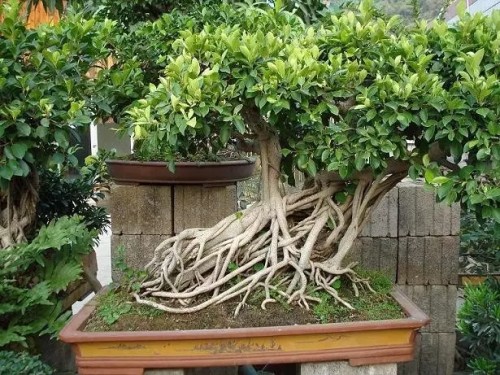
1. Water and fertilizer management
Ficus microcarpa is extremely easy to grow. It can adapt to an environment with plenty of fertilizer and water, and it is also drought-tolerant and waterlogging-tolerant, and can grow in cracks between rocks.
If you want to train it into a bonsai, you first need to grow the trunk well and develop it into a stump. Usually apply thin fertilizer frequently, using decomposed organic fertilizer as a top dressing, once every ~3 days.
For transplanting and repotting, use decomposed organic fertilizer as a base fertilizer. Only sufficient fertilizer and water can make Ficus microcarpa quickly grow thick and strong, and only then can it be trained into a bonsai.
After the ficus has established, it can tolerate long-term water accumulation, otherwise it tends to grow only roots and not a trunk.
2. Daily pruning
Only pruning can produce a good-looking shape. Ficus microcarpa is also fairly tolerant of pruning, and pruning can bring the ficus to a very beautiful state.
Ficus microcarpa can be pruned in all four seasons. A well-shaped bonsai ficus is mainly achieved through pruning; wiring is not even necessary.
When it is growing most vigorously, you can prune it twice in succession, mainly by shortening the branches so that the trunk becomes thicker and stronger. Branches at the base should also be cut off in time.
3. Pinching
Pinching is done to stimulate new buds, which promotes more branching, and in the end you will get a crown. Pinching the buds at the top is very necessary. Pinching can also prevent branches from growing too long and affecting the appearance.
Ficus microcarpa is generally pinched for the first time when 3~4 leaves have grown.
When the new branches grow 3~4 leaves again, pinch them in turn, so that its branches look very nice.
In the end you will get a Ficus microcarpa with many branches and a lush crown.
4. The importance of bud thinning
Bud thinning means that when a tree sprouts, often many buds sprout at the same time.
Bud thinning is very necessary for the better growth of Ficus microcarpa, and it can also make the tree shape more beautiful.
Bud thinning actually means that when buds sprout at the top of the nodes of Ficus microcarpa, you remove the excess buds and keep one or two suitable buds.
This not only reduces the loss of nutrients, but also shapes the tree; otherwise multiple small buds grow into branches, which is unsightly.
In addition to watering, fertilizing, pruning and pest and disease control, stump bonsai management also involves a lot of routine work, such as cleaning, shading, wind protection and cold protection.
1. Cleaning can not only keep the stump bonsai neat and beautiful, but also reduce the breeding of pests and diseases. Frequently remove dead branches, fallen leaves and weeds from the pot mouth, wash off dirt on the pot walls, and keep the place where the bonsai is placed clean as well.
2. Shading: according to the different light requirements of different stump bonsai tree species, they can be divided into sun-loving and shade-loving species. Sun-loving species, such as elm, trident maple, pomegranate, crape myrtle, five-needle pine, black pine, Chinese juniper, etc., as long as water is supplied properly, will not be affected in growth even if exposed to direct sunlight all day. Shade-loving species, such as rhododendron, nandina, Buddha belly bamboo, Buddhist pine, serissa, etc., as well as small stump bonsai and shallow-pot bonsai, should be placed under trees and under a shade shed, avoiding direct sunlight in summer.
3. Wind protection: some old, tall and cliff-style stump bonsai placed in the open air are prone to damage from strong winds such as tropical storms, causing pot stands and flower pots to fall over and branches to break, with serious losses. Therefore, wind protection work should be done well. The stump bonsai can be moved to flat ground, or the pot mouth tipped over; for some large bonsai that are inconvenient to move, 1-2 support posts can be set up, and the trunk and thick branches tied to the support posts to prevent strong winds from blowing them down.
4. Cold protection: tree species with poor cold tolerance, such as orange jasmine, Fujian tea, rhododendron, Buddha belly bamboo, etc., should be put into a greenhouse for the winter; those with medium cold tolerance, such as Buddhist pine, five-needle pine, Japanese apricot, black pine, etc., can have a frame built for cold protection in a sheltered, sunny place, and the flower pots buried in the soil; tree species with strong cold tolerance can be placed in a sheltered, sunny place, and the pots buried in the soil at the same time.