How to care for a Black Bone Tea bonsai? Master these key methods
Black Bone Tea, also called black ebony, is a tree species unique to the area around Taishan in Jiangmen and Yangjiang, Guangdong. It is a bonsai species newly discovered in the past decade or so. Because its growing range is relatively small, it grows slowly, is easy to care for, and can be artificially cultivated. As rare things are precious, it has attracted people's attention, and Black Bone Tea bonsai has gradually become a new trend in the bonsai industry.
The fragrance released by Black Bone Tea benefits the functions of the human heart, liver, kidneys and so on. It can effectively stabilize human brainwaves, making emotions balanced, peaceful and calm, aid sleep, and even help with meditation. When Black Bone Tea is burned, it releases a clear, quiet and fragrant aroma. In addition, its essential elements contain bactericidal benefits and even have the miraculous effect of calming the mind and steadying the spirit. Black Bone Tea is dark black in color, dense in texture, and its fragrance is light, elegant and long-lasting. Used for decoration, it fully displays solemnity. Buddhism even believes that sandalwood has the effect of driving away and warding off evil.
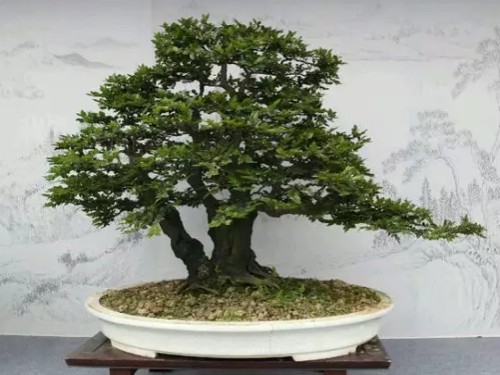
Black Bone Fragrance is mainly a bonsai species grown for its foliage. The leaves of Black Bone Tea bonsai are relatively small and deep green. Its bark and roots appear black, while its wood is very hard, yet its growth rate is very slow. Works shaped into large tree forms have only been seen in bonsai magazines in Taiwan, China. Don't worry, next let the editor take everyone to look at its care methods.
Black Bone Tea grows very slowly and is also the slowest-growing tree species in Lingnan bonsai. It grows even more slowly than boxwood, so when selecting stumps we must pay special attention to choosing stumps that come with grafted supports and preferably have young branches. If its cut opening exceeds 3 cm, it will be very difficult to cultivate matching branch supports. Of course, the best time to dig Black Bone Tea is after the Spring Equinox and before Grain in Ear.
Black Bone Tea has very strong sprouting ability and roots quickly, so basically the trunk, supports and roots can all be cut into place in one go. After the stump is cut, it can be soaked in clean water for 24 hours, then planted with river sand, and placed in a semi-shaded place. It is necessary to maintain the humidity of its dry body. Then after 20 days, secretion of a black liquid can be seen at its cut opening. After a few days, it can sprout. By 60 days, new roots can be seen. So its survival rate is very high.
After Black Bone Tea has survived, it can be moved to a sunny and ventilated place. It can be given light fertilizer water, which can promote strong roots and sturdy branches. After the Autumn Equinox, corresponding supports can be set according to its shape, and all unnecessary branches can be cut off, so that its nutrients can be concentrated on the shaping branches. After the root system of Black Bone Tea grows, it greatly likes fertilizer, so we can appropriately increase fertilizer for it. The pot surface requires us to apply decomposed farmyard manure over the long term, so that each time it is watered, its nutrients are slowly dissolved, which is even more conducive to absorption by the stump.
When watering, the principles of great dryness and great wetness, no watering when not dry, and thorough watering when watering must be followed. After Minor Snow, fertilization should be stopped, and the management of one growth cycle should also be completed. What is worth noting is that throughout the entire growth cycle, the phenomenon of slow growth due to shortage of fertilizer water should not occur. Only such management can be the best kind of management.
The characteristics of Black Bone Tea are fine green leaves and a black trunk, hence the name Black Bone Tea. When new buds emerge in March and April, it is very beautiful. After the bonsai takes shape, it is easy to care for, and pruning just once or twice a year is enough.
Black Bone Tea can be considered an evergreen type of plant bonsai, and it can sprout a new shoot once each season. Therefore, it can be pruned in all four seasons of the year, and each pruning must be carried out after the new shoots have matured. However, spring and autumn are still the best. Black Bone Tea does not easily lose branches, so it can be pruned on a single branch. After sprouting, strong buds should be selected and retained. If new buds are allowed to grow freely, it is very difficult to meet the requirement of horizontally spreading branches. This must be noted.
Compared with other plants, the roots of Black Bone Tea are relatively thick and hard, and generally can be cut into place in one go. However, the best time to dig it is around before and after Grain in Ear, because the roots may be relatively easier to dig at that time. Its survival rate is very high. After more than 20 days, mucus will come out of the wound you cut. After these few days, it begins to grow buds, and then grows new roots. However, it grows especially slowly. Everyone knows that boxwood grows very slowly, right? It grows even more slowly than boxwood.
Even if Black Bone Tea grows very slowly, we still need to prune it often for the sake of its beauty. After pruning, the new buds all grow upward. If you want it to develop in all four directions, then you need to use wire to bend the newly grown buds. As for what shape you want, that depends on how you guide the buds to develop with the wire.
If Black Bone Tea survives, then we move it to a place with sufficient sunlight and give it fertilizer, but not too much and not too concentrated. Light is fine. However, if the roots of Black Bone Tea become larger and harder, then we can increase the intensity of fertilization, but we should pour clean water on top again to disperse the fertilizer strength. When watering, it should be soaked thoroughly, but it is best not to water it very wet in rainy weather, because then the roots may become moldy.
In addition to the above care methods for Black Bone Tea bonsai, personally I suggest that the soil in a Black Bone Tea bonsai is best changed once every five years, as this is greatly beneficial to the growth of the Black Bone Tea bonsai. If you feel that the Black Bone Tea bonsai does not match your aesthetic taste, then you can personally create a shape you like for it. Moreover, during the growth process of a Black Bone Tea bonsai, if you want it to have a unique shape, you can use wire to bind it, which plays a certain role in setting its form.