How to grow a Japanese Persimmon (Diospyros rhombifolia) bonsai? Master these care essentials
Diospyros rhombifolia, a deciduous shrub with papery leaves that are ovate, rhombic or obovate, is a dwarf tree species native to Fujian, Jiangsu and Zhejiang, and a star species in the bonsai world. At exhibitions, it not only earns the approval of bonsai enthusiasts but is also loved by the general public. Because of its unique tree form and petite, lovely fruit, Diospyros rhombifolia is irresistible, and on top of that it is easy to cultivate and propagate and seldom loses branches; bonsai with distinctive character can be created by pruning alone, making it one of the best bonsai materials for most people to grow and enjoy.
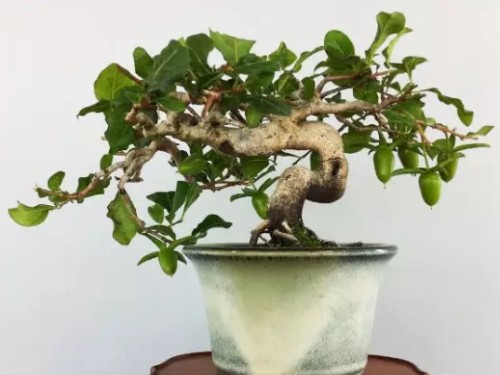
Growing a Diospyros rhombifolia bonsai is not difficult. Diospyros rhombifolia is robust in constitution and tolerant of rough cultivation; it likes light but tolerates shade fairly well, prefers relatively humid climatic conditions, and grows vigorously in fertile, well-drained soil. It adapts well to being potted and easily maintains vigorous vitality. Diospyros rhombifolia tolerates poor soil; with sufficient fertilizer the leaves are thick, deep green and glossy, while with too much fertilizer the leaves curl and wrinkle, and the degree of wrinkling can indicate the fertilizer situation. Diospyros rhombifolia has strong drought tolerance and absorbs and transpires a lot of water; after losing water the leaves become limp, the leaf color darkens and loses its gloss, and when severely short of water the leaves droop and hang down. If this is observed and water is given promptly, vitality can be restored; in severe cases the leaves fall off but new buds can still sprout, while leaves that do not fall off indicate death by dehydration.
Below is a flower lover's summary, based on their own experience, of their insights on caring for Diospyros rhombifolia bonsai in each of the 12 months of the year. Because regions differ, readers can appropriately refer to the care notes for the months before and after and combine them with their own bonsai:
Diospyros rhombifolia care in January:
This month is still the fruit-viewing period. If the fruit is fully ripe it can be picked; after picking the fruit you can repot and divide the root suckers for separate planting. This month is suitable for styling and pruning; thick roots trimmed off during repotting can be buried for root propagation. If conditions permit, you can appropriately spray insecticides and fungicides to prevent and control pests and diseases.
Diospyros rhombifolia care in February:
1. This month some late-flowering, late-fruiting varieties are still in the fruit-viewing period.
2. If the fruit is fully ripe it can be removed; by mid-February at the latest all fruit should be removed to let the plant go dormant.
3. Spray insecticides and fungicides.
4. This month is suitable for styling and pruning.
5. After picking the fruit you can repot and divide the root suckers for separate planting.
6. For young trees in cultivation that you do not plan to let flower and fruit this year, this month onward is the most suitable time to repot.
7. Thick roots trimmed off during repotting can be buried for root propagation.
8. Some Japanese-imported Diospyros may sprout or bloom this month due to climatic conditions; if the variety is not self-fruiting, you need to find a male Diospyros blooming at the same time for pollination in order to get fruit.
Diospyros rhombifolia care in March:
1. Diospyros with a normal flowering period continue to rest this month, while early-blooming varieties will begin to bloom one after another.
2. Spray insecticides and fungicides.
3. This month is suitable for styling and pruning; if aluminum wire has been applied, it is advisable to remove it before budding to avoid leaving constriction marks.
4. This month you can repot and divide the root suckers for separate planting.
5. For young trees in cultivation that you do not plan to let flower and fruit this year, this month onward is the most suitable time to repot.
6. Thick roots trimmed off during repotting can be buried for root propagation.
7. You can sow seeds to hatch young Diospyros.
8. Some Japanese-imported Diospyros may sprout or bloom this month due to climatic conditions; if the variety is not self-fruiting, you need to find a male Diospyros blooming at the same time for pollination in order to get fruit.
9. For those that have not produced new buds by the end of the month, you can prune the branches to check whether they have dried out.
Diospyros rhombifolia care in April:
1. Diospyros with a normal flowering period bloom this month, and early-blooming varieties will begin to set fruit one after another.
2. If the variety is not self-fruiting, you need to find a male Diospyros blooming at the same time for pollination in order to get fruit.
3. For self-fruiting varieties, it is also recommended to help them pollinate so that the fruit will be round and plump in the future.
4. This month you must continue the work of selecting buds, removing buds and blocking buds, which is the basic skill of creating bonsai.
5. Diospyros that have not bloomed or fruited are also suitable for styling and pruning; if aluminum wire has been applied, it is advisable to remove it to avoid leaving constriction marks.
6. This month is the most suitable for sowing seeds to hatch young Diospyros.
7. The most important task this month is pollination.
8. For Diospyros that have not bloomed or fruited, you can fertilize after new buds appear.
9. For Diospyros that are blooming and fruiting, do not fertilize for now to prevent fruit drop. Wait until the fruit is stable next month before starting to fertilize.
Diospyros rhombifolia care in May:
1. May is the month when Diospyros grows most actively.
2. Diospyros with a normal flowering period finish blooming this month, but you still need to prevent fruit drop.
3. For Diospyros without fruit, vigorous branches can be cut back this month to leave only 2~3 leaves.
4. For trees with strong vigor, all leaves can be stripped to force buds, with the aim of turning one branch into two.
5. Diospyros that have not bloomed or fruited this month are suitable for styling and pruning; if aluminum wire has been applied, it is advisable to remove it before constriction marks appear.
6. This month is the most suitable for cuttings and air layering.
7. New leaves mature this month; you can spray some disinfectant to prevent pests and diseases.
8. For Diospyros that have not bloomed or fruited, fertilize after new buds appear, preferably with organic fertilizer.
9. Once the fruit is stable you can begin applying light fertilizer.
Diospyros rhombifolia care in June:
1. June is also the month when Diospyros grows most actively.
2. The fruit of fruiting Diospyros continues to grow, and the fruit set becomes more stable.
3. For Diospyros without fruit, vigorous branches can be cut back this month to leave only 2~3 leaves.
4. For trees with strong vigor, all leaves can be stripped to force buds, with the aim of turning one branch into two.
5. Diospyros that have not bloomed or fruited this month are suitable for styling and pruning; if aluminum wire has been applied, it is advisable to remove it before constriction marks appear.
6. This month is the most suitable for cuttings and air layering.
7. New leaves mature this month; you can spray some disinfectant to prevent pests and diseases.
8. For Diospyros that have not bloomed or fruited, fertilize after new buds appear, preferably with organic fertilizer.
9. Flower buds begin to differentiate this month; you can begin applying high-phosphorus and high-potassium fertilizer.
Diospyros rhombifolia care in July:
1. July is also a month of flower bud differentiation for mature Diospyros and vigorous growth for young trees.
2. The fruit of fruiting Diospyros continues to grow, and the fruit set becomes more stable. For fruiting Diospyros on the top or on leggy branches, you can begin air layering in preparation for cutting them off in November to plant and exhibit.
3. For young Diospyros trees, you can repot this month.
4. For young trees with strong vigor, all leaves can be stripped to force buds, with the aim of turning one branch into two.
5. Diospyros that have not bloomed or fruited this month are suitable for styling and pruning; if aluminum wire has been applied, it is advisable to remove it before constriction marks appear.
6. Pruned-off branches are most suitable for cuttings this month.
7. New leaves mature this month; you can spray some disinfectant to prevent pests and diseases.
8. For Diospyros that have not bloomed or fruited, fertilize after new buds appear, preferably with organic fertilizer.
9. Flower buds begin to differentiate this month; you can begin applying high-phosphorus and high-potassium fertilizer. Small amounts, many times.
Diospyros rhombifolia care in August:
1. August is also a month of flower bud differentiation for mature Diospyros and vigorous growth for young trees; be careful not to let them lose water.
2. The fruit of fruiting Diospyros continues to grow, and the fruit set becomes more stable. For fruiting Diospyros on the top or on leggy branches, you can begin air layering in preparation for cutting them off in November to plant and exhibit.
3. Both fruiting Diospyros and young trees can be repotted this month; be careful not to damage the fine roots when repotting. After repotting fruiting Diospyros, you can pick off some fruit to reduce the burden on the tree.
4. At the beginning of the month, young trees with strong vigor can have all their leaves stripped to force buds, with the aim of increasing branching.
5. Diospyros that have not bloomed or fruited this month are suitable for styling and pruning; if aluminum wire has been applied, it is advisable to remove it before constriction marks appear.
6. Pruned-off branches are most suitable for cuttings this month.
7. New leaves mature this month; you can spray some disinfectant to prevent pests and diseases.
8. For Diospyros that have not bloomed or fruited, fertilize after new buds appear, preferably with organic fertilizer.
9. Flower buds begin to differentiate this month; you can begin applying high-phosphorus and high-potassium fertilizer, in small amounts, many times.
Diospyros rhombifolia care in September:
1. September is also a month when trees store nutrients in preparation for overwintering, so fertilize moderately.
2. The fruit of fruiting Diospyros continues to grow, and the fruit begins to change color this month. For fruiting Diospyros on the top or on leggy branches, you can still begin air layering in preparation for cutting them off in November to plant and exhibit.
3. Both fruiting Diospyros and young trees can be repotted this month; be careful not to damage the fine roots when repotting. After repotting fruiting Diospyros, you can pick off some fruit to reduce the burden on the tree.
4. Leaves with black spots are best removed immediately and discarded sealed in a ziplock bag to prevent contagion.
5. Diospyros that have not bloomed or fruited this month are suitable for styling and pruning; after the leaves fall you can begin wrapping aluminum wire.
6. Pruned-off branches are still suitable for cuttings this month.
7. This month the leaves mature and develop black spots; you can spray some disinfectant to prevent anthracnose.
8. For Diospyros that have not bloomed or fruited, fertilize after new buds appear, preferably with high-phosphorus and high-potassium organic fertilizer.
9. Flower buds are differentiating this month; you can begin applying high-phosphorus and high-potassium fertilizer. Compound fertilizer can be used in small amounts.
Diospyros rhombifolia care in October:
1. October is also a month when trees store nutrients in preparation for overwintering, so fertilize moderately.
2. The fruit begins to ripen red this month and enters the appreciation period.
3. Both fruiting Diospyros and young trees can be repotted this month; be careful not to damage the fine roots when repotting.
4. After repotting fruiting Diospyros, you can pick off some fruit to reduce the burden on the tree.
5. Leaves with black spots are best removed immediately and discarded sealed in a ziplock bag to prevent contagion.
6. Diospyros that have not bloomed or fruited this month are suitable for styling and pruning; after the leaves fall you can begin wrapping aluminum wire.
7. Pruned-off branches are still suitable for cuttings this month.
8. This month the leaves mature and develop black spots; you can spray some disinfectant to prevent anthracnose.
9. For Diospyros that have not bloomed or fruited, fertilize after new buds appear, preferably with high-phosphorus and high-potassium organic fertilizer.
10. Root suckers can be divided into separate pots for cultivation.
Diospyros rhombifolia care in November:
1. This month is the appreciation period, and the fruit becomes more and more ripe. If it snows, they can be moved indoors to continue enjoying them.
2. When a cold snap comes the leaves will gradually fall completely; if they do not fall on their own, you can help strip them at the end of the month, officially beginning dormancy.
3. After stripping the leaves you can do light pruning; as a rule leave just two to three buds per branch and cut off excess branches and buds.
4. After stripping the leaves and finishing pruning, thin branches can be wrapped with aluminum wire to correct the direction and angle of the branches; but remember to remove it before constriction marks appear, within about 2~3 months.
5. After picking fully ripe fruit, you can remove the flesh, soak in water for a day and then sow, or you can refrigerate them until February~March and then hatch the seeds.
6. If the leaves are lush at the beginning of the month, you can also perform air layering.
7. In Taiwan, China, where it is like spring all year round, repotting this month is also possible and will not have much effect on the tree.
Diospyros rhombifolia care in December:
1. This month is still the appreciation period; the fruit becomes more and more ripe, and if exposed to direct sunlight it easily develops age spots. If it snows, the display area can be moved indoors to continue cultivating and enjoying them.
2. When a cold snap comes the leaves will gradually fall completely; if they do not fall on their own, you can help strip them this month, officially beginning dormancy.
3. After stripping the leaves you can do light pruning; as a rule leave just two to three buds per branch and cut off excess branches and buds.
4. After stripping the leaves and finishing pruning, thin branches can be wrapped with aluminum wire to correct the direction and angle of the branches; but remember to remove it before constriction marks appear, within about 2~3 months.
5. After picking fully ripe fruit, you can remove the flesh, soak in water for a day and then sow, or you can refrigerate them until February~March and then hatch the seeds.
6. After the leaves have all fallen, it is recommended to disinfect with a fungicide; you can choose lime-sulfur mixture, diluted 20 times and then sprayed, preferably applied in the evening or on a cloudy day.
Notes:
In spring, before budding, control water and keep the tree on the dry side, so as to avoid oversized leaves and elongated branches and buds. During the water-control process, Diospyros rhombifolia, as a bonsai tree species, is cherished by bonsai lovers everywhere, not merely by local people. Diospyros rhombifolia is widely admired not only because of its small, oily-green, glossy leaves, fragrant flowers, good fruit, black bark and trunk, but even more because it is easy to grow and highly tolerant, and especially because it is long-lived and can be passed down through generations; it is also suitable for being brought indoors and moved out, and for going north or south. Its strong tolerance and long life are rare among other bonsai tree species; the roots, stems and trunks of raw material touch the soil and can root, and a small amount of fibrous roots can gradually support a huge trunk. It has strong shade tolerance. It grows well on a balcony, and can be kept indoors for 1—2 long periods of dampness or flooding without threatening its life.
There are several key times for pruning. First, in spring before budding, before March; after pruning at this time new buds easily sprout on the branches. Second, in summer, cut off branches that grew too long in spring to maintain good proportions; after pruning the viewing period is long, and it can make autumn buds retract and the branch form compact. Third, in autumn, wait for the branches to thicken and then prune to nurture spring buds; when pruning in autumn be careful to retain small fruiting branches so as to favor fruiting in female plants. Grasping these three key pruning times can make the tree form and branch pattern compact and perfect. For cold-region types of Diospyros rhombifolia, which mainly produce spring buds each year, you must cut back before mid-autumn so that new buds are easily nurtured to overwinter and spring buds emerge vigorously.
Diospyros rhombifolia is dioecious, with diverse varieties and roughly half male and half female. Male plants do not bear fruit, but well-developed individuals can produce a few compound inflorescences, bearing 1 female flower among the male flowers, setting fruit, and can also produce autumn flowers and autumn fruit.
Diospyros rhombifolia has hard wood; when the bark of a vigorously growing trunk is damaged and the wood is exposed to sunlight and air, the surface layer can turn black, harden and carbonize without decaying. This phenomenon is rarely seen in other tree species, and this property of Diospyros rhombifolia can be used in carving and shaping the trunk.
Diospyros rhombifolia tolerates poor soil; with sufficient fertilizer the leaves are thick, deep green and glossy, while with too much fertilizer the leaves curl and wrinkle, and the degree of wrinkling can indicate the fertilizer situation. Diospyros rhombifolia has strong drought tolerance and absorbs and transpires a lot of water; after losing water the leaves become limp, the leaf color darkens and loses its gloss, and when severely short of water the leaves droop and hang down. If this is observed and water is given promptly, vitality can be restored; in severe cases the leaves fall off but new buds can still sprout, while leaves that do not fall off indicate death by dehydration.