How to grow Syzygium buxifolium bonsai? A full breakdown of care essentials
As a bonsai tree species, what people care about most is the management after potting and its ability to make a fine potted specimen. There are many varieties of Syzygium buxifolium, reaching more than 20. Their classification is mainly based on differences in leaf shape, leaf color, and leaf arrangement. Different leaf shapes and colors of Syzygium buxifolium grow differently, and their habits also differ. For example, some branches and leaves grow horizontally, some droop, and some shoot straight upward.
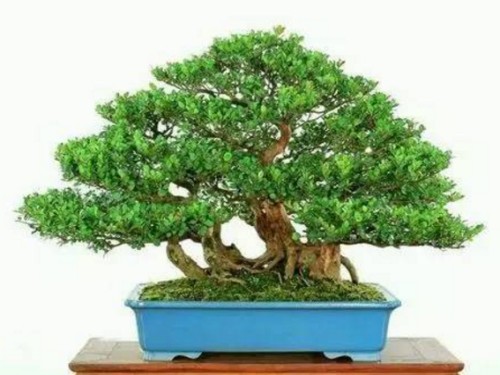
The Syzygium buxifolium plant is relatively short and small, with dense, tough, and pliable branches, and small leaves that are deep green and glossy. It stays verdant through all four seasons. In early summer it blooms with small pink pom-pom-like flowers that set off its melon-seed-like green leaves, giving the tree an extremely graceful form. After old mountain-collected stumps are cultivated and shaped, their horizontal branches can be made to spread out evenly in distinct layers, like piled layers of clouds, rustic and elegantly simple, truly a gem among bonsai materials. Syzygium buxifolium is a mainstream variety among bonsai enthusiasts. As long as you choose good, healthy stumps and care for them properly, a Syzygium buxifolium bonsai can absolutely thrive without decline, and be exquisitely beautiful.
1. Requirements for soil and fertilizer
Syzygium buxifolium is a bonsai tree species that tolerates poor, thin soil, seeks only moisture, does not crave fertilizer, and grows relatively slowly. It requires only ordinary soil that is slightly acidic and has fairly strong moisture retention. If alluvial fine sandy soil with weak moisture retention is used, it most easily causes the Syzygium buxifolium bonsai to dehydrate and wither, or even die. In southern regions, mountain soil can be used as the growing medium. Repotting and changing the soil can be done once every 3~4 years (for medium-sized bonsai), with early April being the suitable time. After changing the soil, water thoroughly, place it in a shady, cool spot, and keep it moist. Once new shoots grow, gradually move it to a place with ample sunlight and rain to encourage vigorous growth. According to the growth habits of Syzygium buxifolium, fast-acting, strong chemical fertilizers can be avoided; instead, use organic fertilizer with stable and long-lasting effects, applying it lightly once a month during the growth period from April to June. Using alum-fermented liquid fertilizer as the main fertilizer can make the Syzygium buxifolium leaves green and glossy, and it is safe and reliable. If concentrated fertilizer or chemical fertilizer is applied, it easily causes fertilizer burn to the roots, resulting in the bonsai shrinking and declining.
2. Sunlight and moisture requirements
Syzygium buxifolium likes light and tolerates shade, and likes high temperatures and high humidity. At the turn of spring and summer, from April to June, it should be placed in a spot with ample sunlight and rain, and the potting soil should always be kept moist, with sufficient water to promote vigorous growth of the bonsai. From late June to August, when the height of summer brings high temperatures, strong direct sunlight can easily crack exposed roots of the bonsai and cause them to dry out. It should be kept in a spot with diffused light. In extremely hot weather, when water evaporates heavily, as long as the potting soil does not become waterlogged, give sufficient water morning and evening, and also spray a mist of water over the plant body 1~2 times to ensure it safely passes the summer. From September to October, many Syzygium buxifolium bonsai have already set fruit. To ensure the fruit is red-purple and glossy, and to enhance the viewing pleasure, place it in a west-to-east-facing position, exposed to sunlight during the day and enjoying the nourishment of autumn dew at night, and control the potting soil moisture appropriately, watering only when dry. In frosty weather, it is best for the potting soil to be on the dry side.
3. Thin the flowers and keep the fruit to promote vigorous, non-declining bonsai growth
Syzygium buxifolium blooms and fruits successively from midsummer into autumn, with fruit persisting until November. It blooms heavily, sets much fruit, and has a long fruiting period. Because the pot is shallow with little soil and limited nutrients, excessive flowering and fruiting consumes nutrients, and the bonsai often develops yellowing and leaf drop, weakening cold resistance and stress resistance, and easily causing some branches to age and partially die back. Therefore, at the start of the flowering period, thin out 2/3 of the flower buds and leave 1/3 to bloom and set fruit. In this way the fruit is plump and glossy, increasing the value of the fruit display, and it can effectively curb partial dieback, keeping the bonsai evergreen and thriving.
4. Prevention and control of pests and diseases
Only very few Syzygium buxifolium bonsai (in relatively shady, poorly ventilated positions) develop white slime mold in autumn that harms small branches. You can scrape off the white slime mold with a bamboo strip and let the bonsai get more sun, which generally controls it. The main insect pest is the tent caterpillar gnawing on tender leaves. You can use a 1200~1500 times dilution of 50% insecticide-moth-killing emulsifiable concentrate or an 800 times dilution of 15% insecticide-emulsifiable concentrate, spraying 1~2 times to kill them. In warm winter and dry climates, red spider mites or sooty mold may occur; you can spray 2~3 times with a 5% laundry detergent solution or a 30% chili pepper infusion to kill them.