What are the care methods for a Buddha's hand bonsai?
Buddha's hand, also known as five-fingered citron, generally grows about 1 m tall. It is evergreen year-round, with green-yellow fruit and a refreshing fragrance. It has now become a valuable ornamental-fruit and ornamental-leaf potted flower, listed as an excellent indoor decoration. When its fruit matures, the carpels separate, forming slender, curved segments shaped like fingers, hence the name Buddha's hand. Its ornamental value differs from that of ordinary bonsai flowers. Pure white and richly fragrant, it blooms in clusters, very endearing. When the fruit ripens, its shape resembles extended fingers, a clenched fist, a fist with fingers, or a hand within a hand, shaped like a human hand, remarkably true to life.
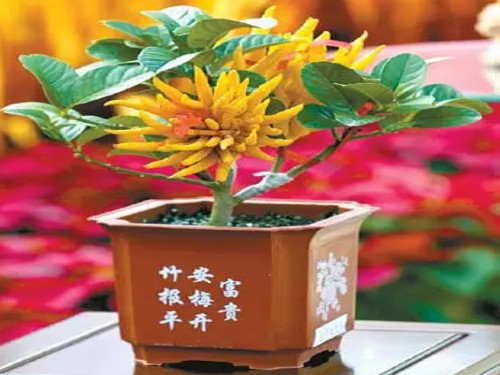
The ripe golden Buddha's hand is golden yellow and constantly gives off fragrance, eliminating odors, purifying indoor air, and inhibiting bacteria. The fruit remains on the plant for a long time, as long as 3-4 months or even longer, allowing long-term appreciation of the Buddha's hand flowers. So how should a Buddha's hand bonsai be cared for? Below is an introduction to the care methods for a Buddha's hand bonsai.
[Watering]
This is the key to managing a potted Buddha's hand well. Normally keep the potting soil moist and water frequently. Summer high temperatures coincide with the vigorous growth period of Buddha's hand, when water demand is relatively high; water once in the morning and once in the afternoon each day, to the extent that the potting soil does not dry out. In addition, spraying water is needed to increase environmental humidity. After autumn begins, the amount of watering can gradually be reduced. In the low-temperature period of winter, it is enough to simply keep the potting soil moist. Special note: when Buddha's hand is in the early stages of flowering and fruiting, watering should not be excessive, otherwise a large amount of flower and fruit drop will occur.
[Fertilizing]
Buddha's hand likes fertilizer. When repotting, apply sufficient base fertilizer. During the growing season, generally apply dilute alum fertilizer water once every half month, and stop applying on rainy days. After the flowering plant forms buds, fertilization should be paused temporarily. Once the young fruit grows to the size of a little finger and the fruit has basically set, then apply a light phosphorus-containing fertilizer water once every 7 to 10 days, for 4 to 5 consecutive times. If Buddha's hand only grows leaves and does not bloom, it is due to too much nitrogen fertilizer; nitrogen fertilizer should be stopped and more phosphorus fertilizer added. If it only blooms but does not set fruit, that is a sign of fertilizer deficiency.
[Flower thinning]
Although Buddha's hand blooms multiple times a year, the flowers that open on the current year's spring shoots around the end of June are mostly bisexual flowers and easily set fruit. Choose moderately long, sturdy short branches with shorter internodes and thicker leaves, keep 1-2 flowers, and remove the rest, to encourage them to grow into large fruit. During the flowering and fruiting period, attention should also be paid to removing new buds sprouting on dry branches to prevent fruit drop.
Issues to note in winter care of Buddha's hand bonsai:
1. In winter, because air conditioning hot air is often running, indoor humidity decreases, the air becomes dry, and the rate of water transpiration from the plant body increases. Also, the indoor air temperature is far higher than the temperature of the growing medium, causing root
growth activity to slow down, while leaf moisture evaporates too quickly, so leaf drop occurs.
Care method: Keep the Buddha's hand bonsai away from the air conditioner. Each day in leisure time, simply use a small spray bottle to spray water in mist form on the Buddha's hand leaf surfaces, increasing the humidity of the air near the Buddha's hand bonsai and slowing transpiration.
2. Control of watering amount
In winter, the growth rate of Buddha's hand slows, so its absorption of water decreases. It is not easy to overwater; water 500 ml per week (a mineral water bottle), divided into two times, about once every three days.
3. Light: try to place the bonsai in a sunny location. If the daytime weather is relatively good, it can be placed outdoors, and brought back in at night.
During the flowering season of Buddha's hand, pay attention to flower and fruit thinning:
If the number of flowers is too large, the flowering period consumes a large amount of nutrients. Flower thinning should be done before the flowers open, keeping the large bisexual flower buds in the middle and removing the other weak flower buds.
The measures to take are:
1. For flower thinning, remove the flowers on the lower part of the tree crown, retain the large flowers at the tips of the fruiting mother branches and the relatively large bisexual flowers in the middle of the flower clusters, and remove the weak small flowers and unisexual flowers.
2. Thin young fruit. Fruit thinning should be carried out in stages. Remove inferior fruit and deformed fruit, and keep good fruit and strong fruit.