Causes of and Solutions for Root Rot in Water-Cultured Dieffenbachia (Alocasia macrorrhizos)
Many gardening enthusiasts run into the problem of root rot in water-cultured Dieffenbachia. In fact, this situation mostly arises because enthusiasts do not understand water-cultured plants well enough. Many enthusiasts think that simply putting the plant's roots into water is enough, but this is actually wrong. Water-cultured plants must go through a series of steps such as root washing, disinfection, and acclimation before they can truly be considered hydroponic plants. For enthusiasts, it often means washing the plant roots clean and then placing them in a hydroponic vessel. Although this can show the effect of water culture for a short time, root rot may appear later on.
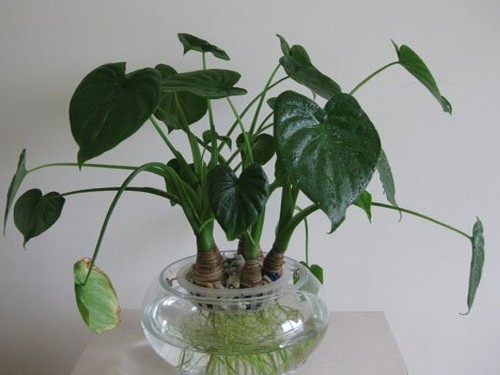
Continuing with Dieffenbachia: water culture of Dieffenbachia is the same as with other flowers and plants. Enthusiasts must remember not to put the rhizome in the water, but rather the roots. In addition, some of the roots should be left exposed so they can come into contact with the air, which helps the roots breathe. See the picture below for details (the picture shows Alocasia 'Qianshou Guanyin', whose habits are the same as Dieffenbachia, so just treat it as Dieffenbachia). The rhizome of Dieffenbachia is outside, and half of the roots it produces are in the water while half are in the air, which is good for root respiration.
For water-cultured Dieffenbachia that has already developed root rot, cut off the rotten parts, then disinfect them if conditions allow, using something like potassium permanganate, or wood ash will also do. After disinfection, let the wound dry in a cool place, then plant it in soil. Wait until the plant returns to normal (has grown roots), and then water-culture it again. If you water-culture it directly after cutting the roots, it will still easily rot again. Enthusiasts can weigh for themselves whether to water-culture after soil planting or to continue with water culture.
[Causes of Root Rot]
Water-cultured Dieffenbachia, because of careful daily maintenance, is mostly in a delicate state, and the cause of root rot may be long-term failure to change the water, which leads to changes in the water, making it difficult to balance acidity and alkalinity, followed by a lack of nutrients, making it unsuitable for the growth of Dieffenbachia roots and causing root rot. Secondly, it may be due to insufficient light, which causes bacteria and pests and diseases to breed on the leaves, making root rot severe.
[Solutions]
Whether soil-cultured or water-cultured Dieffenbachia, once root rot appears, it should be dealt with promptly to avoid the condition spreading and becoming difficult to control. The detailed methods and steps are as follows:
1. Take the water-cultured Dieffenbachia with root rot directly out. For soil-cultured Dieffenbachia, use a small round wooden stick to gently insert around the plant's roots, then carefully separate the Dieffenbachia from the soil until the roots are completely removed, avoiding pulling the roots forcefully.
2. After taking the Dieffenbachia out completely, you can directly use plant pruning tools to cut off the rotten roots, then prune all the branches and leaves of the plant, leaving only the healthy roots.
3. Place the pruned Dieffenbachia roots in clean water to rinse them. After washing off the soil and mud, the roots can be disinfected by directly soaking them in diluted carbendazim or potassium permanganate solution for about 5 minutes. Then take them out, rinse with clean water, and after taking them out place them in a ventilated spot to air-dry for about one day and night.
4. Then prepare a new pot. The best cultivation method for Dieffenbachia after root rot treatment is soil culture. First disinfect the flowerpot, then prepare nutrient soil. At this time the humidity should be about 8%. New soil is the best choice, as it is loose, has a certain air permeability, and contains a lot of sand. The soil should not be too dry. You can choose to water it with rice-washing water.
5. Then bury the treated Dieffenbachia roots in the soil to about two-thirds depth; do not bury them too deep.
6. For later care, avoid excessive moisture. You can maintain about two hours or more of light each day, and adopt the method of "water when dry."
7. For daily fertilizer and water treatment, choose a fertilizer with less irritation to avoid irritating and damaging the roots and causing hard-to-recover damage. Observe frequently. After root rot treatment, Dieffenbachia will sprout new branches in about one month, and at this time the damaged parts from the root rot treatment will also recover. Normally, sufficient nutrients must be ensured, and preventive measures should be taken against various pests and diseases. Dieffenbachia after being regrown from root rot is in a highly susceptible stage, so disinfection can be maintained about twice a month.
8. In the first week after root rot in Dieffenbachia, changes can be considerable, and if after one week it is still wilting and turning yellow, with the roots clearly becoming soft, then it proves that the root rot treatment has failed and the plant is difficult to recover. At this point it should be discarded.