How to grow Cuphea hyssopifolia? A detailed guide to its cultivation methods
Cuphea hyssopifolia, also called purple false heather, belongs to the genus Cuphea in the family Lythraceae and is an upright small shrub. Because of its dense branches and abundant foliage, deep green and glossy leaves that stay evergreen all year round, and its beautiful flowers that bloom continuously throughout the year, it is easy to shape, tolerates pruning well, and has strong landscaping functions and ornamental value.
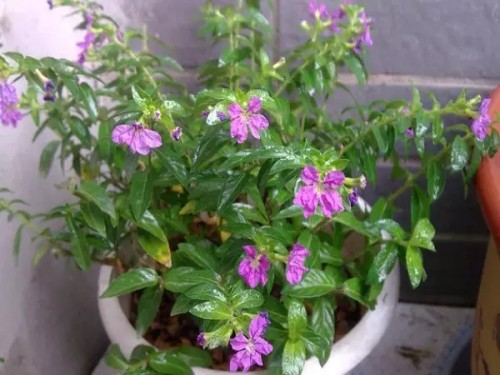
At present, Guangdong, Guangxi, Yunnan, Fujian and other provinces and regions in China have introduced and cultivated it, and it is widely used in landscape greening. It can be used as a low hedge beside garden rocks; it is suitable for planting at the edges of flower borders and flower beds; in open spaces it is best planted in groups, while in small settings it is suitable for clump planting or row planting. Among the green foliage, it looks like a scattering of stars, very pleasant. Planted under tall trees, or combined with evergreen shrubs or other flowers, it can form a beautiful landscape; it can also be planted as ground cover, which can block the spread and growth of weeds, and can also be grown in pots for ornament.
Soil:
Cuphea hyssopifolia prefers well-drained sandy soil. Bag seedlings and potted plants require a fertile, loose medium with good drainage; a mix of 2 parts loam, 1 part peat soil and 1 part sand can be used. For ground planting, pay attention to improving the soil's permeability by adding sand and organic fertilizer.
Light and temperature:
Cuphea hyssopifolia is heat-tolerant and likes high temperatures, is not cold-tolerant, likes light, and can also tolerate partial shade; it grows normally under both full-sun and half-sun conditions.
Fertilizer and water:
Cuphea hyssopifolia is relatively easy to manage. After planting, keep the soil moist; after it recovers, water once every 3-5 days and apply a dilute liquid fertilizer once every 10 days. After it has formed, pay attention to fertilizer and water management.
Pruning:
Cuphea hyssopifolia has strong branching ability; proper pruning increases branching. When the branches are too dense, thin them out appropriately.
Prevention and control:
Poor drainage causes yellowing leaves and leaf drop, which can be solved by improving the soil's permeability.