How to grow potted golden shrimp plant? Detailed care guide
The golden shrimp plant, also known as yellow shrimp flower, coral shrimp plant, golden-wrapped silver, golden-bract shrimp flower, and golden pagoda. It is an evergreen subshrub of the Acanthaceae family, blooming in spring and autumn, with unusual flower shapes. The golden shrimp plant grows 30-50 cm tall, with swollen stem nodes, opposite leaves, and long oval leaves with distinct veins. It gets its name because the yellow bracts on the spike-like inflorescence at the top of the stems are layered one upon another and extend white florets that resemble a shrimp's body.
In fact, the golden-yellow petal-like structures are only bracts that serve a protective function, while the white two-lipped lobed structures growing on the bracts are the true petals. Because of its long blooming period and high ornamental value, the golden shrimp plant has neat clumps, bright yellow flowers, and a long flowering season. It is suitable for decorating conference venues, halls, living rooms, and balconies. In an environment above 15°C, whenever new shoots appear, new inflorescences will form at the tips, so it can be enjoyed all year round.
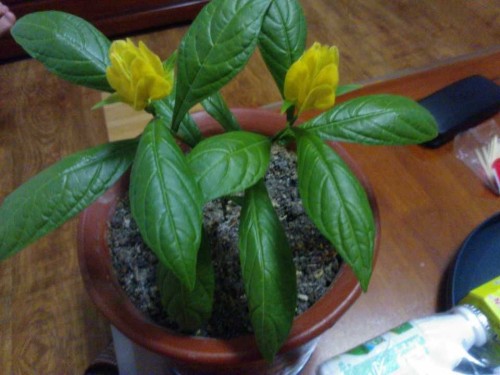
The golden shrimp plant has neat clumps, bright yellow flowers, and a long blooming period. It is suitable for decorating conference venues, halls, living rooms, and balconies. In the south, it is used to arrange flower beds and can also be used in flower borders. In warm regions it can be planted in gardens, while in the north it is grown as a potted greenhouse flower, making it an excellent potted flower variety. Below is an introduction to the care methods for the golden shrimp plant.
[Soil]
It can be mixed with 5 parts leaf mold, 3 parts garden soil, 1 part river sand, and 1 part decomposed organic fertilizer. During the growing season, loosen the soil once every half month, and before taking the plant out in spring each year, repot and change the soil once. The potting soil should be loose, breathable, fertile, and rich in humus. It is commonly mixed with peat soil, leaf mold, or turf soil plus 1/2 perlite or vermiculite, 1/3 river sand, and mixed with a small amount of decomposed cow dung as a base fertilizer.
[Light]
In spring and autumn, it can receive full sunlight. In midsummer, it should be shaded by 30% to 40%, or it is enough to maintain about half a day of light in the morning and evening. In winter, it is best placed in a warm, sunny spot in front of a south-facing window. During the growing period, except for slight shading in midsummer, it should be given sufficient light. This not only makes the plant grow stronger but also reduces disease. Although this flower can also grow fairly well in a semi-shaded environment, if it is too shaded, it will become leggy, and flowering will be delayed and sparse. In addition, the golden shrimp plant prefers sunlight. When grown in the north, it should be placed outdoors for care in spring and autumn, generally without shading, but proper shading is needed around midday in summer. If exposed to scorching sun, the leaves are prone to wilting and the leaf edges to scorching. In winter, placing it in a bright spot in a greenhouse keeps the leaves bright green and glossy, the plant compact, the inflorescences large, and the colors vivid.
[Temperature]
The suitable growing temperature for the golden shrimp plant is about 15°C-25°C. Above 30°C or below 10°C is unfavorable for its growth. In summer, when the temperature reaches above 30°C, a relatively cool environment should be created by building shade and spraying water around it. During overwintering, it requires an indoor temperature of no less than 10°C, otherwise the plant can easily lose all its leaves. Below 4°C to 5°C, it will freeze to death. Plants placed indoors in winter are best warmed with an electric heater.
Low temperatures can easily cause leaf drop, and over time can lead to root rot, and in severe cases the plant will wither and die. Therefore, for households in the north to grow it and have it continue blooming in winter, it should be placed in a greenhouse, with the daytime room temperature kept above 18°C and the nighttime temperature maintained above 10°C, along with appropriate fertilizer and water to achieve this.
In winter, it should be moved indoors to a sunny spot, watering should be slightly controlled, and the temperature must not be lower than 10°C. Otherwise, excessively low temperatures will cause the leaves to turn yellow and drop, and over time will also lead to root rot, and in severe cases even death. In winter, if the daytime temperature is not lower than 25°C and the nighttime temperature is around 15°C, the plant can also bloom, and can be watered and fertilized normally.
[Watering]
During the growing season, not only should the potting soil always be kept moist, but a relatively high air humidity is also required. However, there must be no standing water in the potting soil. In summer and dry seasons, attention should often be paid to increasing the air humidity around the flower pot. During the growing season, not only should the potting soil be kept moist, but a relatively high air humidity is also required. However, there must be no standing water in the potting soil.
In spring and autumn, water once a day. In summer, water 2-3 times a day. You can water once before 10 a.m. each day and once after 3 p.m., and appropriately increase the frequency of spraying the leaves. In winter, just keep the potting soil slightly moist. During the plum rain season, prevent waterlogging and root rot.
[Fertilizing]
During the growing season, generally apply decomposed organic fertilizer once every 15-20 days, or spray with urea + monopotassium phosphate diluted in water. Remember that nitrogen fertilizer must not be excessive, otherwise it easily causes slender flower stems and reduced flowering. During bud formation, spray a 0.2% monopotassium phosphate solution on the leaves, which helps produce more and brighter flowers. During flowering, apply phosphorus and potassium fertilizer twice more to meet the nutritional needs of bud formation and blooming. When the ambient temperature is above 35°C or below 15°C, fertilization should be stopped. If during care the fertilizer is insufficient, plant growth will slow down, leaf color will become dull, and inflorescences will be few and small. In addition, adding 0.1% ferrous sulfate powder irregularly can keep the leaves emerald green and glossy and can also prevent leaf yellowing.
[Pruning]
Newly rooted cuttings should be pinched. When the seedling is about 6 cm tall, pinch once, and when the branches grow to about 4 cm, pinch again to promote branching. One month after pinching, buds can form and flowers can bloom on the new branches. Every spring, pruning should be carried out together with repotting, generally cutting off about 1/2 of the plant height. This not only controls the height and promotes branching, but also prevents the lower leaves from becoming bare and affecting the ornamental appearance.