What to Do If a Potted Giant Taro (Alocasia) Has Root Rot? Detailed Treatment Methods
"Dishuidian" is a commercial name; it is also known as "Dishui Lian" and "Foshou Lian," and other common names include Henyutou, Langdu (Guangdong), wild taro, mountain taro, big-root taro, big-worm taro, Tianyu, Tianmeng, and so on. What is called "calla lily" in Taiwan, China actually refers to Alocasia macrorrhizos. So what should you do if the giant taro has root rot?
Giant taro is prone to root rot in summer, mainly caused by potting soil that is too wet. Pull up the giant taro, cut off the rotten roots, and wear rubber gloves when cutting the roots (giant taro is toxic! Those with skin allergies should be careful.), and cut off a little of the healthy tissue near the rotted part. After cutting off the rotten roots, let the roots dry, and replant after the wounds have healed. Plant it in plain sand, or in sandy loam soil, and do not water for the time being; wait until the potting soil has dried completely before watering. Do the same from then on: if it is not dry, do not water. In addition, place it in a well-ventilated spot.
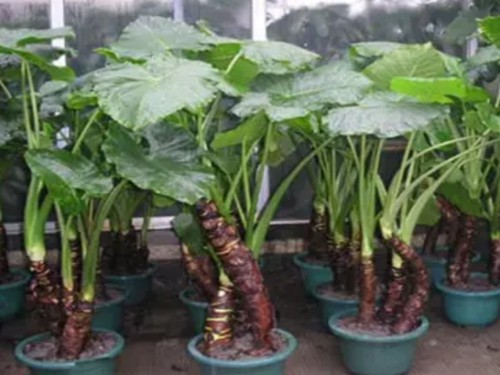
1. Causes of root rot in giant taro
Giant taro can be grown in soil or in water. Root rot in soil-grown giant taro is mainly caused by potting soil that is too wet. When the potting soil is too wet, root and stem rot in giant taro is very likely to occur. The reasons for the potting soil being too wet may be that you watered too much, causing water to accumulate in the pot, or that the soil is highly clayey and has poor air permeability, making it prone to water accumulation itself.
The primary cause of root rot in giant taro is overwatering. Giant taro likes water, but be careful not to let water accumulate in the pot. This is true not only for giant taro but for many flowers: when the potting soil is dry, water thoroughly once, and do not water too frequently.
The second cause of root rot is pests and diseases. If the situation is not too serious, just sprinkle some Fengyoujing (essential balm) around the flowerpot, disinfect, and change the soil. Root rot in water-grown giant taro often occurs mainly because the stem tissue of giant taro is relatively loose; if the water quality is poor, it may cause root rot and stem rot.
2. Solutions for root rot in giant taro
The solutions for root rot in soil-grown giant taro are as follows: pull up the giant taro, cut off the rotten roots, and also cut off a little of the healthy tissue near the rotted part to ensure that what remains is all white. After cutting the roots, be sure to let it dry, and after the wounds have healed, plant it in well-drained, fertile, slightly acidic soil. You can also apply some plant ash to the wounds to disinfect and sterilize them.
It should be noted that the sap of giant taro is toxic, so wear rubber gloves when cutting the roots to prevent poisoning yourself. After planting giant taro in soil, remember to water only after it has dried completely, and if it is not dry, do not water. In addition, keep it in a well-ventilated place for growing.
For hydroponic giant taro with root rot, you should cut off the rotted parts of the roots, wash off the mucus on the tubers and root system, and change the water or nutrient solution. When growing it, be careful to keep the water in the bottle clean.
When you first start growing giant taro, root rot is often caused by pests and diseases or overwatering, causing an originally lush plant to gradually wither. So what should you do if the giant taro has root rot?
Steps:
1. Insert a small wooden stick into the soil beside the root system of the giant taro, gradually separate the soil from the roots, and remove the rotten roots intact.
2. Cut off the rotted root parts.
3. Cut off all the branches and leaves.
4. Put it in clean water and rinse it clean, then soak it in carbendazim or potassium permanganate solution for 5 minutes for treatment, then rinse it clean with clean water, and let it dry in a ventilated place for a full day and night.
5. Disinfect the flowerpot and disinfect the new soil. The new soil must have good air permeability; it is best to choose soil containing more sand.
6. If the new soil is too dry, water it with just a little rice-washing water. From then on, it is better to underwater than to overwater; stick to not watering until it is dry. Do not bury the roots too deep.
7. If the root rot is not too serious, you do not have to follow the above steps. If the rotted part is above the potting soil, you can dig out the rotted part, apply agricultural streptomycin to the wound, and water the roots with diluted carbendazim solution; this should also cure the root rot.
Root rot in soil-grown giant taro is mainly caused by potting soil that is too wet, while root rot in water-grown giant taro is greatly related to water quality. As for solutions, for soil-grown giant taro, pull up the giant taro, cut off the rotten roots, let it dry, and after the wounds have healed, plant it in well-drained, fertile, slightly acidic soil; while for water-grown giant taro with root rot, cut off the rotted parts of the roots, wash off the mucus on the tubers and root system, and change the water or nutrient solution.