How to Deal with Root Rot in Clivia? A Few Remedies to Save It
Once root rot strikes a flowering plant, it quickly causes the above-ground parts to wither and die. If the rot is non-infectious, the plant should be taken out of its pot as early as possible, the rotten roots cut off, and after repotting it should be placed in a semi-shaded spot and cared for carefully. If it is discovered early and treated promptly, it can be saved; but if too much time has passed and the plant has lost too much water, there is no way to save it.
Clivia has bright, showy flowers and high ornamental value, but growing Clivia is not so easy and requires solid cultivation skills. When Clivia suffers root rot, no matter how promptly you try to rescue it, it will cause irreparable damage to the plant's growth and flowering, and it will take quite a long time to fully recover its vigor. Therefore, you should usually do the preventive work as well as possible to avoid root rot in Clivia. What are the main measures to prevent root rot in Clivia?
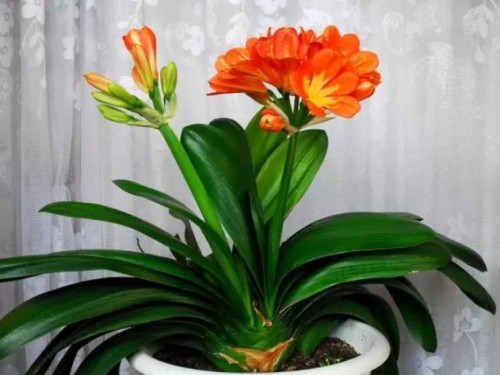
Here are the measures to prevent root rot in Clivia:
1. Make a good growing medium
Practice has shown that mixing 4 parts peat soil, 4 parts leaf mold and 2 parts coarse sand produces a loose, fertile, acidic growing medium with good drainage and aeration. Using this growing medium to plant Clivia favors a well-developed, robust root system and can effectively prevent root rot.
2. Choose a suitable pot
A clay pot with good water absorption and aeration is more suitable, especially a tall cylindrical clay pot, which not only allows the Clivia roots to extend downward but also, because the distance between the pot wall and the roots is small and water seeps away quickly, keeps the soil around the roots from staying wet for too long. The size of the pot should be changed as the Clivia plant grows and develops; it is not advisable to plant a small seedling in a large pot or cram a large plant into a small pot.
3. Do not water too much or too often
Water only when the surface of the potting soil is dry; after one thorough watering, you can go several days without watering. If the potting soil's water content stays too high for a long time, the Clivia's fleshy roots are prone to rotting. In spring and autumn, when Clivia grows vigorously, you can water a little more. In summer, strictly guard against waterlogging from prolonged rain. In winter, decide according to indoor temperature and humidity; generally water about once a week.
4. Fertilize moderately
Clivia does not need strong fertilizer, and especially not raw fertilizer that has not been fully decomposed. Do not fertilize during the high-temperature summer season. During the normal growing period, you can water with a fully decomposed, dilute organic liquid fertilizer about every 10 days, and you can also spray a solution of 0.2% urea and 0.1% potassium dihydrogen phosphate as a foliar feed.
Now let's talk about what to do when Clivia already has root rot. First, don't be nervous or anxious; as long as the base is still there, it can still be saved. Read the following carefully:
The way to rescue a plant with root rot is to tip the plant out, remove and cut off the rotten roots, then coat the wounds with charcoal powder or fine stove ash. You can also rinse the roots with potassium permanganate water and then put them in the sun for about ten minutes, using ultraviolet light to sterilize. If more than half the roots have rotted, trim and clean up the rotten roots, and after sterilizing and disinfecting, you can put the plant in fine sand to encourage rooting. If only a few roots have rotted, you can transplant it into replaced, treated nutrient soil, control watering for half a month, and it can recover after one or two months.
If the fleshy roots have all rotted away, you can cut off all the rotten roots, wash the rhizome clean, coat it with charcoal powder or fine stove ash, and put it in a pot of fine sand to encourage rooting. After two or three months, it can also grow new roots and leaves again.
In addition, using decomposed leaf soil as the growing medium to rescue a Clivia with root rot also works well. The specific method is to wash the fleshy roots twice with clean water, then pinch off the rotten roots, coat the wounds with cigarette ash, let them dry in the shade for two hours, then plant them in a pot of coniferous humus soil, place it in semi-shade, water at the right times, and keep the potting soil moist; after half a month new roots will grow.
When growing Clivia, observe it often; if you find signs of root rot, treat it immediately. Take the plant out, remove the rotten roots, rinse the roots with 1% potassium permanganate water for disinfection, or apply some charcoal powder to the affected areas, and sun the roots in a greenhouse for about 30 minutes. If more than 50% of the roots have rotted or all of them have rotted, after treating them by the above method, use river sand to encourage rooting. The rooting temperature should be higher than the usual temperature, generally controlled at around 22-30°C; after about 2 months new roots will grow, and then you can transplant it into a pot of nutrient soil.