Reasons and Solutions for Yellowing Leaves on Sago Palm Bonsai
As the saying goes, “even the sago palm has bloomed.” In fact, getting a sago palm to bloom is very difficult; generally only trees that have been grown for twenty or thirty years will bloom, and the blooming period is from June to August. Although the sago palm rarely blooms, its leaves are very impressive and magnificent, so the sago palm is also often kept as an excellent foliage plant.
At the mention of the sago palm, a large cluster of green leaves comes to mind, with hard leaves and a thick, sturdy stem. The appearance of the sago palm gives people the impression of being as hard as iron, so in people's minds the sago palm is a plant that is especially easy to keep alive, and traces of it can be seen everywhere in daily life. The sago palm is a beautiful ornamental plant, with a graceful tree shape, vigorous and simple character, and large, beautiful leaves that are lush and deep green all year round. But who would have thought that sago palm leaves could turn yellow? What is going on here? Today, follow the editor to learn about it.
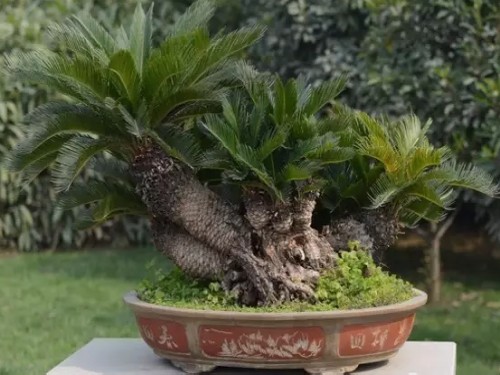
Insufficient light: Sago palms are often used as ornamental trees, but people often plant them indoors to purify the air. However, over time, the sago palm lacks photosynthesis, and its leaves turn yellow. The sago palm is a sun-loving, drought-tolerant and barren-tolerant plant. If it is kept indoors for a long time, its leaves will turn yellow. It should be moved outdoors during the day to get sunlight and moved back indoors at night; this way, the sago palm can stay vigorous!
Excessive light: This is the simplest cause of yellowing sago palm leaves. The sago palm likes a sunny environment and a warm, humid environment, so it should usually be placed in a spot with sunlight. However, the sago palm cannot tolerate harsh sun exposure; especially new leaves are easily scorched and turn yellow, so during the new leaf stage the sago palm must be given some shade.
Improper fertilization: Many people who love their trees dearly always worry that the sago palm is undernourished and often fertilize it, but this inadvertently causes nutrient excess, root rot and yellowing leaves. When fertilizing the sago palm, compound fertilizer must not be applied to the main root; only a very small amount can be evenly applied under an inch of soil at the edge of the pot. If there is root rot, the sago palm should be dug up and the soil rinsed off the roots with water.
Yellow spot disease: also called chlorosis. The cause of the spot disease may be that the planting soil is too alkaline and low in iron content. In the early stage it may be a physiological disease, and in the later stage it may be accompanied by infection by weakly parasitic fungi, causing sago palm leaves to turn yellow. The sago palm should be moved to soil rich in iron, and “carbendazim” should be sprayed in an appropriate amount.
Other causes of yellowing sago palm leaves and treatment methods:
1. Water yellowing: caused by watering too frequently. Its characteristics are that the old leaves show no obvious change while the young leaves turn yellow; watering should be stopped immediately.
2. Drought yellowing: caused by lack of water and drought. Its characteristics are that the old leaves turn yellow first from the bottom up; if the lack of water lasts a little longer, the whole plant's leaves will turn yellow, or it may even die, so it should be watered in time.
3. Fertilizer yellowing: caused by fertilizing too frequently or with too high a concentration; its characteristics are that the young leaves are thick, glossy and uneven; fertilization should be stopped, and the soil should be cultivated and watered.
4. Starvation yellowing: caused by insufficient fertilizer, too low a fertilization concentration, and too long an interval between fertilizations; its characteristics are that the young leaves and tender stems turn yellow first. If this phenomenon is seen and fertilizer is not applied in time, it can also cause the whole plant's leaves to turn yellow or even die; for flowers lacking fertilizer, never apply a large amount of concentrated fertilizer at one time, so as to avoid burning the roots.
5. Iron-deficiency yellow leaves. For woody flowers in greenhouses, because soil fertility conditions vary greatly, yellow leaves often appear. The characteristics are that young leaves are obviously affected while old leaves are less so, the leaf flesh is yellow, the leaf veins are green, and a typical network forms; this can be solved by applying ferrous sulfate aqueous solution. The method is: mix 7 parts cake fertilizer, 5 parts ferrous sulfate and 200 parts water into a diluted solution and water with it.