How to grow variegated star jasmine in pots? Detailed guide to cultivation methods
Variegated star jasmine (Trachelospermum jasminoides 'Variegatum'), its leaves are flowers in themselves. Variegated star jasmine can be propagated by cuttings in any season of the year, but spring and autumn are generally chosen, because in these two seasons the rooting rate can reach over 98%. During the year, from March to August, nitrogen fertilizer can be applied as the main fertilizer to promote plant growth, while by September and early October, an appropriate amount of phosphorus and potassium fertilizer should be applied as a top dressing, which can promote robust plant growth; then starting in October, pruning must be stopped to avoid damage to the branches and leaves of variegated star jasmine.
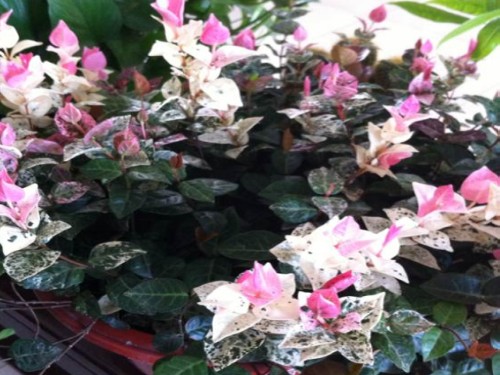
Variegated star jasmine is one of the excellent garden landscaping ground-cover tree species newly developed and strongly promoted in Japan. With its bright colors, strong vitality, excellent resistance and extensive cultivation management, this variety stands out among existing garden landscaping ground-cover plants.
So how can it be grown well?
First, you need to know that the most suitable environment for growing it is well-drained acidic or neutral soil; it has strong disease resistance and grows vigorously. At the same time, it also has strong drought tolerance and resistance to short-term flooding and cold, and the color change of its leaves is related to light and growth conditions, while the display of brilliant colors also requires good light conditions and vigorous growth conditions.
Generally, we can propagate it by cuttings in any season of the year, and if it is in spring and autumn, its rooting rate will reach over 98 percent. Taking cuttings in summer will cause some of the more tender branches to rot, but branches that have reached semi-lignification can all take root and survive. It can be cultivated in large quantities in a semi-shaded, loose and fertile environment; when the plant has reached a certain length and has more branches, it can be transplanted to a place with stronger light conditions for cultivation, which can achieve brilliant leaf color.
We can also cultivate it south of the Yangtze River basin; in order to overwinter safely, we can also take appropriate protective measures, for example, increasing light for it, and from March to August we can also fertilize it, which will further promote plant growth; from September to early October we can also apply top dressing appropriately to promote the plant's robustness, and starting in October pruning must be stopped. If it is kept as an indoor potted ornamental plant, then any region can be chosen, especially a region with good light conditions, which is more suitable for its growth.
The editor believes that as long as you do the above points, the variegated star jasmine you cultivate will surely be more beautiful and more vibrant.
The main ornamental effect of variegated star jasmine is the color group formed by red leaves, pink-red leaves, pure white leaves, variegated leaves and green leaves. To achieve such a perfect effect, it must be carefully tended and well cultivated. Below is an introduction to the care methods for variegated star jasmine:
Placement location: Star jasmine bonsai should be placed in a slightly shaded place with relatively humid air. In winter it can tolerate a little cold, and moving it to an ordinary indoor location is enough.
Watering: Star jasmine likes shade and moisture, but dislikes waterlogging. Usually the pot soil should be kept moist, not too dry, and care should also be taken not to let water accumulate in the pot.
Fertilizing: During the spring and summer growing period, organic liquid fertilizer can be applied regularly, such as fully decomposed cake fertilizer water.
Pruning: At any time, cut off residual branches and dead leaves as well as overly long and overly dense vines, so as to maintain a certain shape.
Repotting: Repot once every 2~3 years, preferably before sprouting in spring. Retain 1B2 of the old soil, replace with fertile, loose humus soil, and line the bottom of the pot with a layer of coarse sand or vermiculite to facilitate drainage.