Reasons for Yellowing and Leaf Drop in Goji Berry (Lycium chinense) Bonsai and Their Solutions
Goji berry is a nourishing Chinese herbal medicine. The plant has strong suckering ability, and people have grown it as potted specimens for appreciation since ancient times. Ordinarily, the drooping goji branches look very elegant, its flowers are purple, and after autumn arrives red fruits adorn the branches; it looks great whenever viewed.
The goji berry has strong branching ability and vigorous new growth. Every year before bud break in early spring, old branches should be cut off; in summer, remove water sprouts; in autumn, remove old branches and diseased or pest-infested branches. Pruning can reduce pests and diseases, enhance ventilation and light penetration, and lower nutrient consumption. For newly planted goji seedlings, when the trunk reaches 60 cm high, pinch off the top and select and keep 3 to 5 side branches. In the second year, cut the selected 3 to 5 side branches back to 30 cm to form the first tier of the canopy. In subsequent years, continue training it to form a three-tiered "floor-upon-floor" canopy, increasing the fruit load. If making a bonsai, before bud break in the second spring you can cut sturdy goji branches into cuttings to root; the following year they will bloom and bear fruit.
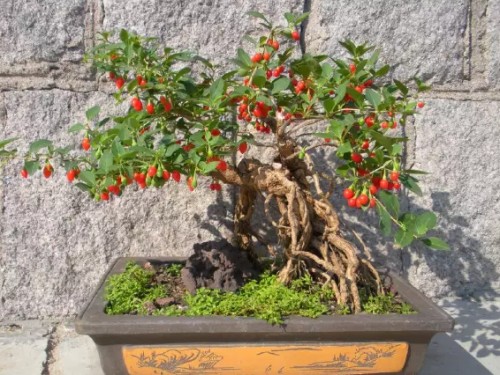
The main causes of yellowing and leaf drop in goji berry bonsai are overwatering, hardened pot soil, or excessively dark conditions.
1. Hardened, water-impermeable soil prevents the water after watering from penetrating into the soil layer, so most of the root system cannot absorb water and nutrients, causing the leaves to lose water and nutrients and develop yellowing and leaf drop. The best remedy is to loosen the soil appropriately, which helps make the soil loose and airy and improves drainage, benefiting root growth.
2. Goji berry is a sun-loving plant. If kept indoors for a long time, it easily develops yellow leaves and leaf drop. If kept indoors, it is best placed in a sunny, well-ventilated spot indoors to benefit photosynthesis. When you have time, it is better to move it outdoors to bask in the morning and evening sun for 2 hours.
3. Yellowing leaves and leaf drop caused by overwatering: ordinarily, watering should not be too wet. Overly wet soil easily accumulates water, causing root rot and yellowing leaves and leaf drop. It is best to keep the soil watered only after it dries, following the rule of not watering until dry, which benefits root growth and makes yellowing leaves and leaf drop less likely.
However, it is worth noting that now is the season when goji berries drop their leaves; normal care and management are all that is needed. After half a month, new buds will sprout, and at that time flowers and leaves grow together. Pay attention to water and fertilizer management, and in autumn the branches will be full of red fruits and lush green leaves.
As long as we routinely do the daily care work for goji berry bonsai, we can not only avoid yellowing and leaf drop but also make it flourish with abundant branches and leaves, lush and vivid. Below, let us learn the care methods for goji berry bonsai:
1. Placement: Goji berry should be placed in a spot with ample sunlight. If placed in shade, it will be unfavorable for flowering and fruiting. In summer, avoid direct sun; in winter it can withstand cold, and can overwinter outdoors above -10°C.
2. Watering: Ordinarily, water according to the principle of "dry-wet alternation"; follow the rule of not watering until dry, and when watering, water thoroughly. During the flowering and fruiting period, pay attention to watering in moderation to prevent excessive dryness or wetness.
3. Fertilizing: Apply light fertilizer frequently. In early summer and early autumn, combined with leaf picking, apply one somewhat stronger fertilizer each time to promote new leaves and flower buds. Before bud break and after fruiting, fertilize appropriately to make the fruit large and the plant robust. Never apply fertilizer too strongly or fertilize during the flowering period.
4. Pruning: Carry out major pruning and shaping every winter and spring. At ordinary times, cut off diseased branches and dense branches at any time to maintain a certain tree shape. Remove suckers promptly.
5. Repotting: Do it once every 1-2 years, preferably in early spring. When repotting, remove half of the old soil and replace it with loose, humus-rich potting soil; you may apply a little base fertilizer. Cut off dead roots and some overly long old roots. Repotting and changing soil is very important. If repotting is not done for many years, the pot soil becomes compacted and drainage is poor, which will seriously affect the tree's vigor.
6. Pest and disease control: The main diseases of goji berry are powdery mildew and black fruit disease, which can be controlled with 0.3-0.5 Baume lime sulfur mixture. In the early stage of disease, fungicides such as carbendazim, thiram, mancozeb and triadimefon can be used alternately for control. The main pests include aphids, psyllids, and gall mites that eat the leaves; they can be controlled by spraying 90% trichlorfon crystal solution, 50% phoxim emulsifiable concentrate, 40% omethoate, fenpropathrin, and other new insecticides and acaricides.