Reasons for Leaf Drop in Ficus Bonsai and How to Solve It
Ficus bonsai refers to potted ficus plants created from ficus material for ornamental purposes through various shaping techniques. Ficus has very strong vitality and is easy to care for, but sometimes problems arise, such as leaf drop.
Nowadays many enthusiasts enjoy growing ficus bonsai, because the shapes of ficus bonsai are very beautiful, and among the many plants its form is especially appealing. However, many people have no idea how to grow ficus, and many also run into problems when planting ficus that lead to its death. Garden enthusiasts often encounter the problem of leaf drop in ficus during cultivation, and truly do not know where to start or how to find a solution.
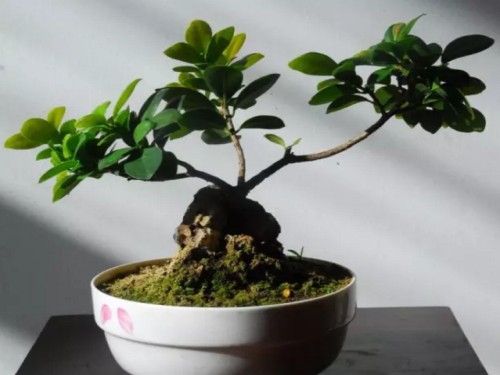
How to prevent and treat leaf drop in ficus bonsai? For this situation, we can summarize the following 6 prevention and treatment measures for ficus bonsai leaf drop:
1. When buying, choose a healthy, long-established potted plant with spreading leaves, deep green and glossy, and free of pests and diseases throughout the plant, and the growing medium should be loose, fertile and airy. It may be that the ficus itself is not healthy enough, or that it does not adapt to the environment after being brought home. Therefore, when buying, choose a healthy bonsai with spreading leaves, deep green and glossy, and free of pests and diseases throughout the plant, and the potting soil should be loose, fertile and airy. After bringing it home, place it in a brighter indoor area or in a courtyard, at a temperature between 10°C and 30°C with little fluctuation, no lower than 5°C in winter, no higher than 35°C in midsummer, and pay attention to ventilation, frequently misting the leaves, etc.
2. Place it in a brighter indoor area, at a temperature between 10°C and 30°C with little fluctuation, no lower than 5°C in winter, no higher than 35°C in midsummer, and pay attention to ventilation, frequently misting the leaves, etc. After Grain Rain and before Cold Dew, it can also be kept outdoors, with slight shading in midsummer. Note that in a dry indoor environment it should be kept away from heat sources, especially at low temperatures.
3. Apply thin fertilizer frequently, mostly applying dilute cake fertilizer water or alum fertilizer water, and intermittently spraying 0.3% urea water, 0.3% potassium dihydrogen phosphate solution, etc. Avoid applying concentrated fertilizer or raw fertilizer.
4. Control leaf drop. Once the ficus drops leaves, spray 95% fruit-setting-prevention wettable powder at 50000 times dilution, plant cytokinin 0.4% wettable powder at 800 times dilution, etc. When fertilizer and water are sufficient, gibberellin at 20 mg/kg water solution can also be sprayed for control, and in severe cases once or twice a week. At the same time, soil, fertilizer, water and management should also be considered comprehensively and treated according to the symptoms.
5. Actively prevent and treat pests and diseases. Duoxiaoling 14.5% water-soluble powder at 150 to 200 times dilution, or 20% Tubao wettable powder at 500 times dilution, etc. can be used to drench the roots, once every 20 days. Apply 3% carbofuran granules to the roots, 5 grams to 10 grams per plant, once every 20 days to control insect pests. Spray 70% thiophanate-methyl wettable powder at 1200 times dilution, etc. on the leaves to prevent and treat leaf diseases.
6. Prevent leaf drop. Spray cytokinin at 50 mg/kg water, 0.01% Fuzi at 300 to 400 times dilution and other solutions, once every 15 to 20 days. During the vigorous growth period in spring and autumn, 15% paclobutrazol wettable powder at 300 to 500 times dilution can also be sprayed once or twice. When the air is dry or during drought, high-fat film concentrated emulsion at 200 times dilution can also be sprayed, etc. Before changing environments or to strengthen the tree's vigor, 5 ppm to 10 ppm ABT No. 3 rooting powder solution can be used to drench the roots.
A reminder from the editor:
Ficus bonsai should generally be placed in a ventilated and well-lit spot. In daily care, pay attention to watering, fertilizing, pruning, and preventing and treating pests and diseases. The ficus needs a certain amount of ambient humidity; otherwise, if sunlight is insufficient, ventilation is poor, and there is no certain ambient humidity, the plant is prone to yellowing and drying out, leading to pest and disease problems, and even death.