Causes and Solutions for Yellowing Leaves on Elm Bonsai
Elm, especially old elm stumps growing in the wild, has endured years of human chopping and carving, or wind and rain erosion and animal gnawing, gradually forming many different strange postures. Some have gnarled roots and are vigorous and ancient-looking; some turn decay into magic, with dead roots and new leaves, presenting a unique scene, making them excellent material for making bonsai. Its tree form is beautiful, its posture elegant, its bark mottled, and its branches and leaves fine and dense, giving it high ornamental value. In gardens, it is very suitable whether planted as a solitary specimen, in groups, or combined with pavilions and arbors; as a shade tree, street tree, or bonsai, it all has good ornamental effects.
To care for elm bonsai, it should be placed in a sunny, well-ventilated environment. But many people have reported to the author that their elm bonsai often shows yellowing leaves and leaf drop, yet they do not know where the problem lies. This article introduces the causes of yellowing leaves on elm bonsai.
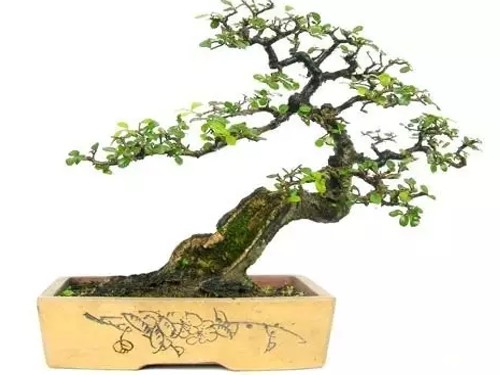
Causes of yellowing leaves on elm bonsai:
1. Temperature too low, causing physiological yellow leaves
2. Water quality too alkaline. Generally this situation is rare; just add a little vinegar and it will be fine.
3. Too little light. This reason is very simple: photosynthesis.
4. Normal alternation of new and old leaves.
5. Caused by root rot due to long-term watering or too much rain, and poor drainage at the bottom of the pot. It is recommended to loosen the soil immediately, water again only after the potting soil dries, and not fertilize at the roots in the short term.
6. Caused by lack of trace elements due to not changing the soil or applying organic fertilizer for many years. It is recommended to replace part of the soil or water with trace element fertilizer.
7. Caused by rotten roots. If the roots are completely rotten, there is probably no saving it. If a small portion of the roots is not rotten, there may still be hope. Just plant it in the ground to cultivate it for a period of time and then pot it again. However, in winter, pay attention to protection and water less, and that will be fine.
The causes of yellowing leaves also include the following:
Insufficient sunlight, overwatering causing root suffocation and root rot, and fungal diseases on the leaf surface. This one of your friend's looks like root suffocation or root rot caused by insufficient sunlight or overwatering.
Identification of leaf surface fungal diseases:
There are two common types: yellow leaf disease, in which the entire leaf goes from light green to light yellow and then falls off; and spotted leaf drop disease, in which brown spots appear on the leaf surface and the leaf falls off only after a long period of time. Please refer to this to determine which cause it is, so as to suit the remedy to the case.
Care notes:
1. Sufficient light is needed
Elm likes light and can only grow well in a sunny place. If light is insufficient, its growth is slow, branches are thin, leaf spacing is long, leaf color is pale, and fibrous roots are few and weak. Summer is the golden period for elm root development; enhancing light will promote vigorous life activity, speed up photosynthesis and metabolism, and make the stump roots further developed and thicker. Moreover, ordinary home flower-growing sites will not have sunlight from morning to night, so there is no need for shading. Even in places with longer sunlight such as rooftop platforms, as long as water is supplied in time in summer, it is impossible for harm to come to the elm bonsai. Whether the root system of an elm bonsai grows well depends entirely on whether there is sufficient light.
2. Prevent waterlogging
Too wet: elm is most afraid of soil that is too wet. Summer is no exception; slightly dry is harmless, but too wet is very harmful. Elm is more tolerant of drought than of moisture. The reason many elm bonsai (especially new stumps) die in summer is mostly excessive watering. Too much water with high temperatures, or improper control of fertilizer concentration, causes the root system to slowly rot until it completely rots, causing the elm bonsai to die in summer.
3. Do not prune heavily
In addition to dissipating heat through water evaporation, the plant's leaf transpiration and heat regulation function is very important. Therefore, in summer, never carry out large-area pruning of elm branches and leaves, so as not to damage its normal regulatory function, causing water in the potting soil to fail to evaporate and the root system to suffocate and rot. In mild cases, it will be difficult to restore normal growth for a time; in severe cases, it will soon die.