A Detailed Guide to the Care of Buddhist Pine (Podocarpus macrophyllus) Bonsai with Needle-like Leaves
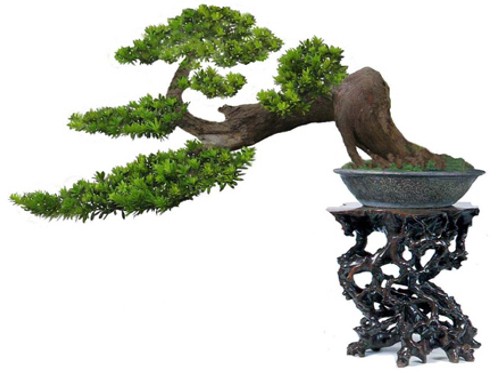
The Buddhist pine bonsai has a lush, elegant, and vigorous tree form, with leaves that stay fresh green all year round, giving a sense of strength and purity. If combined with rocks, shaped into an eagle-claw-embracing-rock posture, it becomes even more antique and distinctive. Grouping Buddhist pine with bamboo and rocks makes an extremely elegant scene. A forest-style Buddhist pine bonsai, paired with grazing scenery, can give the enjoyment of wild charm. If cultivated properly, it can thrive for decades or even a hundred years without decline, becoming an absolutely superb Buddhist pine bonsai.
The needle-leaf Buddhist pine is an evergreen small tree of the Podocarpaceae family, and it is a variety that has mutated through long-term pot cultivation. It stays green all year round, with needles like pearls. Its color is fresh green, its branches and trunk are vigorous, and its lifespan is relatively long. It is a commonly used tree species for making bonsai, with an exquisite tree shape, and is a precious tree species for bonsai making. The needle-leaf Buddhist pine prefers a mild and humid environment, is relatively shade-tolerant, and likes fertile, loose, well-drained, slightly acidic sandy loam. In view of these characteristics, it is not difficult for us to do a good job in the care of needle-leaf Buddhist pine bonsai.
1. Soil
The growing medium can be made from 2 parts forest leaf mold, 2 parts mountain soil, 2 parts humus soil, 2 parts pond mud, and 2 parts decomposed manure, fully mixed, sun-dried for several days, finely crushed and sifted. When potting, decomposed oil cake powder and dried pig manure can also be mixed with a small amount of growing medium.
2. Light
The Buddhist pine belongs to the neutral to shade-leaning tree species. It can accept relatively strong light and can also grow in a relatively shady environment. Although summer temperatures are high and sunlight is intense, because large Buddhist pine trees benefit from high temperature and strong light in maintaining their tree form and leaf shape, there is no need to shade large Buddhist pine trees in summer. However, because Buddhist pine seedlings have tender tissues, they should not be exposed to strong light for long periods, and it is best to keep them under tree shade for care.
3. Temperature
The Buddhist pine likes warmth and has weak cold resistance. When the winter temperature drops to 13°C, it enters a dormant state, and at this time the minimum temperature should not be lower than 10°C.
4. Watering
The Buddhist pine is tolerant of shade and moisture. During the growing period, it should be watered frequently, but it should not be waterlogged. In summer, water should often be sprayed on the leaf surface to keep the leaf color fresh green and the growth good.
5. Fertilizing
A shaped bonsai should not be fertilized too much. In spring, apply 1 to 2 times of thin cake fertilizer water as appropriate, and stop fertilizing in autumn to avoid sprouting autumn buds, which is unfavorable for overwintering.
6. Pruning
The Buddhist pine can be pruned all year round, mainly cutting off leggy branches and diseased or dead branches to maintain a beautiful tree shape. When it blooms, it is best to remove the flower buds in time to avoid fruit formation consuming nutrients and affecting growth vigor.
7. Repotting
It can be repotted once every 2 to 3 years, preferably in March to April in spring. When repotting, replace 1/2 of the old soil, and at the same time cut off dead roots and spread out the fibrous roots. If the plant has grown larger, it can be moved to a larger pot. In addition, combined with repotting, the roots can be gradually raised and attached to rocks to create a raised-root style or rock-attached style bonsai.
When repotting, replace 1/2 of the old soil, and at the same time cut off dead roots and spread out the fibrous roots. If the plant has grown larger, it can be moved to a larger pot. In addition, combined with repotting, the roots can be gradually raised and attached to rocks to create a raised-root style or rock-attached style bonsai.
8. Pests and Diseases
Common diseases include sooty mold and leaf spot. A 0.5% to 1% Bordeaux mixture can be used. One month before the plum rain season, spray once every 10 days for 3 consecutive times to achieve control. The main pests include bagworms, red wax scale insects, and red spider mites. They can be killed by spraying with 1200 to 1500 times diluted dichlorvos solution, or with 1500 times diluted 40% dimethoate solution.
9. Placement
The Buddhist pine has a tall and upright, clear and elegant spirit, displaying a plain, steady, majestic, and vigorous proud momentum. Its tree form spreads out, like a magnanimous host, waving both arms, smiling to welcome guests and modestly seeing off friends, matching people's moods with an endless fairy-like charm. Therefore, it is not very suitable for placement inside the home, and if placed on a balcony, it also requires a spacious area.