Reasons and Solutions for Leaf Drop in Ficus Bonsai
Ficus bonsai is one of the most common bonsai. It stays green all year round, has a graceful shape, and is relatively easy to care for. After caring for ficus bonsai over the past few years, I feel that its most common problem is that it tends to drop leaves. Once, my daughter moved one of the ficus bonsai into a room, and it had only been there for 2 days. By the 3rd day, it had dropped a large number of leaves, which frightened her into quickly moving it back to the yard. I carefully checked the potting soil: it was moist, neither lacking water nor waterlogged. It was autumn at the time, and the room temperature was neither high nor low. So what exactly caused the leaf drop?
According to my analysis: first, the air in the room does not circulate as well as in the yard; second, the light in the room is dimmer, without enough indirect light; third, when the ficus bonsai was moved from the yard into the room, the temperature difference was too great (this point is the main factor). Together, these three points caused the ficus bonsai to drop a large number of leaves.
We know that ficus is a tropical tree species that likes warmth, plenty of sunlight, moisture, and a well-ventilated environment. In our daily care, we should follow these habits of ficus and create an excellent environment suitable for its growth so that it can grow vigorously. Below are several key points for cultivation:
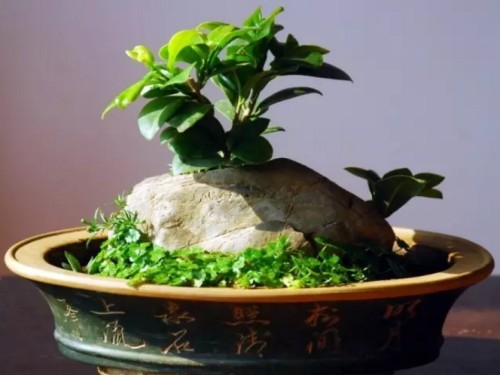
1. Soil: Be sure to use loose soil with good water permeability, and cover the surface of the pot with a layer of moss, which is both attractive and very helpful for drainage and aeration.
2. Sunlight: Ficus likes plenty of sunlight, which can make the plant strong. Even without direct light, there should at least be bright indirect light. Of course, in the height of summer, it is still necessary to avoid the intense sunlight to prevent the leaves from being scorched. If it is placed in too shady a location, it will definitely develop yellow leaves and drop leaves.
3. Temperature: Ficus likes warmth. In winter, the minimum should be kept above 5°C, otherwise it will not just lose leaves but die. Especially in the north, it should be moved indoors for protection.
4. Moisture: Ficus requires moist potting soil, so how moist should it be when watering? For example, soak a towel in water, then take it out and shake it straight, letting it drip naturally. When it stops dripping, the moisture contained inside the towel at that moment is the "moist" state. Similarly, after the potting soil has been watered, the excess water will flow out from the bottom of the pot, and at that time the potting soil in the pot is in a moist state. Therefore, watering ficus should follow the principle of "water when dry, stop when wet." In other words, do not water at will. Instead, wait until the surface soil is dry 2--3 cm before watering, and water until water overflows from the bottom of the pot; only then is it considered thoroughly watered. If the potting soil is too dry or too wet, it will cause yellow leaves and leaf drop.
5. Humidity: This humidity of course refers to air humidity. In the case mentioned above where my daughter moved the ficus into a room and caused leaf drop, insufficient humidity was also a reason. Therefore, it is necessary to regularly keep the placement area moist, and the only way is to spray water on the branches, leaves, and around the area. In our country's north, the air is relatively dry, so this task is even more important.
6. Fertilizer: Ficus likes fertilizer. During the growing season, every 10 days to half a month, apply a complete-element compound fertilizer at 500 times dilution. Lack of nutrients is also a factor in ficus leaf drop and should not be ignored.
Ficus bonsai refers to potted ficus that uses ficus as material and aims to display the form of the ficus trunk and the strange forms of its roots, stems, and leaves. Through pruning, branch shaping, wiring, or grafting techniques and careful cultivation, its growth and development are controlled over the long term to make it a unique artistic bonsai. It is a magnificent and rare flower among ornamental bonsai, suitable for indoor decoration, courtyard display, and can also be displayed and enjoyed in squares, in front of doors, along roads, and other places, and is deeply loved by people from all walks of life.
"I bought a ficus bonsai last week. When it first arrived home, it was still lush and green. Before many days passed, I found that the leaves began to turn yellow from the bottom and drop. I tried putting it in the sunlight and it still dropped; I put it back in indirect light and it still dropped; I watered it thoroughly and it still dropped. I really do not know what to do!" The potted ficus at home is dropping leaves. Why is it dropping leaves? What should be done? Today, the editor will explain several possible causes and solutions for everyone.
Why does ficus bonsai drop leaves? The main reasons for leaf drop in ficus bonsai are:
1. Improper watering. When watering ficus, be sure to stick to the principle of not watering when not dry, and watering thoroughly when watering. The dryness here refers to the surface of the potting soil being dry, not the potting soil being completely dry. Of course, even if it is completely dry, it will not cause much harm to the ficus in a short time, because ficus leaves are thick and small and have a certain drought tolerance.
2. Improper fertilizing. Ficus should be fertilized with light fertilizer applied frequently. Avoid using high-concentration chemical fertilizers or organic fertilizers that have not been fermented and decomposed, otherwise fertilizer damage will occur, with leaf drop in mild cases and death in severe cases.
3. Insufficient light. Ficus grows well in an environment with sufficient light. In the high-temperature period of summer, if 30-50% shade can be provided, the leaf color will appear even more emerald green, but when the temperature is below 32°C, it is best not to shade it, so as to avoid leaf drop.
4. Caused by pests. The main pests that cause leaf drop in ficus are red spider mites and scale insects. Although there is also damage from "thrips," this pest only curls leaves and sucks sap, and its harmfulness is somewhat less than the above two. Moreover, thrips are also easy to control; simply remove and destroy the curled leaves. Red spider mites are relatively small, and the usual damage site is the back of the leaves. They are caused by poor ventilation and dry air. The whole plant can be rinsed with plenty of water and then sprayed with acaricides specialized for mites, such as Mie Jing, Ke Man, and others. Scale insects mostly damage stems, leaf stalks, and other places, vary in size and color, and are round, oval, and so on in shape. They generally do not move, but they are quite harmful and need timely control. They can be brushed off with a toothbrush or wiped clean with a cloth, or controlled by spraying a 0.2% solution of laundry detergent or Fengyoujing, or controlled by spraying pesticides such as methidathion, all with good results.
5. If "dichlorvos" is sprayed in the growing environment of ficus, it will also cause leaf drop. In particular, Golden Coin Ficus is especially sensitive to dichlorvos.
What should be done if ficus bonsai drops leaves? If ficus bonsai drops leaves, the following measures can be taken to solve it:
1. Within four weeks, water less, and usually just keep the growing medium at 50-60% moisture. Too much water will increase the chance of wound rot on the root system. A relatively dry medium is beneficial to the growth of new roots;
2. Provide 50% to 70% shade, or place it in a semi-shady environment for three to four weeks. Too strong light will increase transpiration;
3. Spray more water on the leaves to keep the micro-environment at relatively high air humidity and keep the leaves moist. This can lower leaf temperature, reduce leaf transpiration, and reduce water loss;
4. Soften the water quality. Ginseng Ficus is native to the south and likes slightly acidic water and soil. For the growing medium, it is recommended to use peat soil. The water used for irrigation also needs to be softened: wrap one jin of activated carbon or peat soil in gauze and soak it in a bucket of water for 24 hours, which can reduce the pH of the water.
5. Do not consider fertilizing within four weeks. Ginseng Ficus itself contains a large amount of water and nutrients to sustain it for a period of time. If fertilizer is applied before the wounds on the root system have completely healed, the root system not only cannot absorb it, but overly concentrated fertilizer will also force the water in the root cells to flow back into the medium. After four weeks, it is recommended to apply the nutrient solution sold in flower markets.
Everyone must pay attention to the care of ficus bonsai. When encountering leaf drop in ficus bonsai, pay attention to considering the surrounding temperature, humidity, and other conditions, and it is best to place the ficus bonsai in a place where it can receive sufficient sunlight.