How to grow a Chinese holly bonsai? A complete guide to Chinese holly bonsai care methods
Chinese holly, also known as cat's thorn, tiger thorn, etc., is an evergreen shrub or small tree with unusual leaf shapes, bright green and glossy, evergreen all year round, covered with red berries after autumn, which do not fall through winter, colorful and lovely. It is an excellent foliage and fruit ornamental species, often used for Christmas decorations in European and American countries, so it is also called the “Christmas tree”.
Chinese holly has luxuriant branches and leaves and unusual leaf shapes, especially after autumn when it is loaded with red berries, bright and beautiful. It is a flower variety that excels in both foliage and fruit. Chinese holly has dense branches and unusual leaf shapes, and its red berries are bright in autumn, making it an excellent tree species for foliage and fruit viewing. Old stump bonsai have an elegant, antique posture, are evergreen all year round, and are suitable for viewing throughout the year.
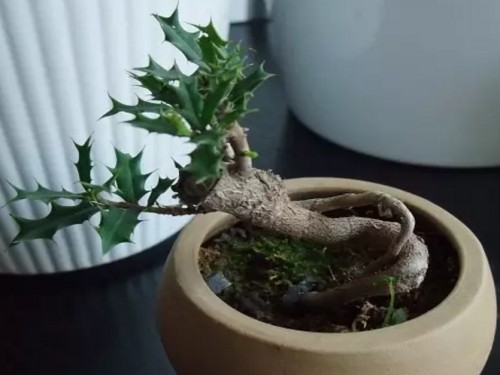
[Care location]
Chinese holly is shade-tolerant and should be placed in a shady, humid environment to grow. In summer, it needs to be cared for under a shade shed or in woodland shade. In winter, it needs to be brought indoors to overwinter, while south of the Yangtze River it can overwinter outdoors.
[Watering]
Usually, the potting soil should be kept somewhat moist. During the spring and summer growing seasons, water frequently, and often spray water on the leaf surface. Chinese holly is drought-tolerant, and during vigorous growth it needs frequent watering. Generally, the potting soil should be kept moist but not waterlogged. In summer, spray water on the leaf surface often to aid evaporation and cooling.
[Fertilizing]
Generally, in spring apply a dilute cake fertilizer water once every 2 weeks, in autumn apply a topdressing once a month, in summer no fertilizer is needed, and in winter each year apply a base fertilizer. During the growing period, apply a dilute, fully decomposed cake fertilizer water once every half month, and in winter only apply a base fertilizer once (organic fertilizer).
[Pruning]
Chinese holly has strong sprouting ability and is very tolerant of pruning. For finished bonsai works, unnecessary water sprouts, sprouting branches and excess buds can be cut off at ordinary times to maintain a certain tree shape. For tree material that needs to be worked on, a certain number of branches can be retained as needed to facilitate shaping. Chinese holly is tolerant of pruning, and can be pruned and reshaped once each in June and July and again in late autumn in October, cutting off dead branches, overly dense branches and water sprouts, and shortening overly long branches.
[Pinching]
During cultivation, care should be taken to frequently pinch the tips, removing overly long young shoots to encourage more branches and leaves to sprout, making the tree shape fuller and more beautiful.
[Repotting]
It prefers fertile acidic soil and is not tolerant of saline-alkaline soil. Chinese holly bonsai is usually repotted once every 2-3 years, often carried out in spring from February to March, or after autumn when the tree enters its dormant period. When repotting, part of the old roots can be trimmed away, sufficient base fertilizer applied, 1/2 of the old soil retained, and the plant repotted.
[Pest and disease control]
Chinese holly has very few pests and diseases. Sometimes the branches and leaves develop sooty mold (also called: soot disease) due to psyllids. From April to May before the plum rain season, spray Bordeaux mixture or lime sulfur mixture once every 10 days. Or in early spring, spray 50% dimethoate emulsifiable concentrate at 2000 times dilution to kill overwintering psyllids, once a week for 3 consecutive times to control psyllid damage. When scale insects are occasionally seen causing damage, spraying lead arsenate can kill them.