How to grow a red maple bonsai? A detailed guide to cultivation techniques
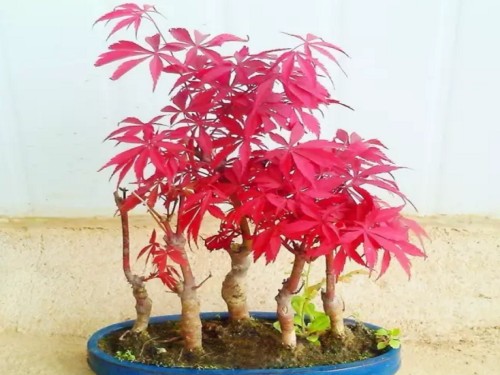
Red maple is a variety of green maple (Japanese maple, Acer palmatum). Its leaves are brilliantly red and beautiful, with elegant leaf shapes and graceful tree form; in spring and autumn the whole tree is covered in red leaves, a truly splendid sight. The red maple has a graceful, dancing form, lovely and striking. It is suitable both for specimen planting or group planting among rocks and green pines and cypresses, and for growing as a potted plant at home or making into a bonsai for viewing; its branches can also be cut for vase arrangements as cut flowers. Let us take a look at how to care for a red maple bonsai.
Depending on the shape of the stump, red maple can be made into bonsai in different styles such as straight-trunk, slanting-trunk, curved-trunk, waterside and cascade styles; several plants can also be planted together in one pot to create double-trunk, triple-trunk, forest and other styles. When making a forest-style bonsai, choose plants of differing heights and sizes and plant them in groups, adding rocks, moss and other accessories to express the mood of "a maple forest drunk with color."
[Light]
Red maple likes a warm, humid environment and ample but soft sunlight. Young trees fear scorching sun and are not drought-tolerant. During the growing season it can be kept in a spot without direct sunlight, and especially avoid the western sun; in high summer it must be protected from scorching sun and can be placed under a shade net or in the shade of other plants, otherwise the leaves will scorch and drop.
[Watering]
Water frequently to keep the potting soil moist, but do not let water accumulate, to avoid root rot. When the air is dry, sprinkle water on the plant and its surroundings to increase air humidity and give the leaves a glossy sheen.
[Fertilizing]
During the growing season, apply a dilute, well-rotted liquid fertilizer or compound fertilizer once every 15 days. Stop fertilizing during high summer heat or on rainy days. The fertilizer solution should be mainly phosphorus and potassium, with nitrogen as a supplement; if phosphorus and potassium are insufficient, the leaves will not turn red.
[Leaf removal]
The red maple is at its most beautiful when new leaves have just emerged. To enhance its ornamental value, you can remove the leaves once each in June and September every year. Apply fertilizer one week before leaf removal; after leaf removal, prune the plant and strengthen water and fertilizer management, and in about 15 days fresh tender red leaves will grow. If the leaves are scorched by strong sun, you can remove all the scorched leaves in August and place the plant in a cool, airy, semi-shaded spot, applying a dilute nitrogen-phosphorus-potassium compound fertilizer solution once a week, and before long fresh red new leaves will grow. During the growing season, promptly remove leaves that affect the tree's shape and the ventilation and light penetration of the inner canopy. After new leaves sprout, pay attention to pinching out the growing tips to encourage fine, dense young branches, so the leaves are small and dense and highly ornamental.
[Shaping]
The shaping method is mainly pruning, with wiring as a supplement; some branches can be pulled to make the layout more reasonable. For red maple bonsai, white stone pots, green glazed ceramic pots or yellow zisha (purple clay) pots are suitable, while red or purple pots similar to the leaf color should be avoided.
[Repotting]
Repot once every 2 to 3 years in spring before budding. The potting soil should be fertile and loose, rich in humus; you can mix 2 parts humus soil with 1 part sandy soil and use that.
[Overwintering]
In southern regions, the pot can be buried outdoors in a wind-sheltered, sunny spot to overwinter. In the north, it is best to overwinter it in a cold room not below 0°C; do not fertilize, and do not water too much, just keep the soil from drying out.
Red maple likes a semi-shaded spot with even sunlight; it is shade-tolerant and fairly cold-tolerant. In the middle and lower reaches of the Yangtze River it can overwinter outdoors; in northern regions it should be overwintered indoors or in a greenhouse. It is suited to growing in a cool, humid environment (half shade, half sun) and in loose, fertile, well-drained neutral or slightly acidic soil.
Notes:
1. For planting, ordinary potting soil can be used; after watering, place it in a semi-shaded spot. Mist the branches and trunk frequently. When the leaves begin to unfurl, light can be increased. After the leaves have fully unfurled, apply one dilute (nitrogen) fertilizer solution. Place it in a semi-shaded spot with even sunlight for normal care.
2. In summer and autumn, pay attention to ventilation. Potted plants should be moved to a semi-shaded spot around midday, and ventilation should be ensured. Under scorching sun, the leaves tend to scorch at the edges, curl and drop. At the same time, pay attention to watering to prevent the soil from becoming too dry.
3. If you want to control leaf viewing artificially, you can do it once each during the two periods between spring and summer and between summer and autumn. Doing it too often will harm the tree. You can remove all leaves once each in June and September, and after 10 days fresh red new leaves will grow. Note two points: first, prune after leaf removal. Second, apply fertilizer one week before leaf removal. To artificially control new leaves, water and fertilizer must be strengthened; this is the key to success.
4. If the leaves are scorched under strong sun, in August you can remove all the scorched leaves, place the plant in a cool, semi-shaded spot, and apply a nitrogen-phosphorus-potassium compound solution, diluted, about 2 times a week. In this way, by autumn, fresh red new leaves will grow.