How to Grow a Syzygium buxifolium Bonsai? Detailed Care Methods and Precautions
The Syzygium buxifolium plant form has a unique ornamental value. Placing a Syzygium buxifolium bonsai in the home can not only enhance the quality and beauty of the living space, but also improve the feng shui of the room, helping everyone enjoy good health.
After more than ten years of observation, Syzygium buxifolium growing at lower altitudes has a stronger bonsai potential than those growing at higher altitudes; those with darker leaf color have a stronger bonsai potential than those with lighter leaf color; those with smaller leaves have a stronger bonsai potential than those with larger leaves; those with pointed leaf shapes have a stronger bonsai potential than those with round leaf shapes.
The reasons for failure in potted Syzygium buxifolium: first, improper excavation of the tree stump; second, improper cultivation of the initial stock. A good Syzygium buxifolium bonsai must start from the moment of digging up the stump, paying attention to the protection and care of the root system, branches and trunk. If purchasing from the market, one must choose stump material with healthy branches (new branches of sufficient length) and bright bark color.
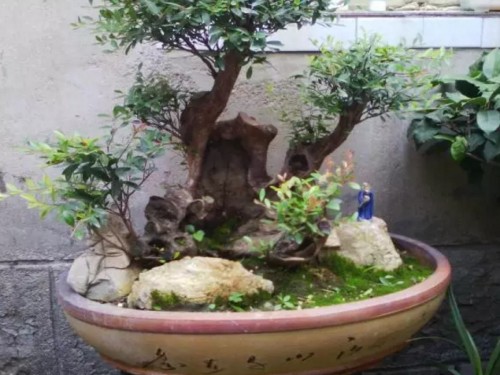
It has been more than 30 years since Syzygium buxifolium was discovered to be a good tree species for bonsai. People like Syzygium buxifolium because it has a natural ornamental beauty. The roots, trunk, branches and leaves of Syzygium buxifolium are each uniquely distinctive and incomparable. People fear Syzygium buxifolium because it seems very difficult to grow well. If the initial stump of Syzygium buxifolium is improperly managed with water and fertilizer or improperly pruned, it is prone to yellowing disease and stunted growth disease, accompanied by the possibility of direct death. So for many years, people have been in a contradictory state of mind toward Syzygium buxifolium, loving it more deeply the more they hate it.
The reason lies in the fact that for a long time, no mature and effective method has been summarized for Syzygium buxifolium bonsai from stump collection, pruning, to later care. Moreover, our fellow bonsai enthusiasts generally only emphasize bonsai styling and do not pay enough attention to care. Coupled with being misled by some reference materials, most people who like Syzygium buxifolium bonsai lack correct care guidance, causing Syzygium buxifolium stumps to frequently develop diseases and die. Because this phenomenon occurs frequently, over time it has formed a fixed misconception in people's minds, namely that Syzygium buxifolium is “hard to keep alive.”
Actually this is not the case. Based on our years of practice and experience, the care of Syzygium buxifolium can follow these practices:
1. Loose potting soil or medium should be used.
2. Attention should be paid to maintaining humidity. The currently common practice in some reference materials of watering potted plants only when dry and stopping when wet should not be adopted in the care of Syzygium buxifolium.
3. Repot at the appropriate time.
4. Grow branches in moderation; do not let branches grow too long. Pruning should be done methodically; the sparse-branch growth method is suitable, cutting sections while retaining branches. The trunk-cutting branch-growing method should not be used. If the trunk-cutting branch-growing method is used, the thickness of the grown branches should not exceed 1 cm. After cutting the trunk, the inner side should preferably have branches or leaves. The cut trunk must be sealed, and leaf surface water should be sprayed more. Binding methods should not be used. If binding must be done, the wire must be removed in advance, otherwise it easily causes branch dieback. Heavy pruning should be done from January to May, and pruning in August and September should be avoided as much as possible.
5. The pH of the potting soil should be maintained at 5-6.
6. Apply light fertilizer frequently, mainly nitrogen and potassium fertilizer, mixed with trace elements and diluted with water for application. Older trees can be given more foliar fertilizer.
7. Potted plants should not be allowed to bloom and bear fruit. Blooming and fruiting not only consumes more nutrients, but also easily causes branch aging, and in severe cases can cause the entire plant to decline. Avoiding blooming can be achieved through two aspects: fertilizer control and adjusting pruning methods.
Syzygium buxifolium is a tree species that requires heavy fertilizer and heavy watering for care. The germination period is within 2 months. There are relatively many care points to note, but they are not difficult to understand and pick up, and it is still quite suitable for beginners to grow.
Precautions
1. Compared with other bonsai materials, Syzygium buxifolium has both common and unique characteristics. Its common characteristic is routine care. Its unique characteristics can be summarized as: it is a subtropical plant, afraid of cold, and grows vigorously when temperatures are high.
2. Because its roots go very deep, Syzygium buxifolium is best planted in a deeper pot. In winter, a shallow pot can be buried in soil and safely overwinter outdoors. The roots and branches of Syzygium buxifolium transport nutrients in vertical correspondence. Based on this characteristic, one can also take platforms according to the density requirements of the styling, or divide one Syzygium buxifolium stump into several. When pruning back and forth on new stumps, one should retain as many branches as possible in a balanced way, and preserve the old roots as much as possible, because damaging roots correspondingly affects the branches. Damaging branches correspondingly affects the roots. Sometimes even if individual roots are damaged, their corresponding branches will also shrink and die.
3. Artistic styling has no fixed framework, but certain requirements should be met. Syzygium buxifolium styling should be based on the branches to determine the shape, and the group shape should follow the momentum; there are several recognized styles that Syzygium buxifolium can draw from, such as the large cascading branches of Japanese white pine from Jiangsu and Zhejiang, the triangular shape favored in Taiwan, China, and the large tree form of Lingnan, etc.; for beautiful stumps, sparse leaves are better; for inferior stumps, the branches and leaves can be emphasized. In short, one should maximize strengths and avoid weaknesses.
4. After the stump is cut according to the styling design, it should be planted in the pot in one step as much as possible. Before planting, seal the cut surfaces of the trunk with wax, then plant in loose, breathable acidic soil. This is the most important task in the planting step and relates to the normal growth of the root system in the future. You can use 4 parts yellow sand or weathered soil (mountain alluvial soil), 4 parts leaf mold, and 2 parts loess, mix well and plant. After moving into the greenhouse, water thoroughly to settle the roots.
5. Syzygium buxifolium excavated in March generally has a germination period of 45 days to 50 days. Stumps excavated in January-February need to dormantly rest in the greenhouse for more than 2 months, and only begin to sprout in mid-April. During the germination period, more moisture is needed; water can be sprayed 3 times a day, combined with watering the roots, ensuring the greenhouse humidity is 80%-90%, to promote branch and trunk germination.
6. Based on the characteristic that Syzygium buxifolium likes heavy water and heavy fertilizer, cake fertilizer and human and livestock manure can be fully composted and then diluted with water to 70%, and applied once every 10 days during the growing period. Watering should follow the morning-spray evening-irrigate method, that is, spray water on the leaf surface in the morning and irrigate the roots in the afternoon. Heavy water and heavy fertilizer promote thickening of branches. After the bonsai has taken shape, fertilizer can be appropriately controlled, but water must not be lacking. Once Syzygium buxifolium lacks water, the leaf surface will shrink, and all previous efforts will be wasted, irreversibly.