Reasons Why Potted Osmanthus Trees Do Not Bloom and Solutions
A gust of wind blew past, and countless osmanthus flowers drifted quietly down at my feet like little golden butterflies. I picked one up and examined it carefully. What a tiny flower! Petals the size of a grain of rice and small stamens make up the delicate little osmanthus. Usually a dozen or so flowers cluster together to form a small flower ball, densely packed, one cluster after another. At first glance, it looks like a small yellow hydrangea. The leaves of the osmanthus tree are pointed at both ends and emerald green, guarding the osmanthus like angels, and the osmanthus blooms to its heart's content under their protection!
From far away, I could already smell the rich fragrance. This reminded me of a poem a poet once wrote: “Osmanthus falls from the moon, its heavenly fragrance drifts beyond the clouds.” No wonder it also has the elegant name———Ten-Mile Fragrance. I took a deep breath, and my whole body immediately felt refreshed, relaxed and joyful.
Osmanthus is one of the ten traditional famous flowers of our country, and it is also a great material for making bonsai. However, many osmanthus bonsai have been grown for many years without blooming, or with very few blooms.
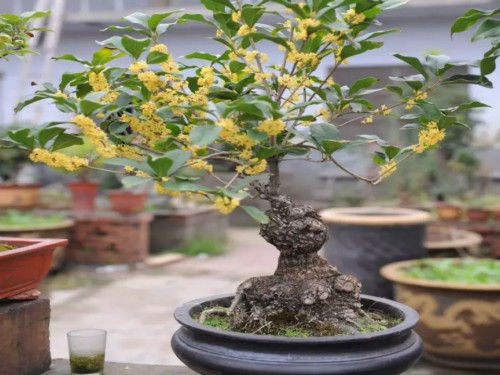
Reasons why potted osmanthus is not easy to bloom:
The osmanthus has a long lifespan, so it also blooms late. Seedling plants propagated by sowing take about 10 years to bloom. Grafted laurel and Four-Season Osmanthus can bloom in the same year; while grafted Golden Osmanthus, Silver Osmanthus, etc., only 20% bloom by the next year; seedlings propagated by division or layering can mostly bloom the next year; cuttings usually take 4 years to bloom. Therefore, it cannot bloom before reaching blooming age. If it has reached blooming age but still does not bloom, it is due to improper care, for the following reasons:
1. Osmanthus likes sunlight and is a long-day flowering plant. Once the balcony is too shady, with daily light below 10 hours, the branches and leaves will not grow luxuriantly, and of course it will not bloom.
2. Improper fertilization. For example, long-term application of nitrogen fertilizer will cause excessive growth of branches and leaves, affecting blooming.
3. Overwatering or water accumulation in the pot during consecutive rainy days can easily cause root rot and leaf drop, affecting blooming.
4. For potted osmanthus, because the pot is not changed for a long time, the roots fill the pot, the root system cannot spread out, and the transport capacity weakens, so it cannot get sufficient nutrients, causing it to fail to bloom normally even during the flowering period.
5. Potted osmanthus is moved indoors too early for winter. If the room temperature is too high, above 10°C, the osmanthus cannot get the physiological requirement of low-temperature dormancy, which will affect blooming the next year.
6. Osmanthus is not tolerant of smoke and dust. If the surrounding air is polluted, its growth will be poor, the leaves will become smaller and fall off easily, and it will be very difficult to bloom. The leaves can be rinsed once every half month and foliar fertilizer applied, so that dust on the leaves can be washed off, and at the same time the fertilizer solution is absorbed through the leaves, making the plant grow robustly and enhancing its ability to resist pollution.
7. In northern regions, household potted osmanthus does not bloom easily because osmanthus needs a low-temperature dormancy stage in winter for flower bud differentiation. In winter, northern indoor spaces all have heating equipment, so the osmanthus does not go through the dormancy stage. Therefore, when growing osmanthus in northern regions, attention should be paid to providing a cold, dry environment in winter, preferably placing it in a place with an average temperature of 3~5°C.
Based on the habits of osmanthus and combined with years of practice, the author summarizes the common countermeasures for potted osmanthus bonsai not blooming or blooming little as follows.
1. Select and breed good varieties:
When cultivating osmanthus bonsai, choose excellent osmanthus varieties with strong adaptability, resistance to pests and diseases, easy blooming, fragrant flowers and bright color, dense internodes, and small leaves. The osmanthus bonsai cultivated from them will bloom easily, bloom more, and have bright color and rich fragrance.
2. Proper placement:
Potted osmanthus needs to be placed in a place with sufficient light. Be sure to ensure a place with more than 10 hours of sunlight every day to meet the sunlight requirement, effectively accumulate nutrients, and allow flower buds to bloom normally; at the same time, keep the osmanthus clean and maintain good ventilation.
3. Rational fertilization:
Fertilization for osmanthus bonsai should be divided into 3 steps: First, before budding in early spring, apply a mixed fertilizer mainly of nitrogen, phosphorus, and potassium once every half month, and from May to August apply phosphorus- and potassium-based fertilizer 3 to 4 more times. Do not apply too much nitrogen fertilizer, to prevent excessive growth of branches and leaves and sparse blooming or no blooming. According to the fertilizer-loving characteristics of osmanthus bonsai, do not apply concentrated fertilizer or raw fertilizer, and achieve thin fertilizer applied frequently.
4. Rational watering:
According to the size and growth characteristics of the osmanthus bonsai, combined with the season, weather, texture and size of the pot, and the amount of potting soil, water reasonably. In spring, autumn, and winter, the osmanthus bonsai should maintain a water content of 30%, and in hot summer, a water content of 60% is appropriate. Do not let it become too dry or too wet, and achieve “do not water if not dry, and water thoroughly when watering.”
5. Move out in early spring, and prune before budding:
Cut off diseased and weak branches and overly dense branches. After budding, according to the number of buds and shoots, properly thin out excessive and overly dense buds and shoots according to the principle of “remove dense ones and keep sparse ones, remove inner ones and keep outer ones, remove weak ones and keep strong ones, remove straight ones and keep flat ones,” so as to improve light, enhance ventilation and light penetration, and promote growth and flower bud differentiation.
When osmanthus branches grow to about 10 cm and form self-pruning and stop growing, before blooming, the osmanthus bonsai must not be shaped and pruned for other reasons (May to August), to prevent cutting off flowering branches. Osmanthus bonsai must not be pruned too heavily, nor be left without pruning for a long time and allowed to grow freely. Only through reasonable pruning to promote the balance between vegetative growth and reproductive growth of osmanthus can the good goal of more blooming be achieved.
6. Change the nutrient soil once every 1 to 2 years:
When new shoots emerge in spring, if the branches are found to be sparse, short, thin and weak, and self-pruning occurs before growing to 10 cm, it indicates that the tree is malnourished. The next year, the pot and soil can be changed before budding. The pot used should be coordinated with the color and size ratio of the osmanthus stump bonsai; the bonsai must not be large with a small pot, nor the pot large with a small bonsai. When malnourished, organic fertilizer can also be reasonably applied as a supplement. In addition, the growth and blooming of osmanthus require relatively more phosphorus and potassium fertilizer, so phosphorus and potassium fertilizer solutions such as 0.2% to 0.3% potassium dihydrogen phosphate can be sprayed on the leaves.
7. Reasonable application of pesticides to repel pests and diseases:
For stinging moths, bagworm moth larvae, etc., 40% dimethoate 1000-times solution, 20% fenpropathrin emulsifiable concentrate 1500-times solution, etc. can be sprayed to kill them; for mites such as red spiders, acaricides such as 1000-times dicofol can be used for control; longhorn beetles damage the trunk of osmanthus, and 500-times dichlorvos solution can be used, soaking cotton with the solution to plug the insect tunnels or injecting the solution into the insect tunnels, then sealing the tunnel openings tightly with mud for fumigation control.
Osmanthus generally suffers from anthracnose, brown spot disease, gray plaster disease, blight spot disease, algal spot disease, sooty mold, etc. For different diseases, fungicides such as carbendazim and chlorothalonil at different concentrations can be selected for control.
8. The drug variety and concentration should be appropriate:
When preventing and controlling osmanthus pests and diseases, the drug variety, concentration, spraying time, etc. used must be selected accurately, and the right medicine must be used for the disease. During prevention and control, be sure to avoid spraying when new shoots are emerging, during the flowering period, and during drought, strong sunlight, and high temperatures. Using too high a drug concentration is the main cause of harm to osmanthus.
9. Move indoors when the temperature is 0°C, cold, and freezing:
If the temperature rises back to 5°C to 10°C, it must be moved outdoors to prevent the osmanthus from failing to get sufficient low-temperature dormancy, continuing to grow, sprouting and unfolding leaves too early, and consuming a large amount of nutrients. The overwintering temperature for potted osmanthus is 3°C to 5°C. Above 0°C, it does not need to be moved indoors; maintain the natural temperature to ensure low-temperature winter dormancy.
10. Osmanthus bonsai should be moved outdoors in spring after there is no freezing:
It must not be moved outdoors too early or too late, and especially avoid moving it outdoors in strong sunlight or windy weather. Choose a cloudy day or rainy day to move it outdoors, so that it gradually adapts to the outdoor environment, which is beneficial to growth, development, and blooming.