What are the reasons potted lotus plants do not bloom, and what should be done?
For potted lotus, choose ornamental varieties suited to pot culture, commonly including "Buddha's Seat", "Chongtai", "Biyangxue", "Da Bilian", "Yizhangqing", "Jiaorong Sanbian", "Shouxingtao", "West Lake", and others. We all know that in the scorching summer season, the lotus in ponds is especially lush and leafy. Growing lotus in pots gives a feeling that is closer to daily life.
Home-grown lotus is mainly cultivated for its flowers, but seed lotus planted in early summer that produces no flower buds and does not bloom when the flowering season arrives is not normal. Lotus failing to bloom is caused by many reasons. If it still has not bloomed by the flowering period, give it more care, improve your cultivation methods, and wait for it to bloom next year! This article explains the reasons lotus does not bloom!
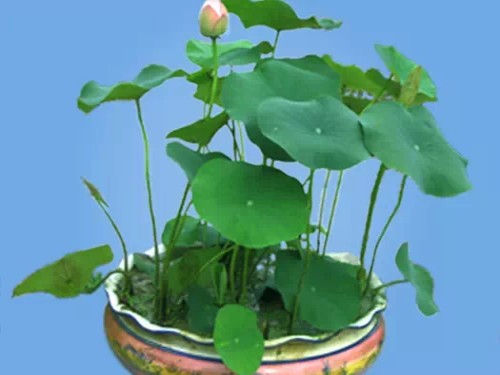
1. Different varieties
There are wild lotus varieties and varieties grown specifically for food; these naturally bloom less, their rhizomes have a stronger growth capacity, they bloom less, or even do not bloom at all. In addition, flowering periods differ slightly among varieties. A few varieties do not begin to form buds until early August and bloom relatively late.
Solution: Before planting, fully understand the habits of lotus, and do not mistake late blooming for failure to bloom!
2. Container light transmission
Lotus bud differentiation requires a relatively enclosed environment; glass containers or white plastic pots are not conducive to flower bud differentiation. Poor flower development will affect blooming.
Solution: If the flower pot has air holes around its sides, seal them with black adhesive tape as much as possible, and try not to use white or even transparent flower pots.
3. Insufficient light
Lotus is a sun-loving plant, and its growing environment needs good ventilation and sufficient light. If it grows for a long time in a shaded environment, the plant cannot get enough light, or because of weather conditions, continuous rainy days during flower bud differentiation prevent the leaves from carrying out photosynthesis, making it very difficult for lotus to bloom!
Solution: Place the lotus in a spot with plenty of sunlight
4. Pot too small
Lotus growth needs enough space. Different varieties need different amounts of growing space, so choose a pot reasonably according to the growth vigor of their rhizomes. If the pot body is small, when the plant enters the budding stage, the rhizome growth space is crowded and the flower buds have no room to grow, making flowering difficult.
Solution: Choose the pot reasonably, selecting the flower pot according to differences in plant type.
5. Density too high
Excessive density means there are two or more lotus plants in the pot, or the leaves are relatively dense and shade each other, so the plant has poor ventilation, which affects blooming!
Solution: Make sure only one plant is grown per pot; for lotus with relatively dense leaves, prune the leaves in time to increase light transmission.
6. Improper depth of pot mud
The depth of the pot mud also greatly affects plant growth. If the pot mud is too deep, the plant roots cannot breathe and flower bud growth is restricted; if the pot mud is too shallow, the root system cannot anchor the plant, and the flower buds easily wobble in the soil and cannot develop normally.
Solution: Usually, for small varieties the pot mud is 17-20 cm, and the pot soil should not be too loose. For medium and large varieties, the pot mud should be more than 30 cm.
In addition, potted lotus needs to be replanted every year, otherwise it grows poorly, the leaves are not lush, and it is not easy to bloom.
Notes:
For potted lotus, it is best to choose ornamental varieties suited to pot culture, such as "Hai'er Lian", "Jiaorong Sanbian", "Bingdi Lian", "Fozuo Lian", "Wanlian", and others. The pots used for potted lotus should preferably be lotus jars, bucket basins, or shallow jars, generally with an inner diameter of 50 cm and a basin depth of about 70 cm. First sprinkle 15 mm of sandy soil on the bottom of the pot, then spread 3-5 cm of garden soil, then add cake fertilizer, crushed bone pieces, chicken and duck manure, etc. as base fertilizer (200-300 g per pot), and on top add another 4-5 cm of garden soil. Plant lotus rhizomes around Qingming Festival; select seed rhizomes with at least 3 nodes, keeping the terminal bud, middle bud, and tail bud intact and undamaged, and plant 1 rhizome per pot. Place the seed rhizome against the edge of the pot and plant it diagonally in the pot with the head low and the tail high; cover the rhizome head with 7-10 cm of soil and the tail with 1-3 cm of soil, just enough that it cannot be seen. Keep the soil surface about 15 cm below the pot rim for future watering.
After planting, place it in a well-ventilated, sunny spot. Just after planting, the water should be shallow, with a water depth of 1-2 cm, and let it receive more sunlight to raise the soil temperature. After the floating leaves emerge, gradually deepen the water level. During the hot midsummer period, when lotus flower buds are in their vigorous growth stage, keep the pot full of water; 1 month after planting, apply 1 dose of decomposed cake fertilizer water, and after the standing leaves emerge, apply decomposed cake fertilizer water or 0.1% concentration urea and monopotassium phosphate 1-2 times; nitrogen fertilizer should not be excessive. In July during the flowering period, apply 0.5% superphosphate once about every 10 days, for 2-3 consecutive applications. In early August, rhizomes begin to grow; do not fertilize at this stage. If there are too many floating leaves in the pot, tuck some of the old floating leaves into the mud so that the leaves in the pot are not overly crowded. After Frost's Descent, the leaves turn yellow and wither; cut off the remaining leaves, remove debris, and place indoors with the room temperature kept at 3-5 degrees C, keeping the pot soil moist, with no light needed.