Causes and Solutions for Yellowing Leaves on Potted Lemon Trees
Many fruit seeds can be grown into beautiful potted plants, and lemon is a great choice. Its tart, refreshing taste makes it especially popular with pregnant women. The steps are similar to those for pomelo: let the leftover lemon seeds dry, peel off the outer skin, plant them directly in a flower pot, and wait for them to sprout. Once it grows well, it also makes a lovely potted plant.
The lemon tree has relatively small, oblong leaves with finely serrated edges. The flowers are solitary, blooming throughout the year with a rich fragrance. The fruit is oblong or oval and ripens in autumn and winter. However, in everyday cultivation, we often encounter yellowing leaves on potted lemon trees at home. Today, the editor will explain what to do when lemon tree leaves turn yellow!
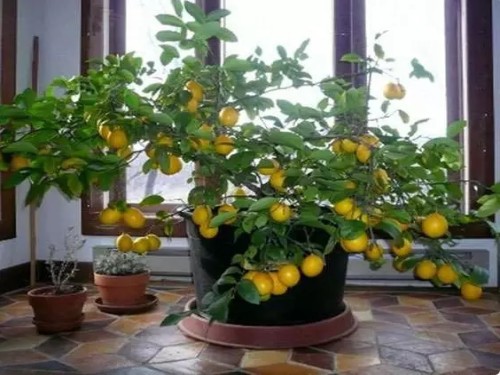
The causes of yellowing lemon tree leaves are generally as follows: iron deficiency, nutrient deficiency chlorosis, malnutrition, root rot, and pest damage.
1. Iron deficiency and nutrient deficiency chlorosis causing yellowing lemon tree leaves: nutrient deficiency chlorosis, such as yellowing of the mesophyll as a symptom of nitrogen deficiency, and yellowing of the veins as a symptom of iron deficiency.
Solution: Supplement with fertilizers containing the deficient nutrient or iron accordingly.
2. Malnutrition causing yellowing lemon tree leaves: after flowering, the leaves turn yellow and drop.
Solution: For yellowing leaves caused by malnutrition, spray with monopotassium phosphate. Besides containing nitrogen, phosphorus, and potassium, this fertilizer also contains a large amount of trace elements. Usage: spray 0.3% on the leaves, and at the same time apply it to the soil in the pot, once every half month during the growing season.
3. Root rot causing yellowing lemon tree leaves: the bark rots and gives off a fermented, alcoholic smell.
Solution: Root rot is often caused by too much water accumulating in the pot or by applying fertilizer that is too concentrated. You can scrape away the diseased part along with a small amount of healthy tissue using a sharp knife, apply 100 times diluted copper hydroxide and 200-300 times diluted thiophanate-methyl to the scraped area, and cover with soil once the wound heals.
4. Pest damage causing yellowing lemon tree leaves: pests visible to the naked eye.
Solution: Remove pests by hand, or spray the appropriate pesticide.
After learning the solutions for yellowing lemon tree leaves, let's now look at the main measures for keeping fruit on potted lemons:
First, strengthen the supply of fertilizer and water to accumulate nutrients;
Second, carry out hand pollination;
Third, thin flowers and fruit.
Lemon fruits are large and require a lot of nutrients, with a normal leaf-to-fruit ratio of 30 to 40:1. Following the principle of removing the weak and keeping the strong, with even distribution, first thin out excess and overly dense flower buds; then, when the young fruits are 1 cm in size, thin out some of the fruits; finally, after the physiological fruit drop, determine the final fruit set according to the leaf-to-fruit ratio. You can also leave no fruit on weak branches and keep only 1 fruit on strong branches.