How to grow a potted lemon tree? A detailed guide to cultivation methods
Growing some plants at home not only beautifies the environment but also brings a very pleasant mood. Watering the flowers and plants every day is a kind of enjoyment. Recently, the potted plants at home have been increasing, almost reaching 20 pots. A long row on the balcony is a beautiful sight. Usually, many fruit seeds can be used to make potted plants. Below, I will share the specific methods for the care and management of potted lemons. Friends who love life can also give it a try.
A potted lemon tree at home is quite easy to care for. The lemon tree is a small tree, and pruning is very important during care. It is necessary to limit its height and also to prevent the loss of water, fertilizer, and nutrients. If a potted lemon tree is not managed properly, it often only blooms without bearing fruit, or bears few fruits, or even does not bloom at all. To make a potted lemon bloom and bear fruit every year, scientific management of water, fertilizer, pruning, and other aspects is necessary to achieve an abundant harvest. Below, I will share the compiled methods for growing lemon trees.
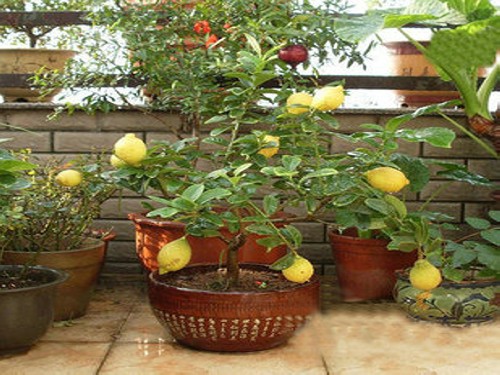
How to care for and manage a lemon tree? The main steps are as follows:
1. "Water withholding" before flowering
To prevent excessive growth of summer shoots and to allow the tree to accumulate nutrients and promote the formation of flower buds, "water withholding" is carried out on potted lemon trees before the End of Heat. The specific method is: more than ten days before the End of Heat, gradually reduce the water supply to the potted lemon tree; stop water supply 5 days before, and after the potting soil is exposed to the sun, a large amount of water evaporates and the potting soil dries out; due to lack of water, the root system causes water loss in the branches and leaves, and the leaves become shriveled and curled. To prevent leaf dehydration, spray water on the leaves in the morning and evening, and also spray a small amount of water on the potting soil, so that the lemon tree is in a condition that is both dry and not dying. Its axillary buds instead swell increasingly, and the bud color changes from green to white. When most of the axillary buds change from green to white, the "water withholding" for flower promotion has succeeded. At this time, promptly resume the water supply to the potted lemon tree.
2. Preserving flowers and fruits
After the lemon tree blooms, in addition to applying a light fertilizer once a week, it is also necessary to thin flowers and fruits. Before the flowers open, first thin out a portion of the flower buds; after the flowers fade and the fruit sets, thin out some young fruits in improper positions, in order to reduce nutrient consumption and let the limited nutrients be concentrated on the retained flowers and fruits, so that the fruits grow larger and better. During the fruit growth period, if there is sufficient fertilizer and water and the plant's nutritional condition is good, some branches will sprout new shoots. The growth of new shoots will inevitably divert some nutrients and affect the growth of the fruit. To protect the fruit, the new shoots that grow out should be removed promptly. When the fruit turns yellow and ripe, stop fertilizing and reduce watering, keeping the soil moist and slightly dry. If excessive fertilizer and water continue to be given, the fruit will mature early and fall early, shortening the ornamental period.
3. Reasonable fertilization
The lemon tree likes fertilizer, so light fertilizer should be applied frequently. Apply a decomposed liquid fertilizer once before the plant sprouts, and afterward apply a nitrogen-based liquid fertilizer once every 7 to 10 days to encourage more branches and leaves and more spring shoots. After each pinching, fertilize promptly to promote earlier maturity of the branches. During the growth period of the lemon tree, some cake fertilizer can be scattered on the surface of the pot, so that each watering allows some fertilizer to seep into the soil and enhance fertility. After autumn begins, reduce fertilization to avoid excessive plant nutrition, which would promote autumn shoots and cause fruit drop by competing with the fruit for nutrients.
4. Reasonable pruning
There are two reasons for pruning a potted lemon tree. First, the pot is small and the soil is limited, so the nutrients provided are limited and cannot meet the growth needs of the lemon tree, making pruning necessary. Second, through shaping and pruning, the reasonable distribution of nutrients within the tree is regulated, so that the limited nutrients are concentrated on supplying buds and leaves, forming more fruiting branches, thereby achieving branches full of flowers and fruits. Before the spring shoots sprout, potted lemon trees must be heavily pruned. First remove dead branches, diseased branches, leggy branches, inward-growing branches, crossing branches, and sprouting branches. For strong branches, prune lightly, leaving 4.5 plump buds; for weak branches, prune heavily, leaving 2.3 buds, to encourage each branch to produce more robust spring shoots. After the spring shoots have grown in fully, to control their leggy growth, light pruning can be done, cutting off 3.4 nodes of the branch tips. When the new shoots that grow later have 6 to 8 nodes, pinch them to induce more summer shoots.
5. Repotting
Because a potted lemon tree has little potting soil, the nutrient supply is very limited. After many years, the soil fertility becomes insufficient, and the lemon tree will weaken year by year, blooming less and bearing few fruits. To keep the lemon tree blooming and bearing fruit every year, repotting is necessary. The most suitable time for repotting is half a month before the lemon tree sprouts. Before repotting, first prepare a pot one size larger than the original, take the lemon out of the pot without breaking the soil ball, shave off a 1.2 cm thick layer of old soil along the soil ball, cut off dead roots and rotten roots, and shave off 1 cm thick soil from the bottom of the soil ball, and take out the tile pieces that were placed at the bottom of the original pot and have become buried in the soil. Place tile pieces over the drainage hole of the new pot, first spread a 2.3 cm thick drainage layer, then spread a 4.5 cm thick layer of nutrient-rich cultivation soil, mixed with a small amount of superphosphate. Then place the lemon tree soil ball into the pot, fill cultivation soil around it up to the pot rim, press the potting soil slightly firm, water thoroughly to settle the roots, place it in a ventilated, semi-shaded place, and after one week put it back in its original place for routine management.
Key points of daily care and management:
1. Hand pollination: Hand pollination is an important measure for bearing more fruit. Pollination is best done promptly after the petals have opened. Doing this work at around 9 o'clock every morning gives better results.
2. Shading at noon: After the lemon tree blooms and before it bears fruit, when the noon temperature exceeds 30 °C, it should be shaded for about 3 hours; otherwise, normal flower formation will be affected and fruit bearing will also be hindered.
3. Preventing leaf drop: Leaf drop affects fruit bearing in lemon trees. To avoid leaf drop, in daily management, avoid watering too much or too little.
4. Reasonable fertilization: Before the lemon tree blooms and after it bears fruit, apply additional fertilizer multiple times, apply a multi-element flower fertilizer once a month, and spray a flower nutrient solution once every half month, to ensure the fruit does not easily fall and is large and bright in color.
5. Spring pruning: In spring, carry out spring pruning together with repotting, cutting off inner branches, dead branches and withered leaves, diseased and pest-infested roots and leaves, and leggy branches, to help the plant bear fruit.
6. Repotting and soil changing: Potted lemon trees must be repotted and have their soil changed in spring from March to April. If the flower pot is too small, replace it with a suitable pot. If the flower pot is still suitable, you can use the original pot and replace it with new soil. When repotting and changing soil, apply base fertilizer.
7. Pest and disease control: Summer and autumn are seasons with frequent pests and diseases for lemon trees, so control should be carried out. In controlling pests and diseases, prevention should be more important than treatment. Spray flower medicine once every half month. The spraying times are around 9 a.m. and around 4 p.m. Do not spray under the strong midday sun, to prevent pesticide damage.
Below, based on my own experience, I will share with you the methods for growing potted lemons at home:
1. Generally, lemons bear fruit in two years, and three-year-old ones can bear more. First, you need to do this: since we are all growing them in pots, you must change the soil in spring and autumn. I use a very large foam box. Pull the whole lemon plant out, and except for the main root, cut off all the other fine roots with a shovel. Then spread fertilizer soil at the bottom of the pot, add a layer of garden soil, and then plant it. This is very simple. If the seedling is not large, it is not hard physical work either.
2. After planting, do not do much after autumn; let it grow. When winter is almost over, around the Beginning of Spring, friends should pay attention: this is the time to make the lemon bloom more and bear more fruit. Take some branches, whether slender or thick, it does not matter. As much as possible, you must bend them downward as much as possible, forming an n shape with the branches at the bottom. When bending, be careful not to break them. Good, fix them with string. Make as many n shapes as possible on the whole lemon plant. This will promote nutrients to move downward, resulting in more flowers and more fruit.
3. The rest is simple. As long as you pay attention to pollination when it blooms and add fertilizer when it bears fruit, there will basically be no problem in preserving flowers and fruits.
4. Some gardening friends have mentioned that some lemons only grow leaves and do not bloom. This is also a common problem with lemons. Here, gardening friends should note that lemons need pruning! It is unlikely that we can prune as frequently as fruit farmers do.
5. Lemon leaves, if it is a perfume lemon, do not throw away the cut leaves; use them to steam fish. Once the fish is done, it carries a lemon fragrance! If there are many leaves, wrap them in gauze, or put them in any box. Placed in a room, they are a natural fragrance.
6. In addition, here comes the secret. In summer, you must grasp the timing well, around the end of August or the beginning of September, gradually... slowly stop watering the lemon. It is very hot here, so I generally give it just a small cup of water every day. Wait until the soil in the pot becomes dry, and you see that the lemon leaves have all become very dry, almost GAME OVER. At this time, water it thoroughly all at once, and restore normal watering. You must control it well, do not let it die of drought. I generally just go about this process.