How to Grow a Chinese Elm Bonsai? Detailed Care Methods and Tips
The Chinese elm (Ulmus parvifolia) trunk is slightly curved, the bark is mottled and elegant, the small branches droop gracefully, and the leaves turn red in autumn. It is a fine ornamental tree and a species for factory landscaping and roadside greening, often planted as a solitary specimen, suitable for planting beside ponds and near pavilions, and can also be placed among rocks, except that it has relatively many pests and diseases. It has strong sprouting ability and is good material for making bonsai. With a graceful tree form, an elegant posture, mottled bark and fine dense branches and leaves, it has high ornamental value. It is very suitable for solitary planting, group planting or planting together with pavilions in courtyards, and it gives good ornamental results whether used as a shade tree, a street tree or made into bonsai.
Many bonsai enthusiasts buy Chinese elm bonsai, but do not know how to grow them. Although Chinese elm bonsai are easy to grow, the survival rate of collected wild stumps is not high, especially when grown on a balcony. Based on years of experience, some flower lovers have summarized some key points for caring for Chinese elm bonsai, hoping to be of help to fellow enthusiasts.
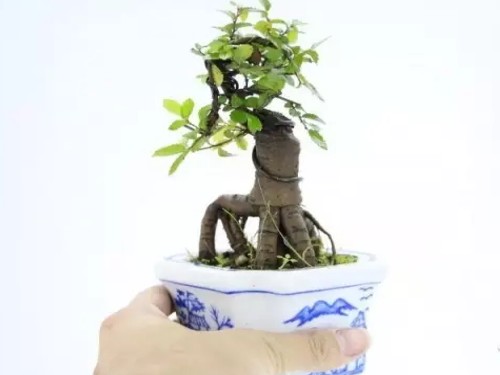
How to Grow a Chinese Elm Bonsai?
1. Be strict when selecting stumps; the stump material must be fresh. Do not take withered, rotten ones or ones without root fibers. Choose as few and as fine as possible rather than many, to ensure that every selected stump can survive.
2. Pre-planting treatment of the Chinese elm is very important, especially caring well for its wounds and cut surfaces, because its wounds tend to bleed a large amount of sap when they meet water. Therefore, after the stump material has been trimmed, be sure to smooth the cut surfaces and wounds. For large cut surfaces, it is best to shape the bark and xylem into a 45-degree slope. This can both prevent bacterial infection and help the wounds heal as quickly as possible and take root sooner.
3. After the wounds have been treated, do not pot them up immediately. Place them in a shady spot to dry in the shade for a few hours, letting the wounds lose water naturally and form a protective film. This can greatly reduce the occurrence of sap flow after the stump material is potted. The biggest shortcoming of all elm species is that they bleed and lose sap easily. If this shortcoming cannot be effectively overcome before and after planting a Chinese elm stump, then it is very difficult to ensure the stump's survival.
4. Some Chinese elm stumps have many holes on them, and many of the holes are also filled with leaf litter soil and weeds, which must be thoroughly cleaned out. The reason is that these debris more or less harbor ant colonies or insect eggs. If they are not cleaned up before potting, then when the weather warms up later, the ants and insect eggs in the holes will become more active and multiply more, making them hard to eradicate and causing endless harm. In the end, the stump may be eaten away by borers and die.
The Chinese elm likes dry conditions and fears moisture, so it should be planted in an unglazed clay pot. The soil is best made by mixing yellow sand, pine needle soil and loess in a 4:3:3 ratio. This kind of soil is both breathable and water-retentive, and will not become waterlogged. Put several layers of tile pieces at the bottom of the pot, then add a layer of coarse sand. After filling with soil, shake it a few times first, then press it down firmly along the edge of the pot, to prevent hollow spaces from forming under the stump roots and affecting root development. After watering thoroughly to settle the roots, cover it with a plastic bag and place it in a relatively fixed spot. Do not move it around often, so as not to loosen the stump roots and break off root buds. Control watering as much as possible, spray water on the branches and trunk more often, and keep the pot soil preferably on the dry side. After a new stump has survived, do not rush to fertilize; this is an important reason many people fail at growing stump material, and fertilization should be done after autumn.
Chinese Elm Bonsai Care Methods:
1. Placement
The Chinese elm is best placed in a spot with ample sunlight and good air circulation. In summer it does not need shading, and in winter it can be placed outdoors. To prevent the pot soil from drying and freezing, the whole pot can be buried in soil.
2. Watering
The Chinese elm likes moisture by nature, so watering should be sufficient. In summer, when temperatures are high and light is strong, water once in the morning and once in the evening, but do not let water accumulate in the pot. In autumn, watering can be reduced, and in winter, if the pot is buried in soil, there is no need to water.
3. Fertilizing
In winter, apply farmyard manure or cake fertilizer once as a base fertilizer. From April to October (except during the plum rain season), apply a thin organic fertilizer once every half month to maintain the nutrients needed for normal growth. The fertilizer should mainly be nitrogen and potassium fertilizers.
4. Pruning
The Chinese elm grows branches and leaves quickly. To maintain the bonsai's shape, it should be pruned regularly. Generally, when new bud branches extend to 5-6 cm, keep only 2-3 leaves and cut off the rest. To control growth, buds and shoot tips can also be pinched off at any time.
5. Repotting
Carry this out once every 2-3 years, with the best time being before budding in spring, though autumn is also acceptable. When repotting, about 1/2 of the old soil can be removed, and some old roots can be cut off, then filled with fertile, loose culture soil.
6. Pest and Disease Control
The Chinese elm has relatively many insect pests, commonly including elm leaf beetles, scale insects, longhorn beetles, stinging moths and bagworms. A 1500-fold dilution of 80% dichlorvos can be sprayed for control. For longhorn beetles that harm the trunk, lime sulfur mixture can be used to plug the insect holes.