How to grow a winter red fruit bonsai? Causes of yellowing leaves and solutions
Winter red fruit flowers easily and has a high fruit-setting rate, with fruit that is entirely red; the fruiting period can extend to the following year when it flowers and grows leaves without the fruit dropping, making it an excellent variety for fruit-viewing bonsai, deeply loved by the people. However, during cultivation, due to the restriction of pot capacity and other influences, the leaves often turn yellow and drop. The main causes of yellowing are as follows:
1. Improper light
Strong light exposure easily causes branches and leaves to wither and yellow, wilt, and scorch at the tips, while weak light easily leads to leggy branches, poor fruit coloration, and small leaves that yellow and drop. Therefore, when the winter red fruit enters its ornamental period, its indoor placement should be near a windowsill, keeping it under bright, indirect light.
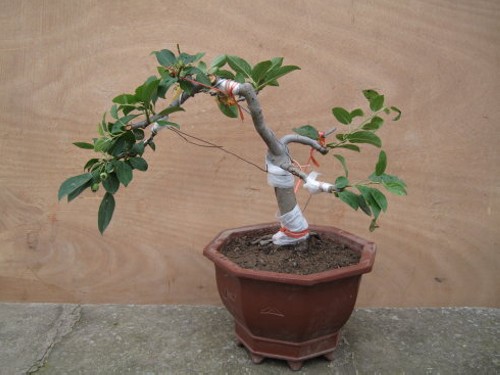
2. Improper temperature
Winter red fruit likes light but cannot tolerate overly intense light, especially in the hot summer, when strong direct sunlight dries the air and raises the pot soil temperature, damaging the roots, reducing enzyme activity, and causing leaves to turn red, with leaf tips drying out, yellowing, and dropping. For this reason, in summer it should be placed in a ventilated spot, and water should be sprayed around the tree frequently to lower the air temperature.
3. Overwatering
(1) Excessive watering of the pot soil causes waterlogging, making the pot soil lack oxygen; some fibrous roots suffocate and rot, losing the ability to absorb water and nutrients, while respiration increases bicarbonate ions, which in turn affects iron absorption, causing the top tender leaves to turn pale yellow and wilt, and the old leaves to gradually turn dull yellow. If this phenomenon is found, the plant should immediately be removed from the pot with its soil ball, placed in a cool, ventilated spot, and the leaves sprayed with water frequently; do not spray water at the roots, so the moisture evaporates as quickly as possible. Once the plant returns to normal, repot it.
(2) If the pot soil is not watered for a long time or watering does not penetrate, the winter red fruit will show normal color in the growing tips and new leaves, while the lower old leaves gradually dry and yellow upward, curl, and drop, and the fruit shrivels with severe fruit drop. When this happens, do not immediately water the pot soil thoroughly; first place it in shade, spray the leaves with water first, and when the leaves are no longer wilted, use the soaking method to let the pot soil slowly absorb water thoroughly. If watering is used, because the pot wall has loose cracks, water easily drains out through the gaps, resulting in incomplete watering. In short, follow the principle of "do not water until dry, and when watering, water thoroughly."
(3) Winter red fruit likes slightly acidic soil. Because water in the north tends to be alkaline, long-term watering gradually makes the pot soil alkaline, preventing the plant from absorbing iron. During cultivation, often use 1 part ferrous sulfate, 10 parts soybean cake fertilizer, and 200 parts water, and after fermentation, dilute it for use to change the pot soil's alkalinity.
4. Excessive fertilization
(1) Too much or too concentrated fertilizer causes yellow leaves. This shows as new leaves that are thick and glossy with a dark green color, but with wrinkled and raised undersides, leaves that do not spread out, and the lower old leaves gradually turning yellow and dropping. At this point, place the winter red fruit in shade, soak the flowerpot in water to dilute the fertilizer, and after two hours, remove the plant from the pot with its soil ball and let the moisture dry. If necessary, remove the old leaves and discard some old soil to replace it with new soil.
(2) Winter red fruit grows vigorously and needs repotting every 2-3 years; otherwise, it easily forms a root pad, causing poor pot soil aeration, difficulty for the roots to absorb water and fertilizer, thin and weak branches, long internodes, thin, tender, yellow leaves, poor flower color, and difficulty setting fruit. For this reason, during the dormant period, repot and change the soil while trimming the roots.
(3) During cultivation, applying unfermented organic fertilizer causes the fertilizer to ferment inside the pot, burning or poisoning the roots, turning the roots black and rotting them, causing leaves to wilt and yellow, and even killing the whole plant. Therefore, organic fertilizer must be fully fermented before use. Iron deficiency chlorosis is usually deeper, with a distinct boundary between yellow and green, and generally no brown spots, while manganese deficiency chlorosis is lighter and often develops brown spots or brown streaks.
How to grow a winter red fruit bonsai?
1. Pot soil
The pot soil should be renewed every 2 years. The pot soil mix can be 35% leaf mold and 35% garden soil, 20% coarse sand, and 10% decomposed animal manure as base fertilizer, mixed together. When repotting and changing the soil, first use a bamboo strip to go around the inner wall once, then invert the pot, hold the soil ball with one hand, and push downward along the drainage hole with the other hand to tip it out. Then use a sharp blade to cut away about 1/3 of the old soil and old roots on the outer part of the soil ball, repot, and water thoroughly.
2. Watering
Watering should follow the principle of "water when dry, not when wet," that is, water after the pot soil is slightly dry, and always water thoroughly. However, at the critical period when flower buds begin to differentiate (starting in June when it enters the physiological differentiation stage), give the winter red fruit bonsai a period of drought treatment, that is, water each time only when the tips of the new shoots wilt; control watering this way 6-8 times. The drought treatment puts the potted tree under water stress, strongly inhibiting the vegetative growth of new shoots and promoting flower bud differentiation.
3. Fertilizing
Fertilizer use should follow the principle of applying thin fertilizer frequently. To fully bring out the fertilizer's effect, attention must be paid to the selection of fertilizers, emphasizing the combination of organic and inorganic fertilizers, slow-release and quick-release fertilizers, and macroelements and microelements. In fertilization methods, combine soil application with foliar spraying. Before flowering, apply more nitrogen fertilizer; use 1:100-150 diluted decomposed cake fertilizer water to water 5-6 times, with each interval about 10 days. After early June, the winter red fruit enters the flower bud differentiation stage, and nitrogen fertilizer should be controlled while increasing phosphorus and potassium fertilizer to promote flower bud differentiation; foliar spraying can be used together if necessary. From July to September, the application of fertilizers with overly high nitrogen content should be strictly controlled or even stopped to prevent a large number of autumn shoots.
4. Overwintering
After Frost's Descent, the winter red fruit should be moved into a cold room or living room, requiring a relatively dry environment with the temperature controlled at 0-12°C. If placed in a hot and humid environment, the fruit is prone to mold and rot. After overwintering, before the flower buds begin to swell and sprout, the winter red fruit should be moved outdoors to be exposed to natural temperatures, so that flower bud development synchronizes with natural fruit trees, making it convenient to use natural fruit tree flowers for pollination to ensure fruit set on the winter red fruit potted tree.