What are the care methods for a winter red fruit bonsai?
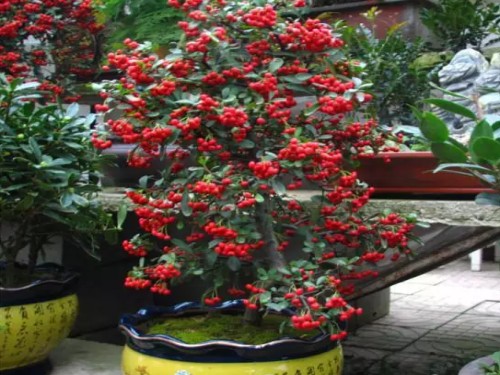
Winter red fruit, also known as pear flower crabapple, and also called longevity fruit or Christmas red fruit, belongs to the Rosaceae family and Malus genus. It is a deciduous shrub or small tree, and an excellent choice for making a bonsai that combines flower viewing and fruit appreciation. When it bears fruit, in summer the fruit is jade-green, in autumn the fruit is yellow with a red glow like sunset clouds, and in winter the fruit not only does not fall, but turns so red it is almost purple, like red pearls. In August the flower buds form, and small purple flowers gradually open. In September the fruit sets, and in October the fruit color gradually turns red.
Winter red fruit is a variety of apple. Its tree form is compact, in spring pale pink flowers cover the branches, and in autumn and winter the tree is hung with exquisite, lovely fruits. Its fruit shape closely resembles an apple, and it is suitable for garden planting or potted viewing and for making bonsai. Below is an introduction to the care methods for a winter red fruit bonsai.
Soil:
Winter red fruit is cold-resistant and afraid of damp heat, and is suitable for growing in sandy soil rich in humus, loose and fertile, and well-drained.
Light:
Winter red fruit prefers a sunny, cool and dry environment. It is generally transplanted or potted in spring each year. During the growing period it requires ample sunlight. If there is insufficient light, it will affect the fruit color, plant shape and fruiting. Therefore, when planted in the ground it can be placed in a sunny, ventilated spot in the courtyard, and when potted the plant should be placed in a sunny place.
Temperature:
Winter red fruit is not tolerant of high temperatures. In summer, if the temperature is above 35°C for a long time, it can be appropriately shaded and ventilated to cool it down. In winter, potted plants can have their pots buried outdoors in a wind-sheltered, sunny spot or be placed in a cold room at 0°C to 10°C to overwinter.
Watering:
During the growing period of winter red fruit, keep the soil moist but not waterlogged. June each year is the flower bud differentiation period, so watering should be controlled for 2 weeks to 3 weeks, and watering resumed when the young leaves wilt, in order to promote the formation of flower buds.
Fertilizing:
In the early stage of plant growth, nitrogen fertilizer can be appropriately increased. After June, control or stop applying nitrogen fertilizer, and increase the application of phosphorus and potassium fertilizers as well as trace elements such as calcium and magnesium, to improve fruit quality and ornamental effect, and to make the branches develop fully, which is beneficial for flower bud formation.
Pruning:
For winter red fruit, promptly remove the tender tips at the ends of the branches to stop the branches from extending, so that nutrients are redistributed, which is beneficial for fruit development. Before spring sprouting, prune and shape the plant once, cutting off diseased and dead branches, crossing branches, overly dense branches and leggy branches, and shortening overly long branches, to facilitate ventilation and light penetration and maintain a beautiful tree shape.
Repotting:
Winter red fruit is generally repotted once every 1 year to 2 years before spring sprouting. The potting soil can use 1 part leaf mold soil and 1 part garden soil, plus 0.5 part coarse sand, and add a small amount of hoof pieces or decomposed animal manure as base fertilizer.
Pests and diseases:
Winter red fruit has relatively few pests and diseases. The main diseases include bacterial leaf spot symptoms, gray mold symptoms and fungal leaf spot symptoms, and the main pests include aphids and fruit borers.