How to care for potted Oriental lilies? Detailed guide to water culture methods
Oriental lily, perhaps for its elegant and noble fragrance, perhaps for its casual blooming, quietly ignites the spark of hope in our hearts. Perhaps in that very moment, we cannot help but sigh: how wonderful flowers are, how beautiful life is!
Lilies can be grown not only in soil but also in water. So how do you grow lilies in water? Today let me explain how to grow lilies in water. For water culture, you must select a large bulb that is thick and fleshy with only one growing point. After moistening and rooting the bulb, disinfect it with a captan solution, wrap it in moss, and place it in a glass container. Lilies cannot tolerate waterlogging, so the bottom should be about 1 cm above the water surface. Change the water in the glass every 1-2 weeks, and keep the water temperature above 10°C. Generally, plant in November and they bloom in May.
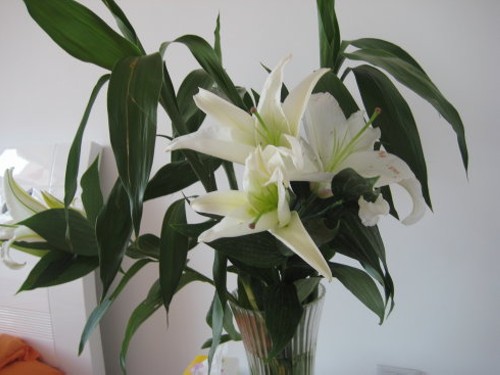
1. Change the water frequently. Generally, when growing lilies in water, it is recommended to change the water frequently. Under normal circumstances, if the temperature is above 20°C, it is recommended to change the water every 2-3 days; if the temperature is around 15-20°C, you can change it every 3 days or once a week; if the temperature is too low, it is best to change the water once a week.
2. Keep sufficient sunlight. Generally, hydroponic lilies also need sufficient sunlight. The suitable growing temperature is generally 15-25°C. If the temperature is too low, it will affect the normal growth of the lily. Increasing the light duration by 6 hours per day can make it bloom earlier; if the light duration is reduced, flowering will be delayed.
3. Add an appropriate amount of nutrient solution. Generally, when water is used as the medium, the medium usually contains no nutrient elements, so an appropriate amount of nutrient solution needs to be added to support plant growth. Different plants need different nutrients, so for the different plants you grow, you need to prepare different nutrient solutions to effectively promote the plants' growth needs.
4. Prune regularly. Generally, lilies need regular pruning during the vase period, preferably once every 2-3 days. This helps the lilies absorb sufficient water and also plays a good role in extending the flowering period.
5. Growth requirements. We also need to understand the growth requirements of lilies. Lilies are short-day plants and require a warm, humid, cool and cold climate. Remember that the temperature must not be too high. Generally in summer, it is recommended to place lilies indoors for growing; too high a temperature is not conducive to their growth requirements.
Precautions:
1. Flowering regulation: If you want Oriental lilies to bloom from November to early February of the following year, treat the bulbs first at 13°C for 2 weeks (14 days), then at 3°C for 4-5 weeks (28-36 days). In this way, they can bloom in November-December. If you want them to bloom in January-February, treat them first at 13°C for 2 weeks, then at 8°C for 4-5 weeks (28-36 days). At this time, after planting, the nighttime temperature is relatively low, so heating should be added to maintain around 15°C.
2. Bud abortion treatment: In forcing cultivation of lilies, when the flower buds grow to 1-2 cm, if the light is insufficient, bud abortion is likely to occur. Bud abortion often occurs from the end of October to mid-March of the following year. It can be prevented by supplemental artificial lighting: hang one 40-watt high-pressure sodium lamp or ordinary waterproof incandescent lamp every 8-10 sq m. Supplemental lighting should begin when the flower buds are 0.5-1 cm and continue until harvest. At 16°C, maintain lighting for about 6 weeks, from 8 p.m. to 4 a.m. the next morning each day. This is very effective in preventing bud abortion, advancing flowering and improving cut flower quality.
3. Overly elongated plants: During the growing period, Oriental lilies should also have the pot rotated once a week. Otherwise, the plant tends to grow lopsided, affecting its appearance.