How to grow potted holly? Care methods and precautions
Holly has lush branches and leaves and stays evergreen all year round. Because of its graceful tree shape and verdant, emerald-green branches and leaves, it is the preferred sapling for park hedge landscaping, so it is mostly planted in courtyards for beautification purposes. It can be used in parks, courtyards, green walls and the central median strips of expressways. Holly has a high transplant survival rate and recovers quickly, and is the most widely used shrub in landscaping. It is itself crisp and glossy, grows healthily and vigorously, and has high ornamental value, making it an excellent ornamental tree species for courtyards. It is suitable for specimen planting on lawns, row planting at gateways, along walls and on both sides of garden paths, or scattered planting on rockeries and small mounds, where it looks lush and lovely. Holly can be dwarfed by using old stumps or by growth suppression, and used to make bonsai.
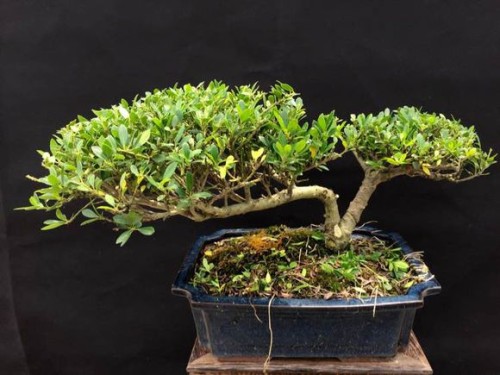
Holly is suitable for planting in moist, semi-shaded places and prefers fertile soil, though it also grows well in ordinary soil and is not strict about environmental requirements. After young seedlings planted in the current year are watered thoroughly once, they can be left to grow naturally. Water once every 15 days depending on soil moisture. Combined with cultivating and weeding, apply appropriate topdressing 1~2 times each spring and autumn every year, generally using a thin liquid fertilizer based mainly on nitrogen. Holly sprouts and grows branches multiple times each year and is extremely tolerant of pruning. In summer, carry out one shaping and pruning; in autumn, according to different landscaping needs, shear flat or prune into spherical or conical shapes, and thin out branches appropriately to maintain a certain crown shape and branch form. In colder places in winter, measures such as mounding soil for cold protection can be taken.
During times when the light is particularly strong, pull open the shade net to avoid the high temperatures brought by strong light, which can affect the growth rate of the young seedlings. After 4 p.m., when the light is weaker, gather up the shade net. However, it is important to note that the shade net is like a cool shed, able to give the plants a comfortable condition; without a shade net, they can still be protected and grow weakly.
Weeding at the seedling stage has two parts. One is manually removing weeds from the nutrient bags, and the other is chemically removing weeds on the ground fabric in the operation paths. Weeds on the ground fabric can be removed by choosing a herbicide: mix the herbicide into a 500-fold dilute solution and spray it directly on the ground fabric. When weeding manually, be extra careful to avoid damaging the plant roots.
Holly trees do not need much fertilizer during the seedling stage; just applying appropriate foliar fertilizer as topdressing is enough. A water-soluble flower fertilizer can be chosen, at a ratio of 5 grams diluted in 2 kilograms of water. After the solution is mixed well, it can be sprayed. The time is best chosen between 4 p.m. — 6 p.m., and the amount of water should be based on completely spraying the leaves once. Generally, doing it once every half month is enough.
During this period, the plants are prone to damage by aphids. For aphids, prevention is mainly the priority. Omethoate 800-fold dilute solution can be used for spraying. The time can be chosen from 8 a.m. to 10 a.m. or after 4 p.m. The amount of pesticide should be based on completely spraying the leaves once. In individual cases, spraying once every 5 days is enough.