Water Fir Bonsai Care Methods and Precautions
The water fir (Metasequoia glyptostroboides) has a straight, upright trunk, a magnificent tree shape, and emerald green foliage that turns golden yellow in autumn. It is a famous ornamental tree for courtyards. Water firs can be planted as single specimens, in rows, or in groups in parks, courtyards, lawns, and green spaces. They can also be planted in masses to create scenic forests and pair well with evergreen groundcover plants; they can also be planted in front of buildings or used as street trees, all with excellent results.
The water fir is a "living fossil" tree species and an ornamental tree for autumn foliage. It can be made into a water fir bonsai for viewing, and can also be used for greening embankments, lakesides, pool edges, courtyards, and more. The water fir is a common ornamental courtyard tree in China. It can not only be used for greening lakesides and pool edges, but can also often be seen in park woodlands, and can also be made into a bonsai for appreciation.
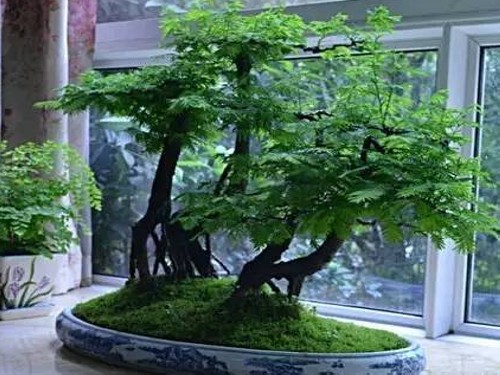
The water fir bonsai is a sun-loving plant and cannot be kept indoors for long periods; it needs plenty of sunlight to grow well. Small bonsai should be repotted and have their soil changed once a year, and they should be pruned frequently each year to keep the overall shape tidy. Pruning is best done during the plant's dormant period. Cut off crossing branches, parallel branches, inward-growing branches, and leggy branches. During the growing season, if branches grow too quickly, use the pinching method to remove the terminal buds to keep the shape tidy. Do not fertilize the bonsai excessively, as this can cause leggy growth. Today we will briefly introduce how to care for a water fir bonsai.
1. The water fir is a precious tree species of Wu. It is generally believed that water fir bonsai care suits a location with sunlight.
2. To properly care for a water fir bonsai, patience is required. Before planting, base fertilizer should be applied first, and the roots of the water fir must not be damaged.
3. After planting, water regularly and water thoroughly.
4. Once the water fir gradually begins to grow, we can fertilize again.
5. During the seedling stage, appropriate pruning is needed. Water firs are extremely easy to keep alive and also easy to care for.
Water and fertilizer treatment: Once the water fir gradually begins to grow, we can fertilize again. For newly planted water fir bonsai, it is generally believed that fertilization should not be applied, especially because fertilizing too early can cause the tree stump to have "indigestion." But practice has proven this is not the case. As long as you can grasp the development condition of the tree stump, especially after new roots have grown, applying a suitable dilute liquid fertilizer in a timely manner can better promote the growth of fibrous roots and the vigorous growth of branches and leaves.
1. For newly planted water fir bonsai, it is generally believed that fertilization should not be applied, especially because fertilizing too early can cause the tree stump to have "indigestion."
2. But practice has proven this is not the case. As long as you can grasp the development condition of the tree stump, especially after new roots have grown, applying a suitable dilute liquid fertilizer in a timely manner can better promote the growth of fibrous roots and the vigorous growth of branches and leaves.
Watering treatment: After planting, the water fir should be watered regularly. When it has just been planted and new roots have not yet formed, it is easy for the branches and trunk to dry up because they cannot absorb water. In the morning and evening, you can use a watering can to spray and moisten the branches and bark, which helps it grow new roots and stay healthy. Of course, you also need to control the amount of water; too much is also not good.
1. A newly planted water fir bonsai has not yet grown new roots, and the original roots have been injured and cannot absorb water, so the branches and trunk are prone to drying up.
2. In the morning and evening, you can use a watering can to spray and moisten the branches, keeping the bark moist.
3. A newly planted water fir bonsai should not be watered too much, otherwise the tree stump will sprout too many buds while the roots grow slowly and cannot supply the evaporation needs of the buds, causing the tree stump to wither.
4. Therefore, the amount of water must be restrained as much as possible. After new roots and new buds have formed, simply water an appropriate amount according to the number of buds.
Watering notes: Watering a water fir bonsai is similar to watering other bonsai.
1. Water according to the situation and master the amount of water.
2. Look at the size and depth of the pot: water less for large pots, more for small pots, less for deep pots, and more for shallow pots.
3. Look at the material of the pot: water more for clay pots, less for ceramic pots, and even less for porcelain pots.
4. Look at the soil: water less for clay soil and more for sandy soil.
A newly planted water fir bonsai has not yet grown new roots, and the original roots have been injured and cannot absorb water, so the branches and trunk are prone to drying up. In the morning and evening, you can use a watering can to spray and moisten the branches, keeping the bark moist. A newly planted water fir bonsai should not be watered too much, otherwise the tree stump will sprout too many buds while the roots grow slowly and cannot supply the evaporation needs of the buds, causing the tree stump to wither. Therefore, the amount of water must be restrained as much as possible. After new roots and new buds have formed, simply water an appropriate amount according to the number of buds.