How to grow a Jade Kirin (Euphorbia neriifolia) bonsai? Growing methods and precautions
The Jade Kirin likes warmth, requires plenty of sunlight, and prefers well-drained sandy loam. It is drought-tolerant, not cold-tolerant, yet also tolerates partial shade, making it suitable for home potted display. It has emerald-green and beautiful leaves, with fleshy stems and leaves, and an elegant plant form that closely resembles the Qilin of ancient Chinese legend, hence the name Jade Kirin. It can mainly be used for living rooms, lobbies, hotels, bookstores, conference arrangements, and reception areas.
The fleshy, modified stems of the Jade Kirin are irregularly palmate and fan-shaped, green when young, and yellow-brown and woody when old, with fleshy leaves densely growing at the tips and edges of the modified stems. At the first China Flower Expo, the Jade Kirin flower submitted for exhibition by Guangxi won the Quality Excellence Award and was selected to be placed in Zhongnanhai as one of the precious flowers cultivated there for the long term. The Jade Kirin is one of the most primitive groups among cactus-type plants. It has the function of absorbing formaldehyde and benzene-type substances. The Jade Kirin likes plenty of sunlight but also tolerates partial shade, and will not die from drying out even with slight drought, making it suitable for home potted display.
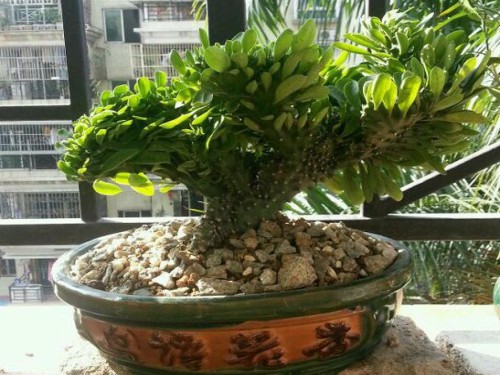
The Jade Kirin is generally propagated by cuttings, and cuttings can be taken anytime from April to October.
1. For cutting time, it is best to choose a sunny morning.
2. After cutting the stem securely, insert the cutting into a sand bed (pot).
3. After cutting, place it in a shaded area for care.
4. Keep it moist, but never allow water to accumulate, as waterlogging will rot the cuttings.
5. Once roots have formed, it can be transplanted.
The Jade Kirin likes soil with good drainage and aeration. After planting and potting, water thoroughly to settle the roots. Afterward, based on actual conditions, water once every two to three days; the amount of water can be less than for ordinary broadleaf flowers, but slightly more than for leafless cactus flowers.
1. Summer and autumn care:
Summer and autumn are the peak growing seasons for the Jade Kirin. Although it likes sunlight, it is afraid of intense direct sunlight. Bamboo blinds, reed screens, or double-layer window screens can be used for shading, with a light transmittance of 60% being ideal. Too much sunlight will cause the leaves to turn yellow, affecting growth and ornamental value. It is drought-tolerant, so watering should be less rather than more, following the principle of "do not water until dry, and when watering, water thoroughly." In summer and autumn, also guard against prolonged rainy spells; water accumulation in the pot and soil staying too wet for too long will cause root rot or rotting of the modified stems. It does not need heavy fertilizing; apply once a month a dilute soybean cake water, sesame paste residue water, or horse hoof water. Excessive fertilizer and water combined with excessive shading often cause the plant to grow leggy and "revert," with the palmate modified stems growing into the columnar fleshy stems of its original species, the Euphorbia neriifolia, severely reducing ornamental value.
2. Winter and spring care:
The Jade Kirin is not cold-tolerant. In China, except for parts of South China and Southwest China where it can be grown in the open ground, it is grown in pots elsewhere, and in winter it should be placed in a sunny room. Generally, it is moved indoors for overwintering before the Frost's Descent around mid-October. Keep the indoor temperature above 15°C so the leaves do not turn yellow; when the room temperature drops below 12°C, the fleshy leaves will fall off and the plant will enter dormancy. During dormancy, watering should be restricted, keeping the potting soil as dry as possible. Only after temperatures gradually rise in early spring can watering be gradually increased. After the weather warms, it can be placed on a balcony or in the yard, but watering should still be somewhat restricted and not excessive. Keep the room temperature above 6°C; when the potting soil is relatively dry, the modified stems will not be damaged by freezing, and new leaves will still grow the following year.
In winter, water less than during the growing season, keeping the potting soil slightly moist. Fertilizing should stop in winter. As temperatures warm up in spring, repotting can be done between Qingming and Guyu. When repotting, remove the old soil, clear away the old soil among the roots, remove decayed roots, and after repotting keep the potting soil moist. First place it indoors for about 10 days, then gradually move it outdoors. The Jade Kirin is generally moved outdoors after temperatures stabilize around Guyu. At first, water sparingly, then increase appropriately as temperatures rise.