Correct methods and detailed steps for repotting a dawn redwood bonsai
The dawn redwood is a "living fossil" tree species, with a straight, tall, upright trunk, a magnificent tree form, and emerald-green foliage that turns golden yellow in autumn. It is an autumn-foliage ornamental tree and a famous courtyard ornamental tree. It can be grown as a dawn redwood bonsai for appreciation, and can also be planted as a specimen, in rows, or in groups in parks, courtyards, lawns, and green spaces. The dawn redwood can also be planted in large stands to create scenic forests, and it pairs well with evergreen groundcover plants; it can also be planted in front of buildings or used as a street tree, all with excellent results.
The dawn redwood bonsai is a sun-loving plant and cannot be kept indoors for long periods; it will only grow well if it gets plenty of sunlight. Small bonsai should be repotted sensibly, with the soil and pot renewed once a year, because in a small pot many roots easily die off, and after rotting they breed pathogens that cause the new roots to develop disease and slowly die.
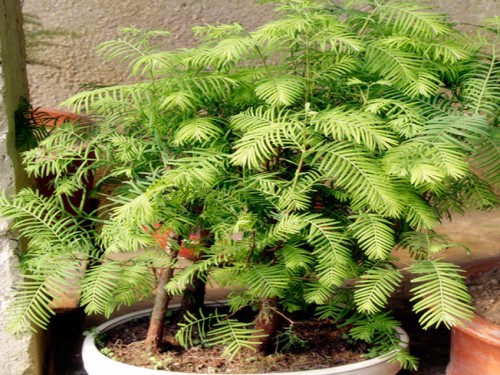
The roots of a dawn redwood bonsai do not need pruning. Depending on how the bonsai is growing, repot it once every 2-3 years, combining repotting with root pruning; roots that are too dense or too long should be pruned. Consider the following situations:
If the tree's new roots are developing poorly and the roots have not densely filled the bottom surface of the soil ball, you can repot it in the original pot and do not need to prune the roots. For tree species with well-developed roots, where the fibrous roots densely fill the bottom surface of the soil ball, you should switch to a slightly larger pot, thin out the dense roots, remove the old roots, and keep a few new roots when repotting. For some old-stump bonsai, when repotting you can raise the roots appropriately to increase their ornamental value, and prune away the old roots and part of the root tips, then bank them with loose, fertile soil to encourage new roots.