Reasons Why Potted Trumpet Vines Don't Bloom and How to Make Them Bloom in the Same Year
The trumpet vine's dry branches are twisted and full of character, its emerald leaves cluster round like a canopy, its flowers are large and brilliantly colored, and its blooming period is very long. It is an excellent greening material for pergolas and flower gates in gardens; it is also extremely suitable for climbing walls, dead trees, and stone cliffs; when dotted among the crevices of rockeries, its profusion of bright blossoms is even more striking; through pruning, shaping, and other cultivation measures, it can be grown as a shrub for ornamental display; it is easy to manage and highly adaptable, making it an ideal material for urban vertical greening, and also a preferred flower for making potted plants and bonsai.
The trumpet vine is a climbing plant, and when planted on a windowsill or balcony, it provides excellent shade and cooling. Its flowers are funnel-shaped, bright red or golden yellow, and vividly colored. When the flowers open, its new branches continue to grow, and the newly grown branches continue to bloom, which is why its blooming period is so long. But according to feedback from many flower enthusiasts, their potted trumpet vines don't bloom. So why doesn't the trumpet vine bloom?
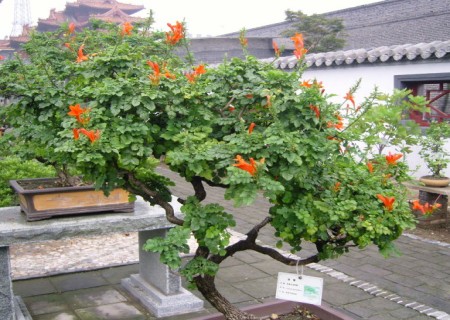
When do potted trumpet vines bloom:
The trumpet vine has a very long blooming period, flowering every year from the fifth lunar month to late autumn, blooming and fading continuously. With green leaves covering the wall and flowering branches stretching out, clusters of orange-red trumpet flowers adorn the branch tips, dancing in the wind, and are especially delightful.
There are mainly three reasons why potted trumpet vines don't bloom:
1. Insufficient sunlight
This is the most important reason. Even in scattered light, the flowers will be noticeably fewer and their color dull. It is not afraid of sun; only with ample sunlight will it bloom abundantly and brilliantly.
2. Still in the seedling stage
Many flower enthusiasts' trumpet vines were obtained from seeds, cuttings, or similar methods, and the plants are still in the seedling stage. Not blooming at this stage is normal. Trumpet vines generally need several years to reach maturity before they may bloom. If your trumpet vine was grown from seed, it may take 10 years to bloom.
2. Improper fertilization
Too much fertilizer or overly rich soil can both cause the trumpet vine not to bloom. Trumpet vines grow very well when planted in rocky soil and bloom much more easily. Trumpet vines do not like heavy fertilizer, so do not fertilize too much, otherwise flowering will be affected. Do not apply only nitrogen fertilizer while neglecting phosphorus and potassium fertilizer; a lack of phosphorus and potassium fertilizer affects flowering.
3. Incorrect pruning
Wrong pruning time or pruning methods can both cause the trumpet vine not to bloom. Trumpet vine flowers generally bloom on the new growth of the current year's branches. If this part is mistakenly cut off during pruning, flowering will be affected. For potted trumpet vines, it is best to choose thick, sturdy old trunks. Young plants can be planted in the ground, cultivated for 2~3 years, then pruned and transplanted into pots. During care, thin branches, overly dense branches, dead branches, and diseased or pest-infested branches should also be pruned.
If pruning is necessary, it can be done in winter or early spring. When pruning in early spring, try to avoid the new branches. Focus on pruning old branches to improve light penetration and promote flowering.
Warm tips:
When winter arrives, after the leaves fall, place it in an environment of around 0°C for care. Do not let the temperature be too high; let it enter full dormancy, control watering, and stop fertilizing.
How to make trumpet vines bloom in the same year:
If cuttings are taken in spring, they will bloom in the same year, just with fewer flowers.
Cuttings can be taken in both spring and summer, choosing thicker one-year-old branches. Cut them into cuttings 10~15 cm long, remove the leaves, then on the cutting bed plant them at a row spacing of 15~20 cm and a plant spacing of 5 cm, inserting 2/3 of the cutting into the soil, then press firm and water. Trumpet vines like fertilizer and moisture. After sprouting, appropriate fertilization is needed, generally applying 1~2 times a month of dilute liquid fertilizer.