What to do if potted narcissus won't bloom? Here's how to make your narcissus bloom quickly
The "Fairy of the Waves," the narcissus, is ranked alongside the orchid, chrysanthemum, and sweet flag as one of the "Four Elegants" of flowers. It is also one of the "Four Friends in the Snow" together with plum blossom, camellia, and winter jasmine. The narcissus is pure and elegant; when it blooms, its delicate fragrance fills the air, making it highly ornamental. During the Spring Festival, keeping a pot of narcissus brings a touch of spring into the home. True to its name, the narcissus not only has an elegant and refined name, but its blooming flowers also carry a subtle floating fragrance, pure and pleasant. The narcissus is a perennial herbaceous plant of the Amaryllidaceae family; generally each bulb can send up 1-2 flower stems, with umbel inflorescences, mostly six petals, and the tips of the petals are goose-yellow.
The narcissus has a cultivation history of more than a thousand years in China. Through over a thousand years of selection and breeding, it has become a uniquely outstanding fine variety among the world's narcissus flowers. Because the narcissus blooms around the Spring Festival, it is also called the "New Year flower," symbolizing good luck for the coming year. Whether for its praised fairy-like grace or its tender flower language, the narcissus is an ornamental flower suitable for placing at home during the New Spring Festival. But during the flowering period, what should you do if the narcissus fails to bloom or produces "mute flowers"?
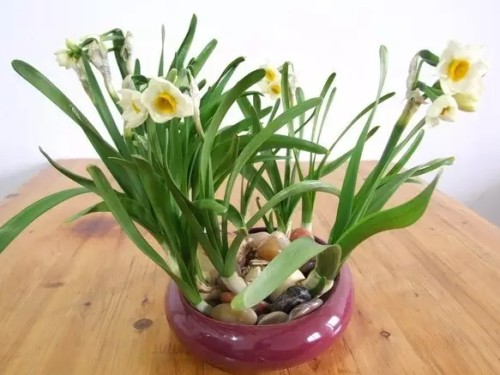
Reasons for not blooming:
1. Poor quality of the bulb
The bulb you bought may not be from the current year, or it may not be a large bulb capable of blooming. Such bulbs need several years of cultivation before they can bloom.
2. Improper timing of water culture
Narcissus generally begins to grow after Frost's Descent. Before Frost's Descent it is in a dormant period (it remains dormant throughout the summer). If bulbs are grown in water before Frost's Descent or after Qingming, the bulbs cannot grow normally and will produce "mute flowers."
3. Improper care
Indoor temperatures that are too high, insufficient sunlight, a dry environment, infrequent water changes, or even damaging the bulb when changing the water can all affect blooming.
Solutions:
Choose high-quality bulbs that are more than three years old. During water culture, it is best to use rainwater or pond water, or tap water that has been left to stand for a while. Ensure sufficient light, no less than 6 hours a day; ensure good ventilation, and keep the temperature at 12-15°C. When the weather in your area is dry, spray the plant with water every day.
It is understood that China has several varieties of narcissus, including the graceful and slender Zhangzhou narcissus, the fragrant and noble Chongming narcissus, and the pure and simple one known as the "Fairy in White," the Putuoshan Guanyin narcissus... No matter which type of narcissus, it generally stores nutrients in spring, goes dormant in summer, regrows in autumn, and blooms in deep winter or early spring. As long as you flower lovers do the following five things well, you need not worry about your narcissus at home failing to bloom.
1. Choose a good flower bulb
From the outside, you should choose a robust, plump, flat-shaped flower bulb. The more small bulblets beside the main bulb, the more flower buds the main bulb has. The outer skin of the flower bulb should be chosen for its vivid color, with the outer membrane dark brown. The spacing between the longitudinal lines on the bulb skin should be wide. The flower bulb should be firm and have a certain weight; when lightly pinched with a finger it should feel solid, and the bottom depression should be small and deep. This indicates that the flower bulb stores a relatively large amount of water.
2. Master the blooming time
From planting in water to blooming, the narcissus generally takes 30-35 days in the south and 35-40 days in the north. Whether it is earlier or later mainly depends on temperature. If you want your narcissus to bloom right at the Spring Festival, then you should plant it 30-40 days before the Spring Festival.
3. Plant good bulbs
First peel off the dried scales on the flower bulb, and use a small knife to cut a vertical cross at the top of the flower bulb, with a depth that preferably does not touch the flower buds. This allows the bulb to loosen and makes it easier for the flower stems to emerge. Then soak it in clean water for 1-2 days, wash away the mucus from the wound, place it in a flowerpot, and fix it with small pebbles and the like to keep the flower bulb upright and prevent it from falling over. Then add clean water, letting the water soak up to 1/3 of the flower bulb.
4. Use good water
For growing narcissus, it is best to use clean spring water, well water, rainwater, or river water. Be sure to change the water once every 1-2 days. Never damage the roots when changing the water. Since the narcissus bulb already stores a large amount of nutrients, there is no need to apply fertilizer during water culture.
5. Control the temperature well
The suitable temperature for narcissus is 10°C-18°C, and the relative humidity is best at 85%-95%. It can also tolerate low temperatures of 0°C. If the climate is warm and the light duration is relatively long, the narcissus will show signs of blooming early; at this time, shade it and lower the temperature.
Usually, move the flowerpot to a cool, ventilated, shaded place and control the water temperature to delay its blooming time. If there is a low-temperature cold wave, during the day you can put the flowerpot in a sunny spot outdoors, and at night move it indoors; this can reduce the impact of low temperatures.
If by the eve of the Spring Festival it still has not formed buds, measures should be taken to increase the temperature or light. It is best to change the water twice during the day with warm water at around 20°C, and at night place the flowerpot under an incandescent light bulb to prolong the light duration, until 3-5 days before the Spring Festival, when the buds are plump and split open, so that the narcissus blooms in time for the festival.