Reasons Why Aptenia cordifolia Does Not Bloom and How to Encourage Flowering
When it comes to Aptenia cordifolia, I believe everyone is familiar with it, right? Aptenia cordifolia is an evergreen plant that produces small red flowers. It not only has extremely high ornamental value, but can also purify the air and absorb radiation, which is very good for human health!
Aptenia cordifolia is a very popular indoor potted plant. Its leaves are lush and green, and especially when the flowering season arrives, the rose-red flowers dotted among them make it a great indoor decoration. But some flower lovers' Aptenia cordifolia does not bloom. What should be done about this?
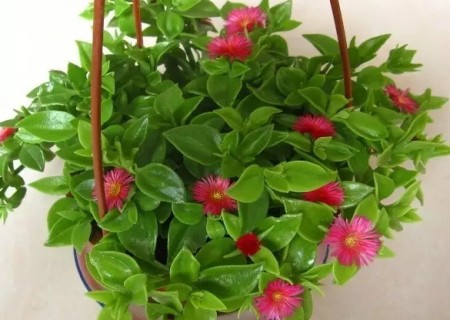
When growing Aptenia cordifolia, the most frustrating thing is when it does not bloom. Although it can be kept as a foliage plant, seeing other people's Aptenia cordifolia covered in small red flowers while your own is green with nothing but leaves all day long makes flower lovers unable to stay calm. In fact, the reason Aptenia cordifolia does not bloom is mostly due to poor gardening habits on the part of flower lovers.
The main reason causing Aptenia cordifolia not to bloom is watering too frequently. Watering too frequently causes the plant to absorb large amounts of nitrogen and phosphorus elements used for stem and leaf growth, while potassium fertilizer, which is difficult to dissolve in water, cannot be supplemented in time, which affects both flowering and fruit setting. That is why some flower lovers' Aptenia cordifolia grows luxuriant branches and leaves but simply does not produce flowers.
During daily care, if flower lovers do not want to grow a pot of foliage plants, appropriate lighting and water control are very necessary. If kept indoors for a long time, it will be very difficult to bloom. Let us first look at the flowering period of Aptenia cordifolia.
The flowering period of Aptenia cordifolia:
It is already winter now, and many flowers have entered their dormant period, so I originally did not want to write about Aptenia cordifolia. But I have grown this flower for many years, and it absolutely will not die no matter how you grow it, and with just a little care it becomes incredibly beautiful. It is a model worker among flowers with a super long flowering period. The flowering period of Aptenia cordifolia is especially long; basically once spring arrives it keeps blooming until nearly the start of winter. Of course, the best flowering season is still April and May in spring, and after that the flower quantity is not as large. Winter is the dormant period, when it does not bloom and the leaves barely grow.
To describe how long the flowering period of Aptenia cordifolia is, we need to look at it from two aspects: one is the flowering period of a single flower, and the other is the flowering period of the whole pot. Generally speaking, a single flower of Aptenia cordifolia can bloom for two or three days, opening during the day and closing at night; while the flowering period of the whole pot can last 3-4 months, that is, from spring to autumn, blooming one after another during this period, with July and August being the most vigorous. Now that we have talked about the flowering period, we cannot help but discuss how to make Aptenia cordifolia bloom more, and how to avoid the phenomenon of Aptenia cordifolia not blooming.
If your potted Aptenia cordifolia shows signs of not blooming, then you may need to look for the cause from the following two aspects:
1. Insufficient light
If light is insufficient, it may also cause Aptenia cordifolia to be unable to bloom. In this case, we need to move the potted Aptenia cordifolia to a place with sufficient light that is relatively warm and well ventilated.
2. Watering too frequently
If watering is too frequent, it will cause the plant to absorb large amounts of nitrogen and phosphorus elements that are beneficial to stem and leaf growth, while potassium fertilizer is difficult to dissolve in water and hard to absorb, resulting in Aptenia cordifolia only growing leaves without blooming. In this case, we only need to reduce the watering frequency and water according to need.
If neither of the above two situations applies, then fellow flower lovers should pay attention to whether they are usually too neglectful in caring for the plant, and should put a little more effort into their potted plants.
How to make Aptenia cordifolia bloom more?
One of the primary conditions is to provide long-day sunlight. Aptenia cordifolia has a characteristic: when the light is not strong, if fertilizer and water are plentiful, it is very easy for it to only grow branches without blooming. Looking at the green branches, the foliage is luxuriant, but there are very few or no flowers. So if you want Aptenia cordifolia to bloom more, flower lovers need to harden their hearts and give it more sun and appropriately control water, as this helps promote flowering.
Care recommendations for Aptenia cordifolia:
1. Aptenia cordifolia likes a warm, dry environment with airy, well-ventilated conditions. It is suitable to choose sandy soil with good drainage for growing it.
2. Provide appropriate light; do not expose it to strong sun in summer, and shade it appropriately. It is best to keep the growing environment at a temperature of around 15 degrees. In winter, when the temperature is relatively low, it will enter a dormant period, so insulation work needs to be done in advance.
3. As long as the growth of Aptenia cordifolia allows, do not water too frequently. Of course, if you are only pursuing luxuriant branches and leaves, frequent watering is not a big problem. If you want it to bloom, you need to appropriately control watering.
4. Rough management. In fact, Aptenia cordifolia is truly easy to grow; it can survive by casual cuttings. Generally, spring and summer are the vigorous growth periods of Aptenia cordifolia, during which it has a relatively large demand for fertilizer and water; after late autumn, Aptenia cordifolia grows slowly and has little demand for fertilizer and water.