Reasons and Solutions for Yellowing Leaves of Potted Cymbidium sinense
Cymbidium sinense, also known as the New Year orchid, originates from China, Vietnam and Myanmar. During the Spring Festival, it is exactly the flowering season of Cymbidium sinense, elegant and delicate, with a subtle fragrance filling the room with the essence of spring. It has a long history of cultivation in China, and in recent years new varieties of Cymbidium sinense have continually come onto the market. Cymbidium sinense has a rich fragrance and varied flower colors, beautiful flowers and fragrance, and a unique leaf shape. Many friends simply cannot resist its enchanting charm.
Cymbidium sinense is a very popular potted plant. It not only has ornamental value but can also purify the environment. However, many people often encounter yellowing leaves when caring for Cymbidium sinense. In fact, this is caused by improper daily care and management. Below, the editor provides a detailed analysis of the causes and solutions for yellowing leaves in Cymbidium sinense.
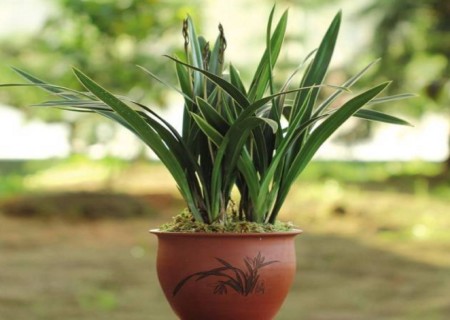
1. Environmental pollution
Cymbidium sinense leaves are long and thin, with many stomata and a large contact surface with the air. If some households happen to place it facing a range hood or a chimney, its leaves will also turn severely yellow.
Solution: Cymbidium sinense especially needs a fresh, pollution-free growing environment. Cymbidium sinense gardens should try to avoid being near factories or workshops that emit thick smoke and exhaust gases and produce large amounts of dust. For household cultivation, keep it as far away as possible from chimneys, range hoods and the outdoor vents of air conditioners.
2. Insufficient light
Too much light easily sunburns the leaves and causes sunscald disease. Excessive shading or long-term placement indoors will also affect the orchid's photosynthesis, causing yellowing leaves, poor growth and difficulty flowering.
Solution: Expose it to appropriate sunlight. In particular, morning light before 9 a.m. is very beneficial for orchid growth and flowering. On sunny days in winter and spring, provide 40%-50% shading; on sunny days in summer and autumn, provide 80%-90% shading.
3. Temperature too low
If it is winter and the leaves of Cymbidium sinense turn yellow, it is mostly caused by freezing due to low temperatures, especially at sub-zero temperatures.
Solution: Therefore, pay attention to protecting Cymbidium sinense from freezing, and do not place it outdoors in winter. The suitable growing temperature for Cymbidium sinense is 18℃~28℃. If it exceeds 30℃ in summer, or if the average winter temperature falls below 10℃, growth will slow or the plant will enter a dormant period.
4. Overwatering
When watering Cymbidium sinense, be sure not to water too much at once. The water cannot be absorbed immediately in the soil, which easily causes the roots of Cymbidium sinense to rot, the roots to decay, and the leaves of Cymbidium sinense to gradually turn yellow, or even the whole plant to die. The watering method must also be appropriate. Many times, when we water plants, we are always used to pouring heavily from the top of the plant. This easily causes water to flow into the new leaf buds, leading to yellowing leaves or even root rot.
Solution: In summer and autumn, water around sunset, and the leaf surface should be dry before nightfall. In winter and spring, watering around sunrise is best, and misting is also needed to increase air humidity to benefit the growth of Cymbidium sinense. When the surface of the growing medium becomes somewhat dry, water it as soon as possible, and do not let it stay dry for too long. The watering method should also be correct; watering along the edge of the pot is better.
5. Too much fertilizer applied
Cymbidium sinense does not depend too much on nutrient fertilizers. If fertilizer is applied frequently over a long period, it will lead to excess nutrients and, over time, will also cause yellowing leaves.
Correct method: Therefore, fertilizer application should be moderate and not too much. Apply fertilizer once a week during the growing season. In autumn and winter, Cymbidium sinense grows slowly, so fertilizer should be reduced to once every 20 days. After fertilizing, spray a small amount of clean water to prevent the fertilizer solution from contaminating the leaves. Fertilizing must be done on sunny evenings; fertilizing on cloudy days risks root rot.
6. Pests and diseases
Because of poor ventilation and high humidity, Cymbidium sinense is prone to black spot disease and mold disease. Pay attention to timely disease prevention. If Cymbidium sinense gets sick, it will also cause yellowing leaves, and Cymbidium sinense has quite a few diseases.
Solution: Remove diseased plants, improve ventilation and reduce humidity; use 65% zineb powder at 600 times dilution or 50% carbendazim at 800 times dilution for control. Apply once every half month, for 3 consecutive times. When humidity is relatively high and ventilation is poor, scale insect damage often occurs. Scale insects, commonly known as orchid lice, are very difficult to eradicate. They can be controlled with 20% omethoate emulsifiable concentrate at 500-800 times dilution.
Notes:
1. Avoid strong light
You can place Cymbidium sinense on an east-facing, south-facing or west-facing balcony for care. Among these, cultivation results on east-facing and west-facing balconies are relatively good. On a south-facing balcony, avoid places with excessively strong sunlight. Because Cymbidium sinense is moderate in height, it can be placed anywhere.
2. Repotting
There is also a limit to the ornamental value of Cymbidium sinense. The best viewing period is 5~7 years after planting. Without repotting, the ornamental value will decrease after 2 years, so it should be repotted and the soil changed in time.